Choosing a software development company in 2026 is a procurement decision, not a beauty contest. Start by defining what you need, then compare vendors on the same criteria: relevant delivery experience, the actual team, technical approach, security, communication, commercial terms, code and data ownership, references, and post-launch support. Price matters, but only after you know what each proposal includes.
The safest process is to shortlist three to five firms, score them against the same requirements, speak with the people who would actually do the work, check references, and use a paid discovery or pilot when the project is large or uncertain. Current vendor-selection guides increasingly use structured scorecards for exactly this reason: they make proposals easier to compare and reduce the influence of polished sales presentations.
1. Define the work before you shortlist vendors
Write down the business outcome, users, must-have capabilities, integrations, security or compliance constraints, rough budget, target date, and what your internal team can own. You do not need a perfect specification, but vendors should receive enough of the same information to produce comparable proposals.
A prototype, an internal workflow tool, a regulated customer platform, and a multi-year modernization program need different delivery teams. Define the risk and complexity first; then decide what kind of partner fits. If you are sending the same brief to several finalists, use Brandligo’s software development RFP template and vendor scorecard to standardize requirements, proposal structure, qualification gates, and weighted evaluation criteria before bids arrive.
2. Decide whether outsourcing is the right model
Build internally when the software is a long-term core capability and you can recruit, manage, and retain the skills it needs. Use a development company when you need specialist expertise, faster capacity, a defined delivery team, or temporary scale. Many businesses use a hybrid model: an internal product or engineering owner keeps architectural and business knowledge while an external team supplies delivery capacity or specialist skills.
Do not assume an agency will always be faster or an in-house team will always be cheaper. The right choice depends on hiring lead time, management capacity, continuity needs, project duration, and how strategically important the knowledge is to your business.
3. Compare scope and total cost, not headline hourly rates
Software-development prices vary widely by country, seniority, specialization, engagement model, company size, and project risk. Broad regional rate tables can be misleading because two vendors quoting the same hourly rate may include very different levels of architecture, product management, QA, DevOps, security, documentation, and support.
Ask each shortlisted company for the same commercial details: team composition, role seniority, estimated effort, assumptions, exclusions, third-party costs, change-request process, expected client responsibilities, and post-launch support. For procurement, the more useful comparison is total expected cost for the same outcome and risk profile rather than a country-level rate benchmark.
4. Choose the delivery geography for operational reasons
Onshore, nearshore, and offshore describe where work is performed, but geography alone does not determine quality or value. Compare the practical consequences: working-hour overlap, language, data-residency requirements, travel needs, governing law, access to specialist talent, support coverage, and whether subcontractors are involved.
For a regulated or business-critical system, contractual location, background checks, data handling, and support coverage may matter more than hourly price. For a startup, access to a senior engineer during your working day may matter more than the vendor’s office postcode.
5. Match the contract model to uncertainty
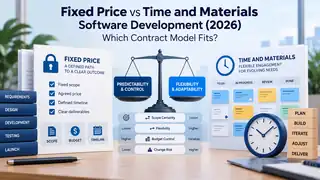
| Engagement model | Best fit | What to clarify |
|---|---|---|
| Fixed price | Well-defined scope with stable acceptance criteria | What is included, what triggers a change request, milestone acceptance |
| Time and materials | Products where priorities or scope will evolve | Team rates, capacity, reporting, budget controls, termination terms |
| Dedicated team | Long-running product development or sustained capacity | Named roles, substitutions, management, notice period, knowledge transfer |
| Paid discovery / pilot | High uncertainty, legacy systems, new vendors, complex architecture | Deliverables, ownership of discovery outputs, decision criteria for the next phase |
No billing model removes delivery risk. The contract should make scope, acceptance, change control, reporting, and exit terms understandable to both sides.
6. Do not accept a confident timeline before discovery
Project duration depends on scope, dependencies, integrations, team size, quality requirements, decision speed, and unknowns in existing systems. Avoid generic promises such as “a simple app takes one to three months” unless they are tied to a defined scope.
A credible vendor explains assumptions, dependencies, milestones, and what could move the date. For uncertain work, ask for a discovery phase that produces architecture decisions, a prioritized backlog, risks, and a refined delivery forecast before committing to a large build.
7. Use a vendor scorecard instead of gut feeling
Score every finalist against the same criteria. You can adjust the weighting for your project, but do it before the sales presentations so a persuasive pitch does not quietly change what matters.
For a deeper evidence review before contract signature, use Brandligo’s software vendor due diligence checklist, which covers 25 checks across delivery, security, ownership, commercial terms and exit risk.
| Criterion | What to verify |
|---|---|
| Relevant experience | Comparable complexity, integrations, industry constraints, and outcomes |
| Actual delivery team | Named roles, seniority, employees vs subcontractors, availability, replacement policy |
| Technical approach | Architecture reasoning, scalability, integration strategy, testing, DevOps, maintainability |
| Security and compliance | Access control, secure development practices, incident handling, data processing, applicable certifications |
| Delivery process | Planning, demos, reporting, risk escalation, QA ownership, change control |
| Commercial clarity | Assumptions, exclusions, payment milestones, change pricing, third-party costs |
| Ownership and exit | Repository access, IP terms, credentials, documentation, handover, termination assistance |
| Support | Warranty scope, production support, response expectations, maintenance options |
| References | Clients with comparable work who can discuss both successes and problems |
8. Meet the engineers, not only the sales team

Ask to speak with the technical lead or engineers expected to work on your project. You are checking communication, reasoning, relevant experience, and whether the proposed team matches the people shown in the pitch. Ask which roles are employees, which may be subcontracted, and how substitutions are handled.
For larger engagements, a small paid discovery or pilot can provide stronger evidence than another sales presentation. Make sure the pilot has clear deliverables and that you can use the resulting documentation or code even if you do not proceed.
9. Check security and compliance at the level your project requires

Do not treat a certification logo as a complete security review. Ask how the vendor manages developer access, production credentials, secrets, code review, dependency risk, backups, incident response, and offboarding. If the project handles regulated or sensitive information, involve your security, privacy, and legal teams and confirm which standards or contractual controls actually apply. For a concrete baseline, NIST’s Secure Software Development Framework (SSDF) gives software acquirers and suppliers a shared vocabulary for discussing secure development practices during procurement.
Also ask how AI coding tools are governed: what source code or customer data can be sent to third-party models, which tools are approved, and how AI-generated code is reviewed and tested.
10. Put code, data, accounts, and handover terms in the contract
Do not assume ownership rules are universal. Have the contract state who owns newly created source code, designs, documentation, data, models, prompts, and other deliverables; when rights transfer; which pre-existing vendor components remain licensed; and what third-party open-source or commercial licenses apply.
For most custom builds, the buyer should also negotiate practical control: access to the source repository, cloud and deployment accounts where appropriate, credentials, build instructions, architecture documentation, and an exit process another team could follow. Have qualified legal counsel review terms that matter to your jurisdiction and project.
11. Call references and ask about problems
Ask for references relevant to your project size and type. Instead of asking only whether they were happy, ask what slipped, how scope changes were handled, whether the proposed team stayed stable, how production issues were managed, and whether handover was clean. A useful reference call reveals how the vendor behaves when the project is under pressure.
Check supplier stability and continuity before you commit
A technically capable vendor can still become a delivery risk if the business is unstable, overly dependent on one or two people, or unable to support the project after launch. NIST’s finalized 2026 C-SCRM Due Diligence Assessment Quick-Start Guide treats supplier stability as one of the core factors buyers should investigate before acquisition decisions.
For a software-development engagement, ask how long the proposed team has worked together, whether critical knowledge sits with a single person, how subcontractors are governed, what happens if key staff leave, how source code and documentation are kept accessible, and what business-continuity arrangements protect active projects. For a larger or longer contract, procurement teams may also need to review financial viability, ownership changes, insurance, litigation or sanctions exposure, and whether the supplier has a credible transition plan if the relationship ends.
The goal is not to demand perfect certainty. It is to understand whether the vendor can keep delivering if normal business disruptions occur. For a deeper supplier-risk review, use Brandligo’s software vendor due diligence checklist and the NIST C-SCRM due-diligence guidance.
12. Watch for procurement red flags
Warning signs include a precise fixed quote attached to a vague scope, refusal to identify the delivery team, unclear subcontracting, weak answers about repository access or security, missing acceptance criteria, no change-control process, pressure to pay heavily upfront, and no defined exit or support plan. A low bid is not automatically bad, but a low bid that omits work required by other proposals needs explanation.
Where to find companies to shortlist
Use several sources rather than relying on a single ranking or directory. Start with Brandligo’s Top Software Development Companies in 2026 for a broad comparison, then narrow candidates by project fit, delivery model, evidence, and location. You can also browse the Brandligo company directory to discover providers, but inclusion in any directory should be treated as a starting point rather than an endorsement.
If geography is an actual procurement requirement, use a regional guide that matches the delivery constraint instead of opening dozens of location pages. For example, buyers who need US East Coast collaboration can use the New York and NYC software development companies guide, while European buyers can compare the Germany guide. For Asia-Pacific sourcing, the India guide and Singapore guide provide more focused starting points.
Whatever source you use, verify the vendor through its own website, current team availability, references, security documentation, and contract terms. A shortlist should be built from evidence that matches your project, not from how many directories a company appears in.
A simple final decision process
Shortlist three to five vendors. Give them the same brief. Score the proposals against criteria agreed in advance. Meet the actual technical team. Call references. Clarify security, ownership, support, and exit terms. For high-risk work, use a paid discovery or pilot. Then compare total value and risk, not just the hourly rate.
Quick questions
Is offshore always cheaper? No. Hourly rates can be lower in some markets, but total cost depends on team composition, management, QA, rework, communication, support, and project risk.
How many companies should I compare? Three to five finalists is usually manageable while still giving you meaningful alternatives. For formal enterprise procurement, the process may be broader.
Should I pay for discovery? It can be sensible when scope or technical risk is unclear. Define the outputs and ownership before paying for it.
What matters most? Relevant evidence and transparent delivery. A vendor should be able to show who will do the work, how it will be governed, what you will own, how risk will be handled, and what happens after launch.
About this article. Updated by the Brandligo editorial desk on September 5, 2026. Brandligo does not independently test every software vendor. Company capabilities, team availability, commercial terms, certifications, and locations can change, so buyers should verify current information directly before procurement.
Research references. This guide was checked against current 2026 buyer guidance from Clutch’s software-developer selection checklist, plus current software-development directories from Clutch and DesignRush. These sources reinforce the importance of defining requirements, comparing comparable proposals, checking relevant experience and client feedback, interviewing the delivery team, clarifying commercial terms, and planning for ongoing support. Brandligo applies those ideas as a buyer framework rather than treating any directory ranking as a substitute for due diligence.