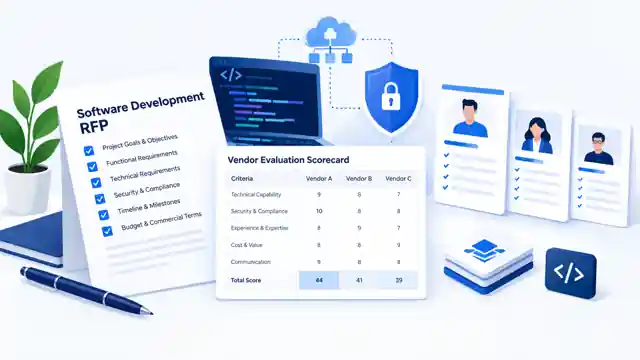
A software vendor evaluation scorecard helps a buying team compare shortlisted vendors against the same requirements instead of letting the strongest demo, lowest headline price or loudest stakeholder decide the outcome.
The most useful scorecards do two things separately: they first test non-negotiable requirements as pass/fail gates, then score the vendors that remain against weighted criteria. That distinction matters because a high average should never hide a failed security, integration, legal or business-critical requirement.
This 2026 guide gives procurement, IT, finance, security and business teams a reusable framework for SaaS, enterprise software and technology-service evaluations. The weights below are an example, not a universal formula: adjust them to the risk and outcome of your purchase.
What is a software vendor evaluation scorecard?
A software vendor evaluation scorecard is a structured decision tool that applies the same criteria, weights, scoring scale and evidence standard to every shortlisted supplier. It turns requirements and due-diligence findings into a comparison that stakeholders can inspect and challenge.
A feature checklist asks whether something exists. A scorecard asks how well the vendor meets the requirement, how important that requirement is, and what evidence supports the rating. Current vendor-selection resources commonly emphasize weighted criteria, total cost, integrations, security, support and evidence-based scoring rather than relying on feature counts alone.
Use gates before weighted scoring
Start with requirements that cannot reasonably be traded away. Treat these as pass/fail gates rather than giving them ordinary weights. Examples might include a mandatory identity provider, required data residency, an essential API, an accessibility requirement, a contractual condition, or a security control required by your organization.
This prevents a mathematical problem: without gates, a vendor could fail a critical requirement yet compensate with strong scores on less important categories. Record each gate, the evidence required to pass it, who validates it, and whether an exception can be approved.
| Gate | Evidence | Decision |
|---|---|---|
| Mandatory business capability | Scripted demo or proof of concept | Pass / Fail / Exception |
| Required integration | Technical documentation or validated test | Pass / Fail / Exception |
| Security/privacy requirement | Security documentation and review | Pass / Fail / Exception |
| Data ownership/export | Contract language and export demonstration | Pass / Fail / Exception |
| Commercial constraint | Written proposal/order form | Pass / Fail / Exception |
Example software vendor scorecard
Once a vendor clears the mandatory gates, score the factors where trade-offs are acceptable. A practical starting framework is below. Change the weights before reviewing final vendor scores so the method reflects your priorities rather than the vendor you already prefer.
| Category | Example weight | What to evaluate |
|---|---|---|
| Business & functional fit | 25% | Required workflows, usability, administration and measurable outcome fit |
| Technical & integration fit | 15% | Architecture, APIs, identity, interoperability, performance and data portability |
| Security, privacy & compliance | 15% | Access controls, data handling, incident response, assurance evidence and relevant obligations |
| Total cost of ownership | 15% | Licensing, implementation, migration, support, usage, growth and exit costs |
| Implementation & change | 10% | Migration approach, resources, training, timeline and acceptance plan |
| Vendor & service risk | 10% | Support model, continuity, references, dependencies and roadmap |
| Commercial & contractual fit | 10% | Renewal, price changes, service commitments, termination and transition terms |
The example totals 100%, but the numbers are deliberately not presented as a best-practice standard. A regulated system may deserve substantially more security weight; a short-lived low-risk tool may need a lighter model.
Define the scoring scale before vendors are rated
A 1–5 scale is easy to use only if evaluators share the same meaning. Define anchors before scoring. For example:
| Score | Meaning | Evidence expectation |
|---|---|---|
| 1 | Does not meet the requirement | Clear gap or unacceptable limitation |
| 2 | Partially meets it with material gaps | Workaround, customization or unresolved risk |
| 3 | Meets the requirement adequately | Requirement demonstrated or documented |
| 4 | Meets it well with useful advantages | Strong evidence plus relevant additional value |
| 5 | Exceeds the defined requirement materially | Verified advantage that matters to the use case |
A score of 5 should not mean “we liked the demo.” Require the evaluator to identify the evidence behind material ratings.
How to calculate a weighted vendor score
For each criterion, multiply the normalized score by its weight, then add the weighted results. If you use a 1–5 scale and percentage weights, a simple formula is:
Weighted contribution = (vendor score ÷ 5) × criterion weight
If a vendor scores 4/5 on a criterion weighted at 20%, that criterion contributes 16 percentage points to the total. Apply the same calculation to every shortlisted vendor.
Do not let the total become an automatic award decision. Keep failed gates, unresolved risks, confidence in the evidence and important contractual exceptions visible beside the number.
Score evidence, not sales claims
The scorecard is only as reliable as the evidence behind it. Match the evidence to the claim. A scripted demonstration can validate workflow fit; API documentation and a technical session can test integration assumptions; a proof of concept can validate a high-risk use case; contractual documents can confirm service and commercial commitments.
For material purchases, keep a short evidence note or source beside important scores. This creates an audit trail and makes disagreements easier to resolve because reviewers can challenge the evidence rather than debating impressions.
Brandligo’s software vendor due diligence checklist provides a deeper pre-signature review for security, operational, contractual and supplier-risk questions.
Separate total cost from headline price
Pricing deserves a consistent comparison model. Use the same contract term, user assumptions, implementation scope and consumption assumptions for every vendor.
Include subscription or license fees, implementation, migration, integrations, training, premium support, internal administration, usage-based charges, expected growth and material exit costs. A low first-year quote can become expensive if implementation or consumption assumptions differ materially.
The broader software procurement strategy guide explains how total cost, governance, implementation and renewal planning fit into the complete buying process.
Use independent scoring before the consensus meeting
When several stakeholders are involved, ask them to score their assigned areas independently before the group discussion. Then compare the largest scoring differences.
A disagreement can be useful: one evaluator may have evidence another has not seen, or two people may be interpreting the criterion differently. Resolve that underlying issue instead of simply averaging incompatible judgments.
Assign specialist ownership where appropriate. Security teams should validate security evidence; technical teams should assess architecture and integration; finance/procurement should normalize commercial assumptions; business users should test workflow fit.
Connect the scorecard to the RFP
The strongest scorecards are designed before proposals arrive. Turn important evaluation criteria into clear RFP questions and request evidence in a format that can be compared across vendors.
Brandligo’s software development RFP template shows how requirements, vendor responses and scoring can work together. For development partners specifically, the software development company selection guide covers team, delivery model, technical fit, references and commercial assumptions.
Common scorecard mistakes
- Choosing weights after seeing vendor performance. Set the method before final scoring.
- Using too many criteria. Duplicate or low-value criteria dilute the factors that actually affect the decision.
- Mixing must-haves with preferences. Put true deal-breakers in the gate stage.
- Scoring without evidence. Require a source for important ratings.
- Double-counting. The same issue should not quietly receive weight in several categories unless that is intentional.
- Comparing inconsistent commercial scopes. Normalize quantities, term, services and assumptions first.
- Treating the highest total as automatic approval. Keep exceptions, risks and confidence visible.
A reusable vendor evaluation workflow
- Define the business outcome and scope.
- Separate mandatory gates from weighted preferences.
- Agree the criteria, definitions and weights before final vendor evaluation.
- Define the 1–5 scoring anchors and required evidence.
- Issue comparable questions or an RFP to shortlisted vendors.
- Validate critical claims through demonstrations, documentation, references or proof of concept.
- Normalize total-cost assumptions.
- Have appropriate stakeholders score independently.
- Investigate material scoring differences and unresolved risks.
- Document the final decision rationale, exceptions and conditions.
Authoritative frameworks to use alongside the scorecard
A scorecard is an internal decision framework, not a substitute for security or compliance assessment. For cybersecurity risk management, teams can use the NIST Cybersecurity Framework. When evaluating software-development practices, the NIST Secure Software Development Framework provides a primary reference. Organizations with information-security management requirements can also consult ISO/IEC 27001.
Frequently asked questions
What criteria should a software vendor scorecard include?
Typical categories include business fit, technical and integration fit, security/privacy, total cost, implementation, vendor/service risk and commercial terms. The exact criteria should come from the purchase requirements and risk profile rather than a generic template.
Should every criterion be weighted?
No. Requirements that cannot be traded away are better handled as pass/fail gates. Weight the criteria where a stronger result in one area can legitimately compensate for a weaker result elsewhere.
Is a 1–5 scoring scale enough?
Usually, provided each score has a defined meaning and material ratings are supported by evidence. More scoring precision does not necessarily make the underlying judgment more reliable.
Should vendor price have the highest weight?
Not automatically. The weight should reflect the organization’s objective, risk and purchasing context. Compare total cost on consistent assumptions rather than weighting headline price by default.
Can the highest weighted score select the vendor automatically?
It should inform the decision, not replace governance. Review failed or excepted gates, unresolved risks, evidence quality and contractual conditions before approval.
Final takeaway
A useful software vendor evaluation scorecard is not a spreadsheet designed to manufacture certainty. It is a disciplined way to make trade-offs visible. Gate the requirements you cannot compromise, weight the factors you can trade, define scoring rules before evaluation, require evidence, and preserve the reasoning behind the final decision.

Leave a Reply