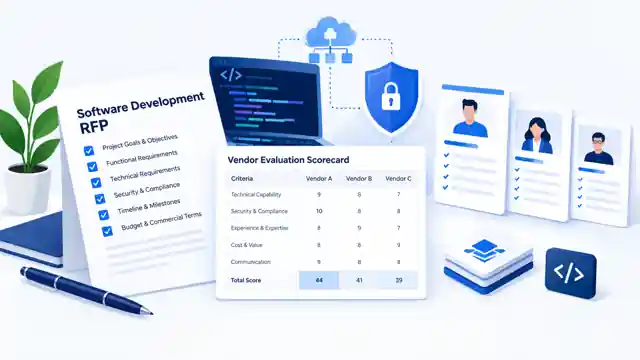
A software development RFP should make competing proposals easier to compare, not simply make the procurement document longer. In 2026, a useful request for proposal defines the business outcome, users, scope boundaries, technical constraints, integrations, security expectations, ownership and handover terms, commercial assumptions, and exactly how vendors will be evaluated.
The biggest improvement you can make is to separate mandatory qualification gates from scored criteria. A vendor that cannot meet a non-negotiable security, legal, data-residency, delivery, or ownership requirement should not be rescued by a strong sales presentation or a low price. For the vendors that pass those gates, use the same evidence requests and weighted scorecard.
This template is designed for buyers procuring custom software, SaaS development, web or mobile applications, enterprise integrations, modernization work, and long-running product engineering. Adapt it to your project rather than sending every section unchanged.
What should a software development RFP include?
At minimum, include the business problem, target users, project scope, explicit exclusions, functional and non-functional requirements, current technical environment, integrations, security and privacy requirements, expected delivery team, milestones, proposal format, commercial assumptions, IP and handover expectations, support requirements, vendor evidence, evaluation criteria, and procurement timeline.
Current RFP guides consistently emphasize scope clarity, technical constraints, integrations, team composition, budget or commercial guidance, and transparent evaluation criteria. The gap is often evidence quality: asking whether a vendor is “experienced” produces a claim, while asking for the proposed technical lead, their role on two comparable projects, and a reference you can contact produces something you can verify.
1. Start with the business outcome, not a feature dump
Open the RFP with a short description of the problem, who experiences it, why the project matters now, and what success should look like after launch. Vendors need enough context to challenge assumptions and propose a sensible solution.
Include the intended users, expected usage or transaction volumes where known, major business workflows, important dependencies, and measurable outcomes. If numbers are uncertain, label them as estimates instead of presenting guesses as requirements.
Template prompts
- What business problem are we solving?
- Who are the primary and secondary users?
- What must improve after launch?
- Which outcomes will determine whether the project succeeded?
- What constraints are already fixed?
2. Define scope, priorities, and explicit non-goals
Separate must-have scope from desirable scope and future ideas. This prevents one bidder from pricing only the minimum while another quietly includes migration, QA, DevOps, analytics, documentation, and post-launch support.
State what is in scope for the first release, what may be added later, and what is explicitly out of scope. For uncertain requirements, ask vendors to identify assumptions and propose a discovery approach rather than pretending uncertainty does not exist.
Useful scope categories
- Discovery, requirements refinement, and architecture
- UX and interface design
- Frontend and backend engineering
- APIs and third-party integrations
- Data migration and cleansing
- Testing and quality assurance
- Cloud, CI/CD, observability, and deployment
- Documentation and knowledge transfer
- Training, warranty, maintenance, and production support
3. Give vendors the technical environment they need to price responsibly
Describe the systems the new software must work with. Include existing applications, APIs, identity providers, databases, cloud environments, deployment constraints, supported devices or browsers, and any architecture decisions that truly are non-negotiable.
Avoid prescribing a technology merely because it is familiar internally. Distinguish between a real constraint and a preference, and ask vendors to explain material trade-offs in their proposed architecture.
Ask every bidder to disclose
- Proposed architecture and the reasoning behind it
- Key technologies and third-party dependencies
- Integration assumptions and missing documentation
- Scalability and performance assumptions
- Hosting and deployment responsibilities
- How technical debt and maintainability will be managed
4. Put security and software-supply-chain requirements inside the RFP
Security should be part of vendor selection, not paperwork added after the preferred bidder has been chosen. NIST’s Secure Software Development Framework gives acquirers and suppliers a common vocabulary for discussing secure development practices, including preparing the organization, protecting software, producing well-secured software, and responding to vulnerabilities.
NIST also finalized SP 1326 in July 2026 for cybersecurity supply-chain due diligence. It frames supplier assessment around factors including provenance, resilience, foundational cyber practices, supply-chain tiers, and foreign ownership, control, or influence. Not every project needs the same depth of review, but higher-risk software procurement should ask for evidence proportionate to the system’s criticality.
Security questions to adapt
- How are developer, repository, cloud, and production privileges controlled and reviewed?
- How are secrets and credentials stored, rotated, and revoked?
- How are dependencies inventoried and vulnerability findings handled?
- What secure-code review, testing, and release controls are used?
- How are security incidents detected, escalated, communicated, and investigated?
- Which subcontractors or important technology suppliers will be involved?
- How are AI coding assistants governed when customer code, data, or credentials are involved?
For deeper finalist checks, use Brandligo’s software vendor due diligence checklist after the proposal stage.
5. Define data, privacy, and AI-use expectations
Describe the data categories the system will process and any known residency, retention, access, deletion, or cross-border requirements. Ask vendors to identify where production data, backups, logs, source code, and support access will exist.
If the vendor may use generative AI or coding assistants, make the policy explicit. Ask which tools are approved, what information may be sent to third-party models, whether prompts or outputs are retained, how generated code is reviewed, and how licensing or provenance concerns are handled. Legal and privacy requirements vary by jurisdiction, so involve qualified advisers where the project warrants it.
6. Ask for the actual delivery team
A company profile is not a delivery plan. Require the proposed roles, seniority, location, availability, employment or subcontractor status where relevant, and the process for replacing key people.
Ask who will own architecture, engineering management, product or project management, QA, DevOps, security, and UX. For a finalist, interview the technical lead and other critical people rather than evaluating only the sales team.
7. Make proposals commercially comparable
Tell vendors what commercial detail you expect. If you allow more than one engagement model, ask each bidder to explain which model it recommends and why.
| Commercial item | Ask vendors to provide |
|---|---|
| Team | Roles, seniority, rates or pricing basis, expected allocation |
| Estimate | Effort, assumptions, exclusions, contingency and dependencies |
| Milestones | Deliverables, acceptance points and payment triggers |
| Third-party cost | Cloud, licenses, APIs, tooling and other pass-through costs |
| Change control | How scope changes are estimated, approved and billed |
| Support | Warranty, maintenance, support hours and response expectations |
| Exit | Notice, handover assistance and transition charges |
A headline hourly rate is not a total-cost comparison. Normalize the proposals around the same scope and identify material exclusions before scoring price.
8. Specify code, IP, accounts, documentation, and exit expectations
State what you expect to own and control. Depending on the engagement, this may include newly created source code, designs, documentation, configuration, data models, deployment scripts, prompts, tests, and other deliverables. Identify how pre-existing vendor components and third-party software will be treated.
Also define practical control: repository access, cloud and deployment accounts where appropriate, credentials, build instructions, architecture documentation, data export, and transition assistance. Have qualified legal counsel review IP, licensing, liability, confidentiality, privacy, and jurisdiction-specific contract terms.
9. Require a common proposal response format
Comparable proposals are easier to evaluate. Give every bidder the same response structure and ask them to flag deviations rather than burying assumptions in a sales deck.
- Executive summary and understanding of the problem
- Proposed solution and architecture
- Scope, assumptions, exclusions, and dependencies
- Delivery approach, milestones, and governance
- Named team and locations
- Security, privacy, and software-supply-chain responses
- Relevant evidence, case studies, and references
- Commercial proposal and third-party costs
- Support, warranty, maintenance, and exit
- Risks, open questions, and requested deviations
10. Separate qualification gates from the vendor scorecard
Use qualification gates for requirements you genuinely cannot trade away. Examples may include an essential regulatory condition, a required data location, a conflict-of-interest rule, a minimum insurance condition, acceptance of a critical IP term, or the ability to provide a named team within the required window. Do not turn preferences into arbitrary gates.
Then score qualified proposals using criteria and weights agreed before proposals are opened. The example below is a starting framework, not a universal formula.
| Criterion | Example weight | Evidence to examine |
|---|---|---|
| Fit to requirements | 20% | Coverage, gaps, assumptions, solution fit |
| Technical approach | 20% | Architecture reasoning, integrations, maintainability, testing |
| Security and risk | 15% | Controls, secure development, dependencies, incident process |
| Delivery team | 15% | Named people, seniority, availability, continuity |
| Relevant evidence | 10% | Comparable work and reference validation |
| Delivery and governance | 10% | Milestones, reporting, QA, risk and change management |
| Commercial value | 10% | Normalized total cost, clarity, flexibility, exclusions |
Adjust the weights for your risk profile. A regulated platform may weight security more heavily; a bounded internal prototype may emphasize speed and delivery fit. Publish or at least freeze the scoring rules before presentations so the team does not change weights to justify a preferred vendor.
11. Use anchored scoring and evidence notes
A number without a definition creates false precision. Define what a weak, acceptable, strong, and exceptional response means for each criterion. Require evaluators to record the evidence behind material scores.
Where possible, have evaluators score independently before a moderation meeting. Discuss large differences, resolve factual misunderstandings, and preserve a short decision record. The goal is not to make judgment disappear; it is to make judgment more transparent and repeatable.
12. Build a procurement timeline with a real Q&A window
Give all bidders access to the same material information. Include an RFP release date, deadline for questions, date when consolidated answers will be shared, proposal deadline, finalist interviews or workshops, reference checks, target decision date, and expected contract or discovery start.
If one vendor’s question reveals information that changes the scope, share the clarification consistently with other bidders unless confidentiality or procurement rules require a different process.
13. Evaluate the proposal, then verify the finalist
The RFP scorecard narrows the field; it does not replace due diligence. For finalists, validate references, proposed personnel, security claims, important certifications where applicable, ownership and subcontracting, commercial assumptions, and the contract terms that affect continuity and exit.
Brandligo’s software development company selection guide provides the broader evaluation process, while the 25-check software vendor due diligence checklist is designed for deeper verification before signature. You can also browse the Brandligo company directory when building a shortlist, but a directory listing is a discovery signal, not a substitute for project-specific verification.
Copy-and-adapt software development RFP outline
- Organization and project context
- Business problem and desired outcomes
- Users and usage assumptions
- Scope, priorities, and non-goals
- Functional requirements
- Non-functional requirements
- Current architecture and integrations
- Security, privacy, and AI-use requirements
- Data migration and data-management requirements
- Delivery team and working model
- Milestones, acceptance, and governance
- Commercial response format
- IP, licensing, repositories, documentation, and handover
- Support, maintenance, and exit
- Vendor evidence and references
- Qualification gates
- Evaluation criteria and scoring
- Submission instructions and procurement timeline
Questions buyers frequently ask
Should an RFP include a budget?
A budget range or clear commercial constraint can help vendors propose an appropriately sized solution. If procurement rules prevent disclosure, at least require consistent pricing assumptions and a detailed breakdown so proposals can be normalized.
How many vendors should receive the RFP?
There is no universal number. For a private mid-market procurement, a focused shortlist is usually easier to evaluate well than a very large field. Formal public procurement may have different rules. The important point is to give all eligible bidders consistent information and evaluation criteria.
Should we prescribe the technology stack?
Only where there is a real constraint. State required compatibility, security, hosting, integration, skills, or operational constraints, then allow vendors to explain the architecture that best satisfies them.
Is the lowest bid the best bid?
Not necessarily. First normalize scope, team, assumptions, third-party costs, support, and risk. A cheaper proposal that excludes migration, QA, DevOps, documentation, or support may not actually have the lower total cost.
What should happen after scoring?
Interview the actual team, clarify assumptions, call relevant references, verify important security and ownership claims, complete due diligence, and negotiate the contract. For high-uncertainty work, a paid discovery phase or bounded pilot can provide additional evidence before a large commitment.
Primary references
This guide uses current market results to understand buyer intent and recurring RFP topics, but its procurement recommendations are independently synthesized. For security and supplier-risk requirements, Brandligo relies on primary NIST guidance: the Secure Software Development Framework and the finalized NIST SP 1326 C-SCRM Due Diligence Assessment Quick-Start Guide, published July 8, 2026.
Editorial note: This template is general procurement guidance, not legal, security, privacy, or regulatory advice. Adapt requirements to the project’s jurisdiction, risk, and procurement rules, and use qualified specialists where appropriate.



Leave a Reply