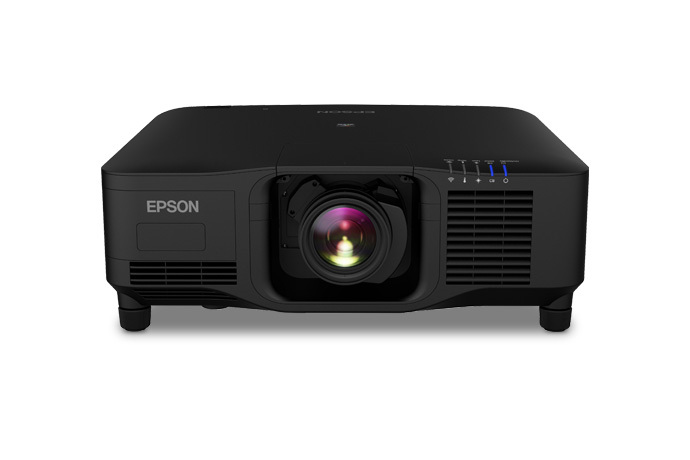
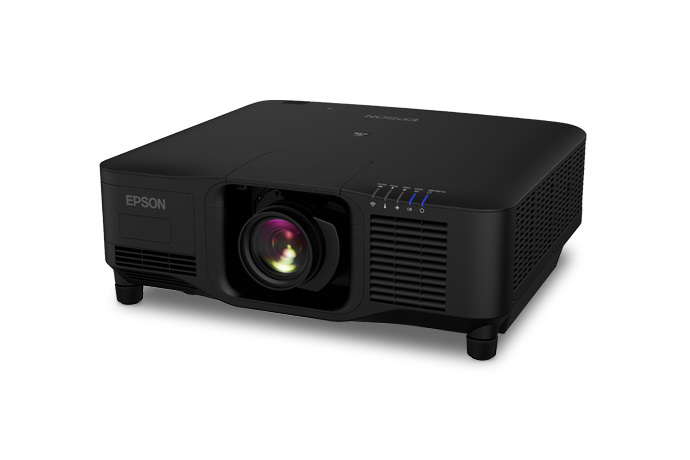
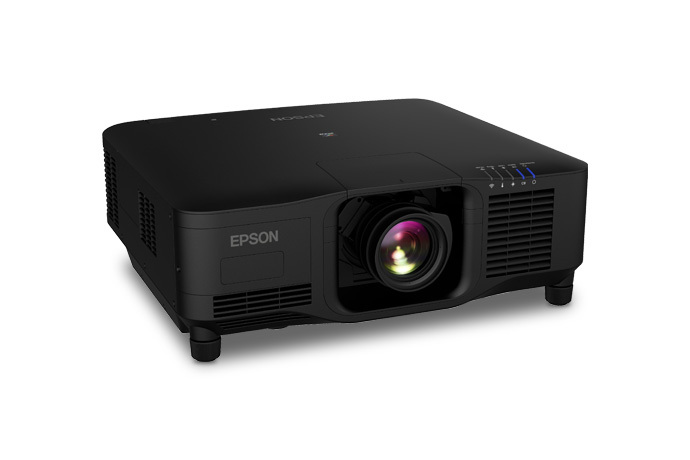
About EB-PQ2213B
The Epson EB-PQ2213B is the 13,000-lumen model in Epson's EB-PQ large-venue 4K laser projector family. It sits between the 10,000-lumen EB-PQ2010 models and the 16,000-lumen EB-PQ2216 models, making it a practical middle step for theaters, museums, immersive rooms, auditoriums, rental work and other installations where 10,000 lumens may not leave enough brightness headroom. Epson ships the projector body without a lens, so buyers should treat the lens, mount, signal path and commissioning work as part of the project rather than extras to think about later.
Key specifications
Display
| White brightness | 13,000 lumens in Normal Light Source Mode |
|---|---|
| Color brightness | 13,000 lumens in Normal Light Source Mode |
| On-screen resolution | 3840 x 2160 using Epson 4K Crystal Motion technology |
| Imaging technology | 3-chip 3LCD |
Optics
| Optional powered lenses | 10; lens sold separately |
|---|
Light source
| Type | Laser diode |
|---|---|
| Rated life | Up to about 20,000 hours Normal or Quiet; up to about 30,000 hours Extended |
Installation
| Optical module | IP5X-rated hermetically sealed optical and light-source module |
|---|---|
| Cooling | Liquid cooling with filterless cabinet |
| Mechanical shutter | Yes |
Connectivity
| SDI | Input and output |
|---|
Power
| Power supply | 100 - 240 V AC, +/-10%, 50/60 Hz |
|---|
Physical
| Weight | Approximately 64.3 lb (29.2 kg) without lens |
|---|
What do you get for the 13,000-lumen tier?
Epson rates the EB-PQ2213B at 13,000 lumens for both white and color brightness in Normal light source mode. It uses Epson's 3-chip 3LCD system and 4K Crystal Motion technology to produce 3840 x 2160 imagery on screen. Epson also includes HDR support, frame interpolation and scene adaptive gamma correction, features intended to keep detailed large-format content looking convincing rather than simply bright.
This model is black, which is often useful in theaters and live-production environments where the projector should visually disappear. It also includes a mechanical shutter, unlike the 8,000- and 10,000-lumen EB-PQ2008 and EB-PQ2010 tiers. Epson lists SDI input and output on this model, an important distinction for professional video workflows.
How flexible is the lens and installation setup?
The lens is not included. Epson supports 10 optional powered lenses on the EB-PQ2213B, allowing an integrator to choose around throw distance, screen size and room geometry. Epson's specifications list powered focus and optical zoom with supported lenses, plus substantial lens shift. The optional PixAlign camera can add automated assistance for multi-projector work such as screen matching, color calibration, geometry and edge blending.
Built-in NFC is useful during setup, while Epson's projector management tools are aimed at fleets and permanent installations. For the 13,000-lumen tier Epson also uses a filterless cabinet, an IP5X-rated hermetically sealed optical and light-source module, and liquid cooling. These are meaningful features for venues where dust, long operating schedules and service access matter.
What should buyers know about power, heat and maintenance?
The EB-PQ2213B accepts 100 to 240 V AC according to Epson's current technical documentation. Epson lists power consumption at 951 W in Normal or Custom light source mode on 100 to 120 V, and 925 W on 220 to 240 V. That means power, cooling and ventilation should be considered during venue design even though this model does not carry the same full-performance 220 V requirement Epson specifies for the 16,000- and 20,000-lumen EB-PQ models.
Epson rates the laser light source for up to about 20,000 hours in Normal or Quiet mode and up to about 30,000 hours in Extended mode, with actual life depending on operating conditions and usage. The projector weighs about 64.3 lb, or 29.2 kg, without a lens, so mounting and handling should be planned professionally.
How does it compare with the EB-PQ2010 and EB-PQ2216?
The EB-PQ2213B is a useful bridge between two distinct buying decisions. Compared with the 10,000-lumen EB-PQ2010, it provides 30 percent more rated brightness and moves into Epson's more rugged filterless, sealed-optics and liquid-cooled chassis class. That can justify the step up for larger screens, brighter spaces and demanding event work.
The 16,000-lumen EB-PQ2216 models provide another 3,000 lumens when more output is required, but Epson specifies a 220 V connection for their full operation and performance. The EB-PQ2213B can therefore be attractive where 13,000 lumens is sufficient and a conventional 100 to 240 V installation is preferable.
Who should choose something else?
Choose a lower-output EB-PQ2008 or EB-PQ2010 if the screen, ambient light and throw calculations do not require 13,000 lumens. They are lighter choices for installations where the extra brightness and ruggedized high-output chassis are unnecessary. Buyers who need maximum output for very large projection surfaces, outdoor-adjacent spaces or major live productions should compare the EB-PQ2216 and EB-PQ2220B instead.
A classroom, ordinary meeting room or home theater is usually a poor match for the EB-PQ2213B. Epson's PowerLite models are easier to justify for mainstream business and education, while Epson's home-entertainment ranges are designed around residential viewing. This projector makes the most sense when a professional AV designer can take advantage of its brightness, lens choice, SDI connectivity and multi-projector installation tools.
Reviews
No reviews yet
Nobody has reviewed EB-PQ2213B here yet.