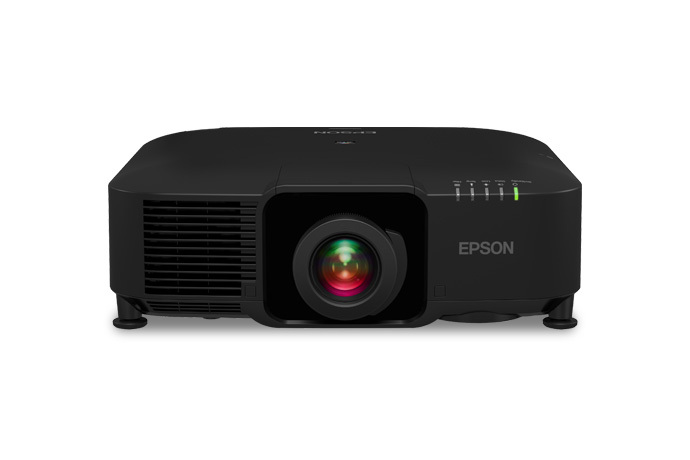
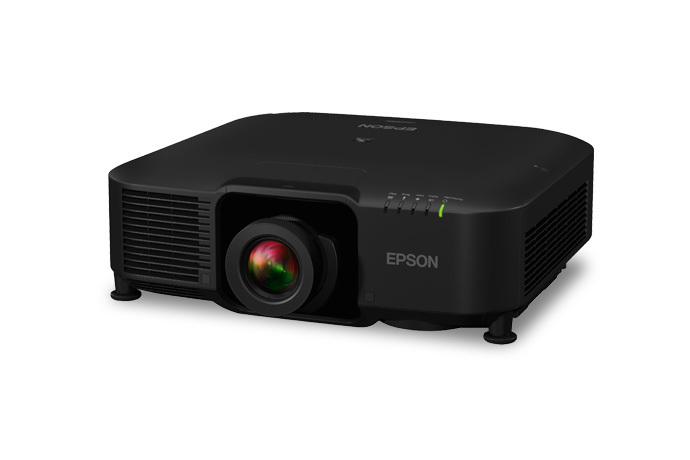
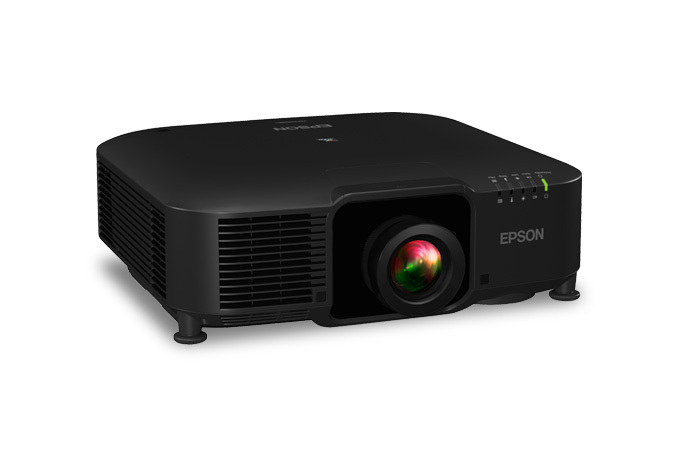
About EB-PQ2010B
Epson's EB-PQ2010B is the black 10,000-lumen model in the EB-PQ Series, aimed at large venues, live events, museums, higher education and immersive installations. It combines equal white and color brightness with Epson's 3-chip 3LCD system and 4K Crystal Motion technology to put 3840 x 2160 detail on screen. The chassis is sold without a lens, so buyers can match one of Epson's optional powered lenses to the room instead of accepting a fixed throw range. Epson began shipping the EB-PQ Series in May 2024, making this a current professional projector rather than a legacy model.
Key specifications
Display
| Color brightness | 10,000 lumens |
|---|---|
| White brightness | 10,000 lumens |
| Imaging technology | 3-chip 3LCD |
| On-screen resolution | 3840 x 2160 with 4K Crystal Motion |
Light source
| Type | Laser diode |
|---|---|
| Life | Up to about 20,000 hours Normal/Quiet; up to about 30,000 hours Extended |
Installation
| Lens system | 10 optional powered lenses; lens sold separately |
|---|---|
| Focus | Powered |
| Chassis color | Black |
Connectivity
| Professional video | 12G-SDI input/output plus HDMI |
|---|
Physical
| Weight without lens | Approximately 40 lb (18.6 kg) |
|---|
Power
| Supply | 100-240 V AC, 50/60 Hz |
|---|
Model
| Epson model number | V11HB02820 |
|---|
What does the EB-PQ2010B do well?
Its main advantage is delivering 10,000 lumens of equal white and color brightness in a relatively compact professional chassis. Epson combines 3-chip 3LCD imaging with 4K Crystal Motion, a thermo-controlled panel and a double micro-lens array. The result is intended for detailed large-screen work where viewers may sit close enough to notice image structure.
Epson also includes frame interpolation for fast-moving material, HDR support and scene adaptive gamma correction. The laser light source is rated for up to about 20,000 hours in Normal or Quiet mode, or up to about 30,000 hours in Extended mode, although brightness and actual life vary with settings, environment and use.
How flexible is installation?
The projector supports 10 optional powered lenses, with the standard ELPLM15 lens also sold separately. That matters for auditoriums, rental staging and permanent installations because lens choice can be matched to throw distance, screen size and mounting constraints. Powered focus and zoom support professional setup, while built-in NFC can simplify configuration before the projector is fully commissioned.
For multi-projector work, Epson offers the optional PixAlign camera. It can assist with tasks such as edge blending, geometry alignment, color calibration and screen matching. The EB-PQ2010B also includes professional connectivity including HDMI and 12G-SDI, making it better suited to production environments than a typical business projector.
What should buyers budget beyond the projector?
The lens is not included, so the projector body is only part of the installed cost. A professional project may also need a mount, signal distribution, control hardware, cabling, calibration and the optional PixAlign camera. Epson does not present a simple consumer checkout price on the current US product page, instead directing buyers to request information, so Brandligo does not invent a street price.
The projector weighs about 40 pounds without a lens. It is compact for its output class, but it is still installation equipment rather than something most teams will casually move between meeting rooms.
What are the practical limitations?
This is not a complete projector purchase until a suitable lens is selected. Buyers should also note that the EB-PQ2010B uses an air filter, unlike the higher-output 13,000-, 16,000- and 20,000-lumen EB-PQ models that Epson describes with filterless cabinets and sealed optical systems. High-dust installations therefore deserve a closer look at maintenance planning or Epson's optional external filter guidance.
Some long-throw lens combinations can fall into a higher laser risk group and require professional installation and safety planning. Epson specifically states that combinations using certain lenses are intended for professional use. Integrators should verify lens-specific hazard distances and local installation requirements rather than treating every lens as interchangeable from a safety perspective.
How does it compare with other EB-PQ models?
The EB-PQ2008B is the natural step down when 8,000 lumens is enough and budget or power use matters more than maximum output. The EB-PQ2213B, EB-PQ2216B and EB-PQ2220B move upward to 13,000, 16,000 and 20,000 lumens for larger screens, brighter environments and demanding staging work. Those higher-output models also add design changes aimed at harsher professional installations.
The EB-PQ2010W is the white-chassis counterpart when the projector needs to blend into a light ceiling or architectural environment. Choosing between black and white should be based on the installation rather than image performance.
Who should choose something else?
Small classrooms, conference rooms and portable presenters should look at lower-output Epson PowerLite models instead. They can be easier to deploy and avoid paying for interchangeable lenses and large-venue integration features that may never be used. Home theater buyers should consider Epson's Q-Series, Pro Cinema or Home Cinema ranges, which are designed around entertainment priorities rather than venue control and multi-projector workflows.
For a venue that genuinely needs 10,000 lumens, interchangeable lenses, 4K on-screen detail and production-friendly connectivity, the EB-PQ2010B sits in a useful middle position: substantially brighter than ordinary installation projectors without jumping directly to the size and infrastructure of Epson's 13,000- to 20,000-lumen tiers.
Reviews
No reviews yet
Nobody has reviewed EB-PQ2010B here yet.