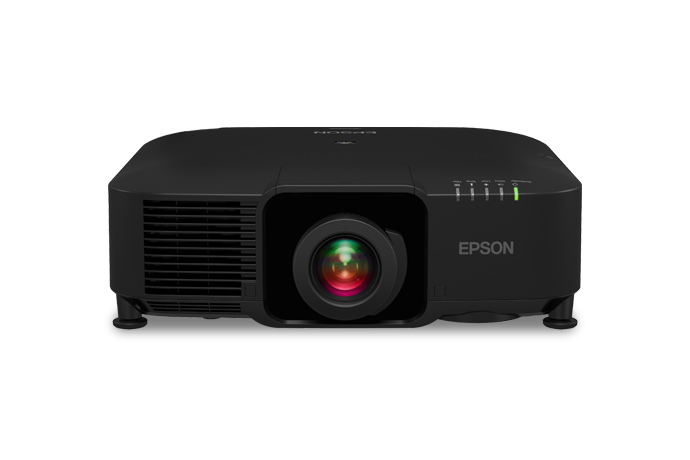
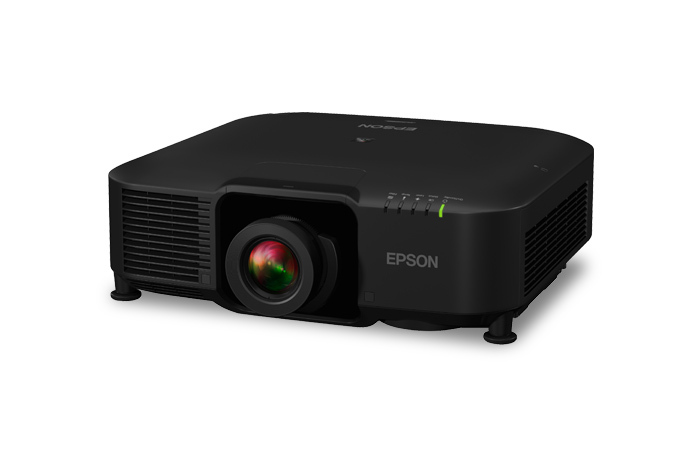
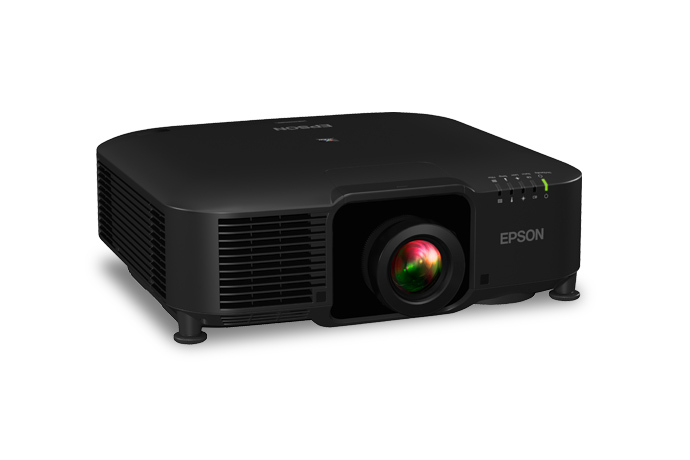
About EB-PQ2008B
Epson's EB-PQ2008B is the black 8,000-lumen entry point to the EB-PQ large-venue family. It is aimed at museums, auditoriums, higher-education spaces, houses of worship, corporate experience centers and live-event installations that need a bright 4K image, interchangeable lenses and professional setup tools without stepping up to the 10,000-lumen and higher EB-PQ models. Epson began shipping the EB-PQ lineup in May 2024. The projector uses Epson's 3-chip 3LCD system and 4K Crystal Motion technology to produce 3840 x 2160 imagery on screen.
Key specifications
Image
| Color brightness | 8,000 lumens |
|---|---|
| White brightness | 8,000 lumens |
| Imaging technology | 3-chip 3LCD |
| On-screen resolution | 3840 x 2160 via 4K Crystal Motion |
Light source
| Type | Laser diode |
|---|---|
| Rated life | Up to about 20,000 hours in Normal or Quiet mode; up to about 30,000 hours in Extended mode |
Installation
| Lenses | 10 optional powered lenses; lens sold separately |
|---|---|
| Weight | Approximately 40.6 lb (18.4 kg) without lens |
Connectivity
| HDMI | Two HDMI inputs and one HDMI output |
|---|---|
| HDBaseT | Input supported |
| SDI | Not included on EB-PQ2008B |
Power
| Power supply | 100 - 240 V AC, 50/60 Hz |
|---|
What does the EB-PQ2008B do well?
Its strongest argument is the combination of 8,000 lumens of equal white and color brightness with a compact professional chassis. Epson pairs that output with a high native contrast design, frame interpolation, HDR support and scene adaptive gamma correction. This makes the projector useful where detail and color need to hold up on a large screen rather than simply producing a bright presentation image.
The laser light source is rated for up to about 20,000 hours in Normal or Quiet mode, with Epson listing up to about 30,000 hours in Extended mode. Actual life varies with operating mode, environment and use, and brightness decreases over time.
How flexible is installation?
The EB-PQ2008B does not include a lens. Instead, Epson supports 10 optional powered lenses, including an ultra short throw option, so an integrator can choose optics around screen size, throw distance and room geometry. That flexibility is valuable for projection mapping, rear projection, museums and venues where the projector cannot simply sit at a conventional distance from the screen.
Built-in NFC can reduce setup time across multiple units. Epson's optional PixAlign camera adds assisted tools for edge blending, stacking, automatic color calibration and screen matching. Epson Projector Professional Tool and Epson Projector Management - Connected are also intended for multi-projector setup and fleet management.
What connectivity and operating details matter?
Epson provides two HDMI inputs and one HDMI output for daisy chaining, plus HDBaseT input. Unlike the EB-PQ2010B above it, Epson's launch table lists the EB-PQ2008B without SDI input and output. That distinction matters for broadcast and live-production workflows where SDI is already part of the signal chain.
The projector accepts 100 to 240 V AC. Epson's documentation lists normal or custom light-source consumption at 522 W on 100 to 120 V and 502 W on 220 to 240 V. The chassis weighs about 40.6 lb without a lens, so this is installation equipment rather than a projector most buyers will move casually between rooms.
What should buyers budget beyond the projector?
The lens is a separate purchase, and that changes the real installed cost. Buyers should also account for the mount or rigging, signal distribution, cabling, control hardware and professional calibration where the project uses blending, stacking or unusual geometry. A quote for the projector body alone is therefore not a reliable total-project comparison.
Epson's US page currently routes buyers to request more information rather than presenting a simple consumer checkout price. For that reason, a current retail price should not be guessed. Integrators and Epson channel partners are the better source for a configuration-specific quote.
Who should choose a different Epson projector?
Choose the EB-PQ2010B if 10,000 lumens gives useful headroom or if SDI connectivity is important. Larger venues and demanding event work may justify the 13,000-, 16,000- or 20,000-lumen EB-PQ models. Buyers who want the same 8,000-lumen tier in a lighter-looking installation can consider the white EB-PQ2008W instead.
For classrooms, small meeting rooms and ordinary office presentations, the EB-PQ2008B is usually more projector than the job requires. A fixed-lens PowerLite model can be simpler and less costly. Home theater buyers should also look elsewhere in Epson's range because EB-PQ is designed around professional installation rather than living-room convenience.
Is the EB-PQ2008B still a current choice?
Yes. Epson's current US product page continues to list the EB-PQ2008B and its professional accessories and support resources. Its 2024 launch date does not make it a legacy listing in this catalogue. It remains part of Epson's modern EB-PQ platform and fills the lower-brightness end of the same family as the EB-PQ2010B, EB-PQ2216B and EB-PQ2220B.
Reviews
No reviews yet
Nobody has reviewed EB-PQ2008B here yet.