About SmartThings hub
The SmartThings hub is the radio bridge in Samsung's smart home system. The SmartThings app can talk to wifi and cloud-connected devices on its own, but Zigbee and Thread devices are short-range and low-power and speak neither wifi nor the internet, so something in the house has to sit between them and Samsung's servers. That something is the hub. It is also what makes a house a Matter fabric rather than a collection of cloud accounts. The important thing to understand about this line in 2026 is that the hub is usually not a separate purchase any more. Samsung's April 2025 Newsroom post on the subject describes hubs as built into devices people already own, listing built-in SmartThings hubs across Samsung TVs, Smart Monitors, soundbars including the HW-Q990 series, Family Hub refrigerators, The Freestyle projectors and the Music Frame, alongside the standalone SmartThings Station and the older V2 and V3 hubs. Samsung's own SmartThings page, read in August 2026, states that Samsung TVs of Q60 or above released after 2022 include a built-in hub supporting Matter, Thread and Zigbee.
What the hub is actually for
Three jobs. First, it carries the radios: Zigbee for the long tail of sensors, bulbs and buttons, and Thread for newer low-power Matter devices. Second, it acts as a Matter controller and commissioner, which is what lets Matter devices be added to your home rather than to a manufacturer's cloud. Third, it runs some automation locally, so a motion sensor turning on a light does not have to make a round trip to a data centre.
What it is not is a requirement. If every device you own is wifi or connects through a manufacturer's cloud integration, the SmartThings app works without a hub at all.
The hub is now mostly something you already own
Samsung's strategy since 2025 has been to stop selling the hub as a puck and start shipping it inside things people buy anyway. The Newsroom post cited above sets out that position directly, and the practical result is that a household with a recent Samsung TV or a Family Hub fridge already has a hub sitting in the living room or the kitchen, at no extra cost and with no setup beyond activating it in the app.
This is genuinely convenient and it has a catch. A hub inside a television is a hub that depends on the television. Placement is decided by where the TV goes rather than by where the Zigbee mesh needs its coordinator, and a TV in a cabinet at one end of the house is a poor radio position for sensors at the other end. Anyone planning more than a handful of Zigbee or Thread devices should think about coverage before assuming the built-in hub is enough.
The standalone hubs that are still sold
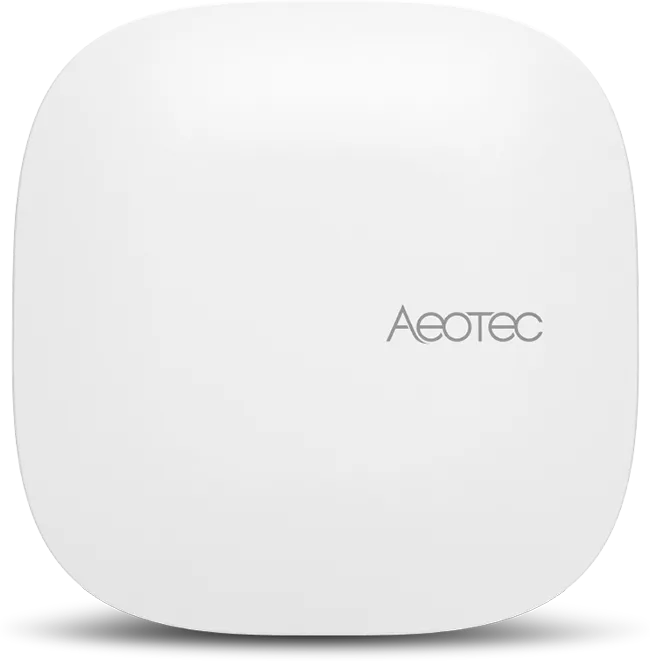
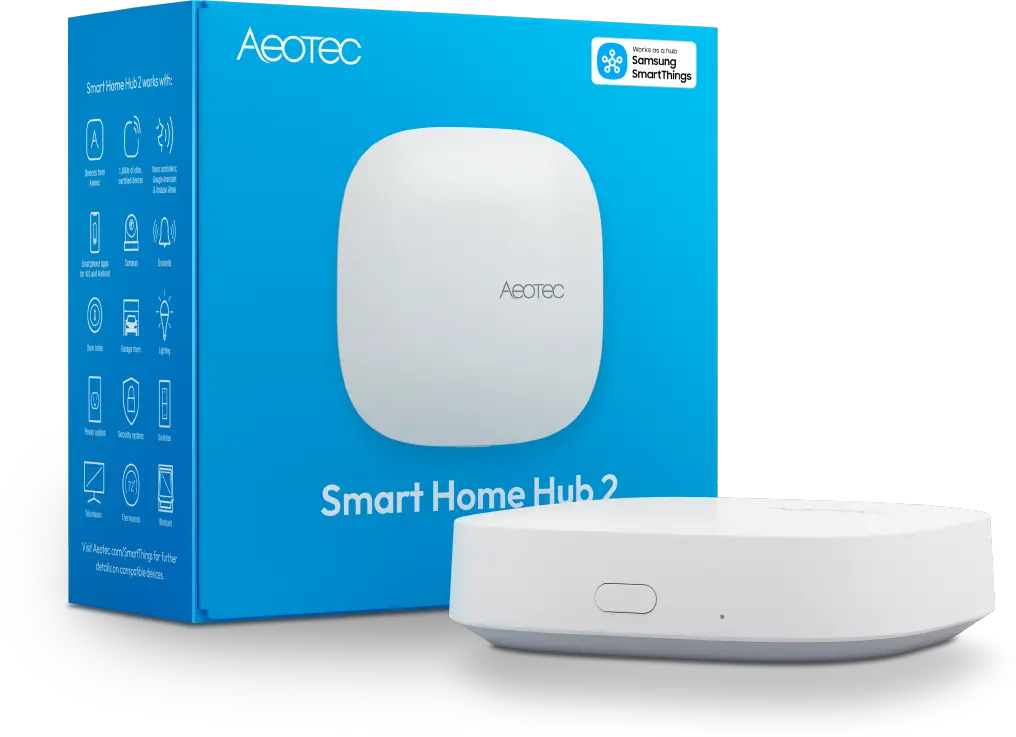
Standalone hardware has not disappeared. Aeotec, which manufactures the SmartThings hub line under licence, lists the Smart Home Hub 2 on its own site as certified to work with Samsung SmartThings, supporting Matter, Thread, Zigbee 3.0, wifi, Ethernet and Bluetooth for onboarding and diagnostics, with retail availability in North America given as 30 October 2025 and named retail routes including samsung.com and the Aeotec store. Samsung's US site lists it at 119.99 US dollars, though when checked in August 2026 both delivery and store pickup showed as unavailable. The SmartThings Station, a small hub that doubles as a wireless phone charger, is also listed by Samsung as a standalone option, as are the older V2 and V3 hubs.
Radios in 2026, including the end of Z-Wave
The single most consequential change in this line is the loss of Z-Wave. SamMobile reported on 4 September 2025 that the Aeotec Smart Home Hub 2 drops the Z-Wave radio that every previous SmartThings hub carried, supporting Bluetooth Low Energy, Zigbee, Thread and Matter instead, and that owners of Z-Wave devices need to stay on the previous-generation hub, which was said to be phased out by the end of 2026. Aeotec's own specification list for the Hub 2 makes no mention of Z-Wave.
If you have Z-Wave locks, sensors or switches, that is the fact to plan around. It does not mean your existing hub stops working today, but the replacement path inside SmartThings no longer exists.
Thread and Matter, dated to August 2026
Thread support moves fast, so date any claim you read. On 1 October 2025 the SmartThings blog announced two-way Thread network unification using Thread 1.4 credential sharing: a SmartThings hub can join a Thread network another vendor's border router already created, or a third-party border router can join the SmartThings network, so the house runs one mesh instead of several. At launch this was limited to the Aeotec Smart Home Hub and Smart Home Hub 2, required hub firmware in the 0.58.x range, and needed recent app builds. SamMobile's coverage the next day gave the concrete case: joining a SmartThings hub to a Thread network created by a Google Nest Hub or an Apple HomePod. Before this, running SmartThings alongside another Thread ecosystem meant two overlapping meshes competing for the same devices.
How it compares with Apple, Google, Amazon and Hubitat
Apple TV and HomePod, Google Nest hubs and Amazon Echo devices all act as Matter controllers and Thread border routers, and any of them will do the basic job. What separates the SmartThings hub is Zigbee: a broad Zigbee 3.0 implementation is not something Apple or Google offer in their mainstream hubs, and if your house runs on Zigbee sensors that matters more than any comparison of app design.
Hubitat is the direct rival for people who want local processing. It keeps automations running on the box rather than in a cloud, and it still supports Z-Wave, which SmartThings is walking away from. It asks more of you in setup and has a smaller consumer device catalogue.
On reliability, an independent review published on Matter Alpha on 19 March 2025 by Christian Cawley found the TV-based hub easy to set up for Matter devices but reported repeated unexplained disconnections that needed a power cycle, and other users describing the same. That is one reviewer, not a measured failure rate, but it is the complaint that recurs.
Who should buy something else
If your home is built on Z-Wave, do not buy into current SmartThings hardware. The newest hub has no Z-Wave radio and the older one that does is on its way out. Hubitat, or Home Assistant with a Z-Wave stick, will serve you for years longer.
If you want automations that survive an internet outage, look at Home Assistant or Hubitat. SmartThings does run some logic locally, but the platform as a whole is built around Samsung's cloud.
If you want to own and tinker with the system rather than simply use it, Home Assistant is the better answer. It is free, open source, will talk to hardware SmartThings has never heard of, and it will cost you evenings. Note also that Home Assistant's SmartThings integration is cloud based, and its own documentation flags that free SmartThings API access is being phased out from October 2026 in favour of a paid personal plan, so using a SmartThings hub as a back door into Home Assistant is not the free move it used to be.
And if you own no Samsung devices, buying a standalone SmartThings hub is a harder case to make than it was. Much of the value of this line now comes from the hub arriving free inside a television you were buying anyway.
Reviews
No reviews yet
Nobody has reviewed SmartThings hub here yet.