About Azure Peering Service
Azure Peering Service is a Microsoft Azure networking service for enterprises that want more predictable public internet connectivity to Microsoft cloud services without buying a private circuit. It works through approved internet service providers, internet exchange partners, and software-defined cloud interconnect providers that maintain direct connectivity with the Microsoft global network. The service is intended for organizations that use Microsoft 365, Dynamics 365, Azure, or other Microsoft online services over the public internet and want optimized routing, fewer external network hops, and better visibility into latency and BGP route behavior. Peering Service is not private connectivity. It remains an IP service over the public internet and should be evaluated separately from ExpressRoute and VPN Gateway.
What is included
Connectivity
| Connectivity model | Optimized public internet connectivity through Microsoft-approved Peering Service partners |
|---|---|
| Private connectivity | No; Peering Service uses the public internet |
Routing
| Preferred cloud egress routing | Cold-potato routing with preferred Microsoft Edge handoff |
|---|---|
| Required BGP community | 8075:8007 for Peering Service prefix advertisements |
| AS path limit | Maximum AS path length of 3 and no private ASNs |
Resilience
| Local redundancy | Redundant and diverse provider peering links and router paths at peering locations |
|---|---|
| Backup behavior | Optional backup provider peering location; normal internet is fallback if no backup location is selected |
Monitoring
| Connection telemetry | Primary and backup peering session availability when the resource is registered in Azure |
|---|---|
| Prefix telemetry | Median latency plus BGP prefix events including announcements, withdrawals, and primary or backup route changes |
Providers
| Partner types | ISP, IXP, and software-defined cloud interconnect providers approved for Peering Service |
|---|
Addressing
| Customer prerequisites | Own ASN for IX partner scenarios or own IP address ranges for ISP partner scenarios |
|---|---|
| Prefixes smaller than /24 | Supported when registered by the partner and activated by the customer with the Peering Service prefix key |
Compatibility
| Internet Routing Preference | Not compatible with Azure public IP Internet Routing Preference |
|---|
Alternatives
| Private connectivity alternatives | Azure ExpressRoute or Azure VPN Gateway depending on private connectivity requirements |
|---|
What problem does Azure Peering Service solve?
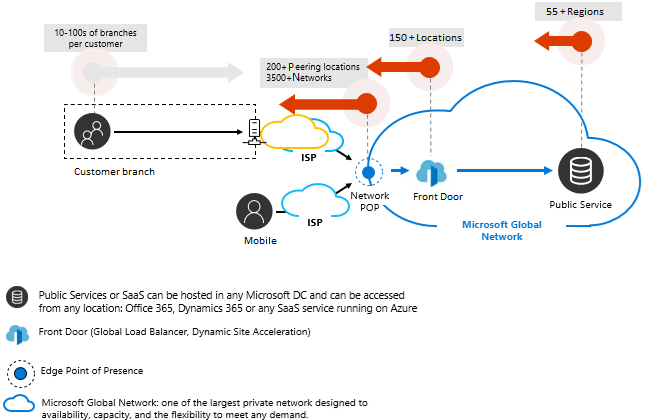
Normal internet routing can send Microsoft cloud traffic across several autonomous networks before it reaches the Microsoft edge or returns to an enterprise location. Those paths can change because each network makes its own routing decisions. Peering Service reduces that uncertainty by using Microsoft-approved connectivity partners and preferred handoff locations. Microsoft keeps traffic on its global network for as long as practical and hands it directly to the selected provider near the customer location. This can reduce external AS hops and make Microsoft cloud routing more predictable for offices that depend heavily on SaaS and Azure services.
The service is aimed at enterprise internet connectivity rather than application delivery. It does not accelerate arbitrary internet destinations, terminate private networks, or replace workload-level monitoring. Its value is strongest when Microsoft traffic quality is important enough that the organization wants a provider relationship designed around Microsoft peering.
How does Azure Peering Service work?
Customers obtain the connectivity service from a participating Peering Service partner. Microsoft states that customers do not have to register with Microsoft simply to use the connectivity service. Registration in the Azure portal is needed when the customer wants Microsoft telemetry and route monitoring for the Peering Service connection.
The partner connects to Microsoft through Peering Service-enabled peering. Microsoft and the provider use routing policies that favor direct and reliable paths. Peering Service uses Microsoft public service prefixes and the public internet, so it should not be described as a private circuit. Microsoft documents cold-potato routing as the preferred approach for traffic originating from the Microsoft cloud, which keeps traffic on the Microsoft network until it reaches the preferred Microsoft edge handoff.
What reliability and failover design does Microsoft document?
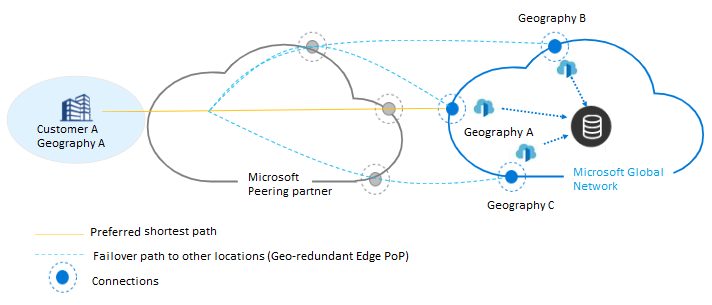
Microsoft documents both local redundancy and geo-redundancy. At a peering location, the service provider is expected to use redundant and diverse links and router paths. Geo-redundancy uses alternate Microsoft edge locations so traffic can move to another site if the preferred edge location has degraded performance.
When a customer creates a Peering Service connection in the Azure portal, Microsoft lets the customer choose a primary provider peering location and an optional backup peering location. Microsoft states that the backup location becomes active for disaster recovery if the primary peering location fails. If no backup location is selected, the internet is the default failover route. This means buyers should confirm whether the partner supports a suitable backup peering location instead of assuming geographic resilience is automatic.
What prefix requirements must be met?
Microsoft validates Peering Service prefixes before optimized routing is activated. The prefix cannot be from a private address range, the origin ASN must be registered in a major routing registry, and the Peering Service prefix key must match the key created during provider registration. The prefix must be announced from all primary and backup peering sessions that are part of the design.
Microsoft also requires the route to carry the Peering Service BGP community 8075:8007. The AS path cannot exceed a length of three and cannot contain private ASNs. These validation rules matter operationally because a connection can exist while a prefix still fails activation. Network teams should verify routing registry records, provider advertisements, the service key, and BGP policy before treating a deployment as ready.
Are prefixes smaller than /24 supported?
Yes, Microsoft states that Peering Service can support customer prefixes smaller than /24. The smaller prefix must first be registered by the Peering Service partner in the peering resource so a service key can be generated. The customer then activates that prefix in the Peering Service resource using the service key.
Smaller-prefix support should not be read as permission to skip Microsoft validation. The same public-address, origin ASN, route advertisement, BGP community, and AS-path checks still matter. Buyers with many branch-office prefixes should confirm how their provider will register and manage those prefixes before rollout.
What monitoring and telemetry are available?
When the Peering Service connection is registered in Azure, customers can use Microsoft telemetry for the registered connection and prefixes. Microsoft documents provider primary and backup peering session availability on the Peering Service resource. For Peering Service prefixes, Microsoft exposes median latency measurements and BGP-related prefix events such as announcements, withdrawals, and route transitions between primary and backup paths.
At the underlying peering level, Microsoft also documents session availability, ingress traffic rate, egress traffic rate, flap event count, and packet drop rate. Telemetry can help a network team distinguish provider, routing, or Microsoft-edge issues, but it is still only one part of operational monitoring. Application performance, DNS, endpoint health, local LAN conditions, and security controls should be monitored separately.
How is Peering Service different from ExpressRoute and VPN Gateway?
Peering Service remains public connectivity. Microsoft explicitly states that it is not a private connectivity product. Azure ExpressRoute provides private dedicated connectivity from customer locations to Microsoft, while VPN Gateway provides encrypted tunnels over the internet to Azure virtual networks.
Choose Peering Service when users still need public access to Microsoft services but want routing through a selected provider with Microsoft-backed peering design and telemetry. Choose ExpressRoute when private connectivity and private IP routing are required. Choose VPN Gateway when encrypted site-to-site or point-to-site connectivity to Azure virtual networks is the primary requirement and internet transport is acceptable.
Who can use Azure Peering Service?
Microsoft positions Peering Service for enterprise customers connecting to Microsoft online services over the internet. Customers using an internet exchange partner need their own ASN. Customers using an ISP partner need their own IP address ranges. Microsoft also allows customers to use multiple Peering Service providers in the same or different regions, but different prefixes must be registered with each provider.
Availability depends on suitable participating providers and peering locations. Microsoft publishes a current partner and location list, so procurement should verify coverage in the required metro instead of assuming that a global Azure presence means Peering Service is available through every carrier or exchange.
How does pricing work?
Microsoft does not publish a single universal customer price for Azure Peering Service connectivity. The customer obtains the service through an approved provider, so commercial pricing depends on that provider, location, bandwidth, access circuit, installation, support, and contract terms. The Azure resource is used for registration, telemetry, and connection management rather than representing a simple Microsoft per-hour or per-GB tariff.
Pricing was checked against current Microsoft Peering Service documentation on August 31, 2026. Buyers should request a complete quote from the provider and confirm what is included, especially last-mile access, internet transit, cross-connects, installation, port charges, support, and any service-level commitments.
What limitations should buyers know about?
Peering Service does not create private connectivity and does not replace security controls such as firewalls, endpoint protection, identity, or application-layer policy. Microsoft also states that Peering Service is not compatible with Azure public IP Internet Routing Preference because the two features use different routing objectives.
Prefix activation depends on meeting Microsoft's validation rules. Provider coverage can also vary by geography, and backup behavior depends on how the connection is configured. If no provider backup peering location is selected, normal internet routing is the fallback when the primary Peering Service location fails. These dependencies make provider design and route validation important parts of deployment.
Who should choose something else?
Choose ExpressRoute if the requirement is private dedicated connectivity to Microsoft rather than optimized public internet routing. Choose VPN Gateway if encrypted private connectivity to Azure virtual networks is the main requirement. Standard enterprise internet service may be enough for smaller organizations that do not have measurable Microsoft cloud latency, path stability, or support requirements.
Azure Front Door, Traffic Manager, and Load Balancer address application delivery and traffic-distribution problems rather than enterprise access to Microsoft's public cloud edge, so they are not direct replacements. Organizations that mainly need better SaaS performance should first measure current latency, packet loss, route changes, and provider behavior before adding a specialized connectivity service.
Reviews
No reviews yet
Nobody has reviewed Azure Peering Service here yet.