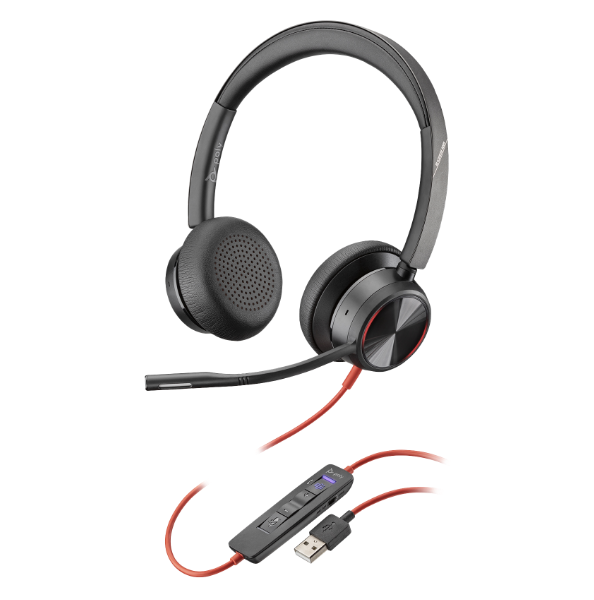

About Poly Blackwire
Blackwire is Poly's corded headset family, now sold under HP after its acquisition of the company. Every model in the line connects by cable and draws its power from that cable, which is the whole point: there is no battery to charge, no dongle to lose and no pairing step at the start of a shift. That makes Blackwire the default choice for contact centres, shared desks and any deployment where a headset is issued rather than chosen. The range runs from the entry-level 3200 series through the 3300 and 5200 series to the 8225 at the top, and models are offered in both monaural and stereo forms. Connection type, noise cancelling and certification vary by series, so the series number matters more than the family name.
Key specifications
Connection
| Power and connection | Corded, powered over the cable. No battery and no wireless dongle. |
|---|
Microphone
| Microphone | Noise cancelling boom microphone across the range |
|---|
Audio
| Hearing protection | Poly SoundGuard |
|---|
Management
| Fleet management | HP Poly Lens |
|---|
Wearing style
| Wearing styles | Monaural and stereo, by series. The 8225 is stereo only. |
|---|
How the Blackwire series differ
The 3200 series is the entry point, described by HP as durable, lightweight and easy to deploy. It is the model bought in quantity when the requirement is a working headset on every desk rather than a good one.
The 3300 series adds a more considered design and Microsoft Teams certification, and is offered over USB-C. It is the sensible middle of the range for a standardised office fleet.
The 5200 series is the ergonomic step up, notable for offering USB-C, USB-A and a 3.5mm connection, which makes it the most portable of the group for someone moving between a laptop, a desk dock and a phone.
The 8225 sits alone at the top. It is stereo only, connects by USB-C with a tethered USB-A adapter, and is the only model in the family with active noise cancelling. Every series below it offers a noise cancelling microphone, which is a different thing: it cleans up what the far end hears, not what the wearer hears.
What the whole range shares
Three things hold across Blackwire. Every model has a noise cancelling microphone on a boom, positioned close to the mouth with a deliberately short pickup range, so the person on the other end of the call hears a voice rather than an office. Every model includes SoundGuard hearing protection, which limits sudden volume spikes, a real requirement in contact centres and in some jurisdictions a legal one. And every model is plug and play, with no software required to make it work.
Poly Lens is the management layer that makes the range viable at scale. It gives an IT team visibility of every deployed headset, and handles configuration, firmware updates and usage reporting across a fleet from one console. For a business buying ten headsets this is irrelevant. For one buying a thousand it is most of the reason to choose Poly at all.
What the 8225 adds, and whether it is worth it
The 8225 is the only Blackwire with hybrid active noise cancelling, using four microphones and offering three settings through an inline switch rather than a single on and off. It also carries Poly's Acoustic Fence technology, which narrows the transmit pickup so that only the wearer's voice is sent. It is certified for Microsoft Teams, Zoom and Chromebook, with a dedicated Teams button on one variant.
Independent testing puts the noise reduction at a useful rather than dramatic level. Headset Advisor measured roughly a 30 percent reduction in background noise with ANC engaged, and was more impressed by the weight: at 6.5oz it is around half what a Jabra Evolve 80 weighs, which matters over an eight hour shift. That review also priced the 8225 as a premium product and pointed to cheaper headsets with stronger bass, positioning it as the light and comfortable option rather than the best sounding one.
Comfort and build over a full shift
Reviewers are consistent that Blackwire is comfortable at first and less so after a couple of hours. Testing of the 5220 found leatherette earcups that trap heat past the two hour mark, and a headband without click-stop adjustment that drifts out of position roughly every ninety minutes. Build quality drew no such complaint: braided cables, hinges that stay tight and a boom arm that holds its position were all noted approvingly.
The microphone has a real limitation worth knowing. The same review found frequency response capping around 10kHz, which makes voices sound slightly telephonic next to a wideband gaming or podcasting microphone. For business calls that is an acceptable trade and arguably the point, since the narrow band is part of how the headset rejects room noise.
How Blackwire compares with its nearest rivals
The direct comparison is Jabra's Evolve and Evolve2 wired models, and the two families are close enough that fleet buyers usually decide on management software and support terms rather than on the hardware. Poly Lens is the strongest argument for Blackwire in a large deployment. Logitech's Zone Wired is the other common alternative and tends to compete on price.
Against consumer headsets the comparison is less even than it looks. A gaming headset at the same money will sound better for music and worse on calls, because it is tuned for wide frequency response rather than for voice isolation and it usually lacks hearing protection and certification. Blackwire is a work tool, and it is priced and built as one.
Who should buy something else
Anyone who wants a headset for music, gaming or general listening should look elsewhere. Blackwire is voice-first, its microphone is band-limited by design, and reviewers repeatedly found cheaper headsets with better bass. A pair of consumer headphones with a decent microphone will be more enjoyable for everything except calls.
Anyone who moves around while on calls should buy wireless. The whole argument for Blackwire is the cable, and if a user needs to stand up and walk to a printer mid-call, that argument inverts. Poly's own Voyager range exists for exactly this.
Anyone wearing a headset for more than about two hours at a stretch should try one on first, or budget for velour earcups, because heat build-up is the most consistent complaint in the reviews. And anyone buying a handful of headsets for a small team is paying for fleet management software they will never open, which is a large part of the price.
Where to buy
Links go to the seller, not through us. We take no commission and these are not affiliate links, so the order below says nothing about who pays what. Prices and stock change constantly, so check on the day.
Reviews
No reviews yet
Nobody has reviewed Poly Blackwire here yet.