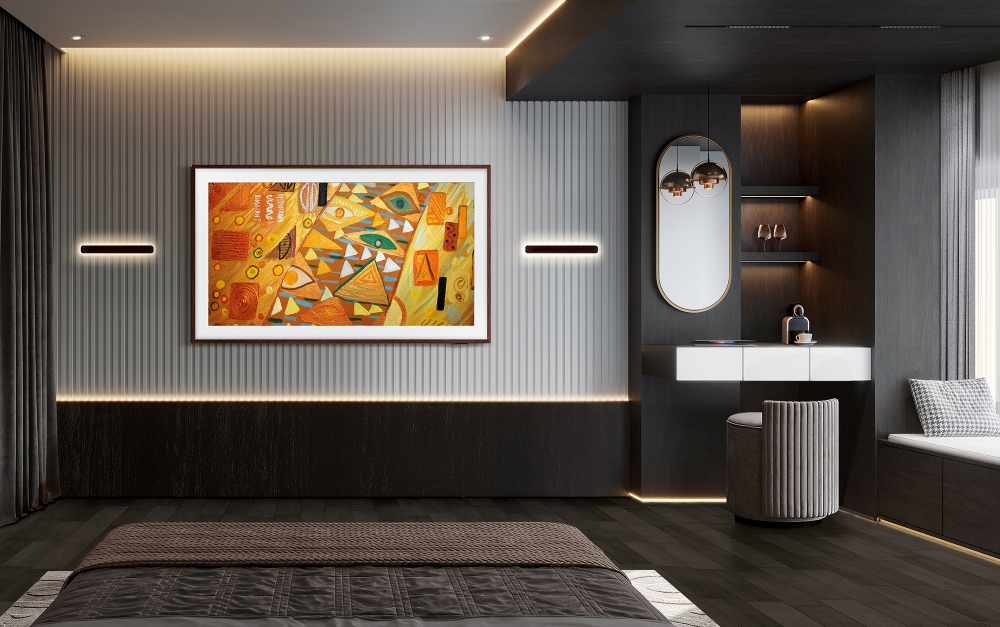
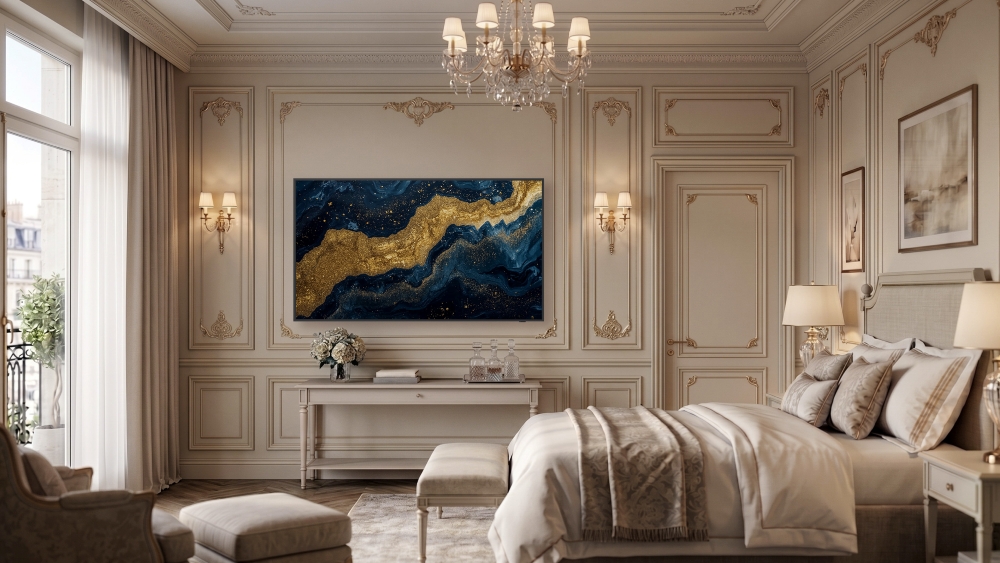
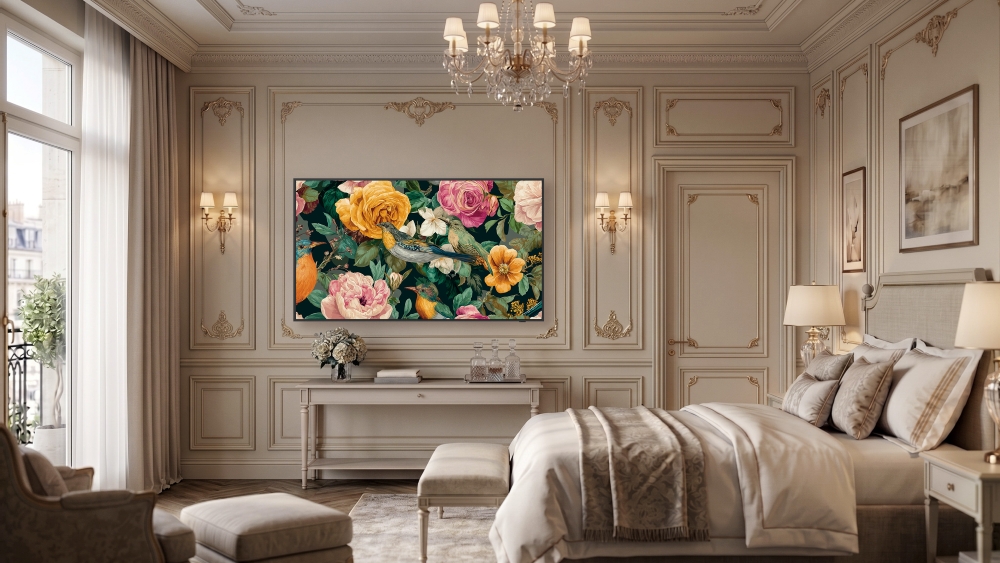
About The Frame
The Frame is Samsung's art television: a flat panel built so that the hours it spends switched off are the hours that earn it a place on the wall. A matte anti-reflection screen, an interchangeable bezel, a motion sensor that wakes the panel when somebody walks into the room, and a store of artwork to fill it. Samsung splits the line in two. The Frame is the QLED version, sold from small kitchen sizes up to 65 inches, with the smallest model at Full HD rather than 4K. The Frame Pro is the Neo QLED version, sold at 65 inches and above, with a wireless connection box in place of a wired one. Everything below applies to both unless stated.
Key specifications
Display
| Screen finish | Matte, anti-reflection |
|---|---|
| HDR formats | HDR10, HDR10+, HLG (no Dolby Vision) |
Art
| Art Mode sensors | Motion sensor and ambient brightness sensor |
|---|---|
| Art source | Samsung Art Store, plus personal photographs |
Installation
| Wall mount | Slim-fit near-flush mount included |
|---|---|
| Bezels | Interchangeable, sold separately |
| Connections | Separate connection box; wireless on The Frame Pro |
What the matte screen buys, and what it costs
The matte layer is the whole idea. A glossy panel in a lit room mirrors the window opposite it, which is fatal for a still image meant to read as a print. A matte finish scatters that light instead, and reviewers consistently report that artwork on The Frame reads as a painting rather than as a screen showing a picture of one.
The cost lands on moving pictures in a dark room. Trusted Reviews found the edge-lit local dimming only fair, with a blue cast in dark borders and peak brightness around 667 nits on the model it measured. Tech Advisor found visible backlight in the letterbox bars of widescreen films. The layer that kills reflections also lifts the black floor, so a film watched with the lights off looks flatter here than on a comparable glossy panel.
In a bright living room, which is where most people actually watch television, the trade runs the other way and The Frame holds up better than its specification sheet suggests.
Art Mode and the Samsung Art Store
Art Mode is what happens when you press the power button. Instead of going dark, the panel switches to a still image, then uses a brightness sensor to dim and tint it to match the light in the room. A motion sensor switches the panel off entirely when the room empties, which is what keeps the feature from becoming an electricity bill.
The images come from your own photographs or from the Samsung Art Store. Samsung gives every owner a rotating free selection, currently thirty pieces a month, and sells a subscription for the full catalogue of several thousand works licensed from institutions including The Met and MoMA. Samsung's US site lists that subscription at 4.99 dollars a month. The free tier suits plenty of buyers. The paid one is the difference between a screensaver and a curated wall.
Installation is most of the product
The Frame is sold as furniture, and the installation reflects that. Every model ships with a slim-fit wall mount that holds the panel almost flush to the wall, with a gap measured in millimetres rather than inches. The inputs live in a separate connection box rather than in the television itself, so only one thin cable has to reach the screen. On The Frame Pro that box is wireless, sending video to the panel from up to thirty feet away, which removes the last cable but adds a box that needs its own power.
Bezels are the other half of the look. They attach to the front of the panel and are sold separately, in a range of finishes and widths. Budget for one at the point of purchase. A Frame without a bezel is a black rectangle, which defeats the object.
The Frame against a standard Samsung television
The honest comparison is not against another art television. It is against the ordinary Samsung set one tier up in picture quality at the same outlay. A Neo QLED in that bracket will be brighter, will hold black better, and will not carry a matte layer. If the television lives in a dedicated room and is switched on whenever anyone is in there, that is the better buy and it is not a close call.
The Frame earns its premium in rooms where the television is visible all day and watched for a few hours of it: an open-plan living room, a bedroom, a hallway. What you are paying for is the eighteen hours it is off, not the six it is on.
Who should buy something else
A film enthusiast with a dark room should not buy this. The matte screen lifts black levels, and an OLED set is the direct answer to that problem. Reviewers who tested The Frame said so plainly.
Anyone who needs Dolby Vision should look elsewhere. The Frame supports HDR10, HDR10+ and HLG, and Samsung does not carry Dolby Vision on its televisions, so material mastered for it falls back to a lesser format.
Anyone buying purely on picture quality per pound should take a standard QLED or Neo QLED instead. The bezel, the matte layer and the art licensing are all real costs, and none of them improves the image.
Anyone who cannot wall-mount should think again. The Frame will sit on a stand, but the design assumes plaster. Standing proud on a cabinet, it is an expensive television with slightly worse contrast than its neighbours and none of the effect it was bought for.
Where to buy
Links go to the seller, not through us. We take no commission and these are not affiliate links, so the order below says nothing about who pays what. Prices and stock change constantly, so check on the day.
Reviews
No reviews yet
Nobody has reviewed The Frame here yet.