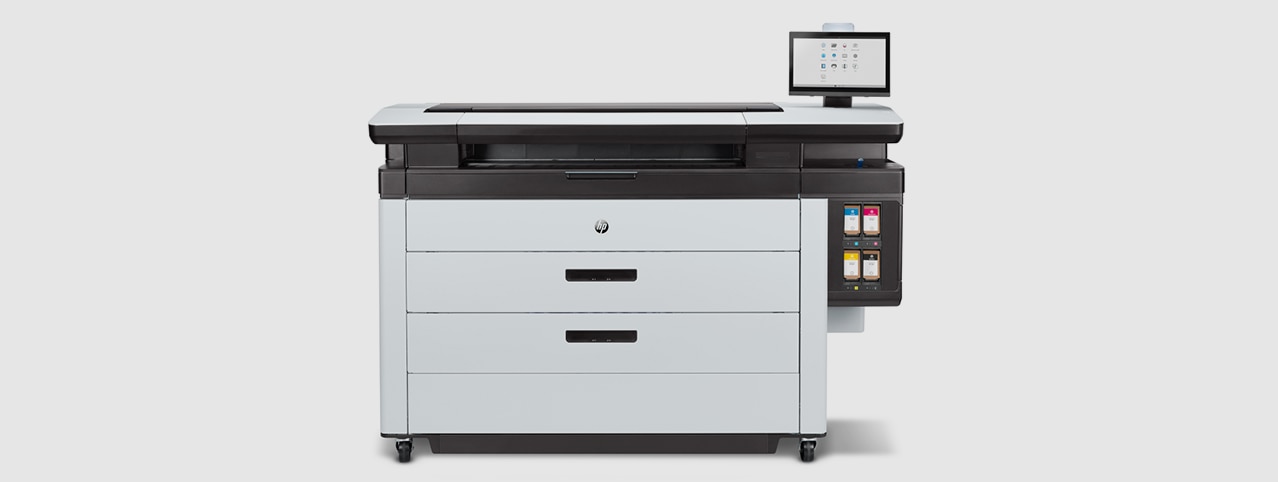
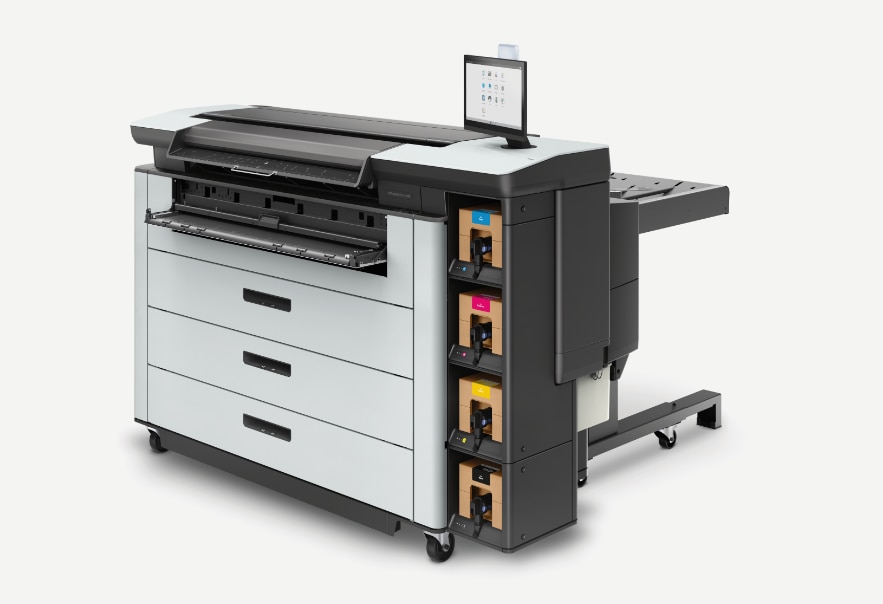
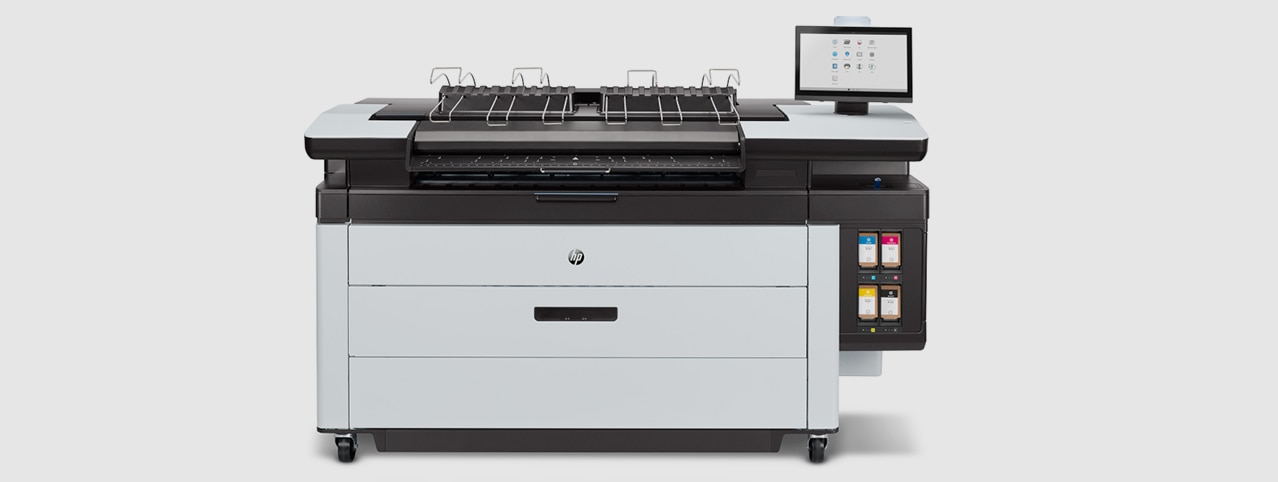
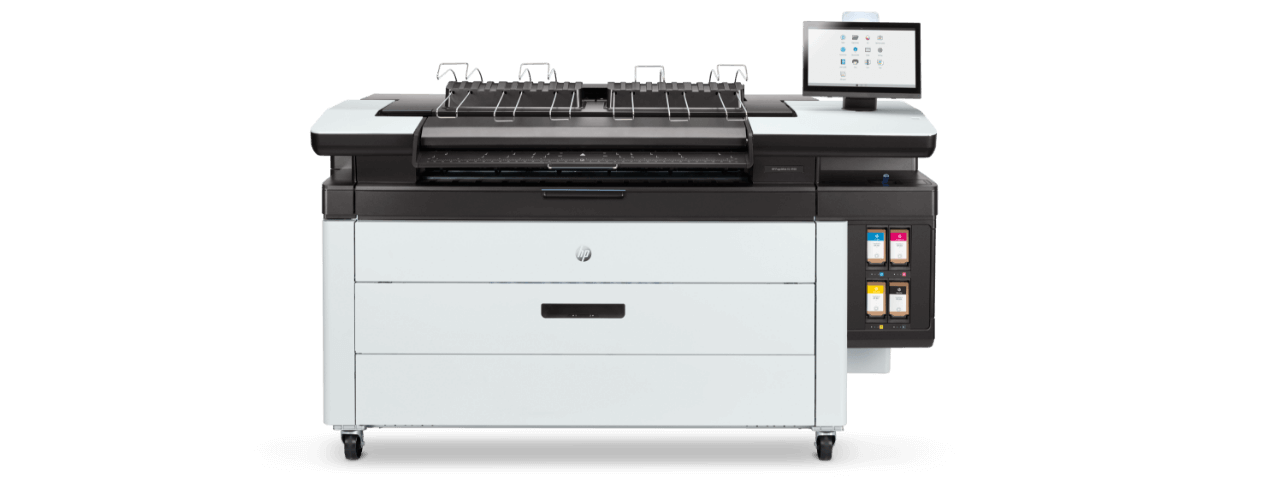
About HP PageWide XL
HP PageWide XL is HP's line of high volume large format printers, sold to reprographics departments, reprohouses and print service providers rather than to individual offices. The defining choice is the print technology. Instead of moving a small printhead back and forth across the sheet, a PageWide XL machine holds a stationary array of printheads that spans the full width of the media and prints in one pass as the paper moves beneath it. That is where the speeds come from, and it is why HP aimed the range at buyers who were running a monochrome LED plotter alongside a separate colour inkjet device. One PageWide XL is meant to replace both, and the whole case for the line rests on whether that consolidation is worth the capital outlay.
Key specifications
Technology
| Print technology | HP PageWide single pass inkjet, with a stationary printhead array spanning the media width |
|---|---|
| Output | Monochrome and colour from the same device |
| Printheads | Lifetime printheads, per HP |
Supplies
| Ink supplies | Carton based HP cartridges, 500 ml to 5 litres depending on model |
|---|
Range
| Technical models | PageWide XL 3950, 4250, 4700, 5200 and 8200 |
|---|---|
| Graphics models | PageWide XL Pro 5200, Pro 8200 and Pro 10000 |
How the single pass design changes the economics
Because the printhead array does not travel, the paper sets the pace rather than the carriage. HP quotes lifetime printheads, so the consumable that dominates running cost is ink rather than head replacement, and the ink arrives in carton based cartridges that run from 500 ml up to 5 litres depending on the model. HP also states that Eco-Carton supplies on the 8200 use more than 60 percent recycled material.
The number HP leans on hardest is that colour and monochrome come off the same machine at comparable quality and comparable cost. For a reprographics room, that removes the routing decision entirely: a drawing set with three coloured sheets in it no longer has to be split across two devices and reassembled by hand. HP claims energy consumption around ten times lower than comparable LED equipment and total cost of ownership savings of up to 50 percent over five years. Those are the maker's own figures and worth checking against your own volumes before they carry any weight in a business case.
The trade is the entry price. A printhead array as wide as the media is a large fixed cost, so these are capital purchases with a service contract attached, not devices you buy on a departmental budget.
The technical printers and the Pro printers
The range splits cleanly into two families and it is worth knowing which one you are being quoted.
The technical printers are the PageWide XL 3950, 4250, 4700, 5200 and 8200, the middle models available as multifunction units with a built in scanner. These are roll fed only, taking four to six rolls, and they exist for CAD drawings, GIS maps and drawing sets produced in quantity. The 8200 sits at the top with up to six spindle-less drawers and automatic roll switching, which is the feature that lets a long queue of mixed sizes run without an operator changing media.
The Pro printers are the PageWide XL Pro 5200, Pro 8200 and Pro 10000. These add rigid and sheet media to the roll handling: the Pro 8200 takes sheets and boards up to 10 mm thick from A2 to B1, and prints on both sides. That is what moves the line from technical documents into short term retail graphics, posters and presentation boards. HP positions the Pro family at print service providers and reprohouses who want to sell graphics work without buying a second class of machine.
What the speed figures actually mean
The speeds are quoted in D or A1 pages per minute, which is the reprographics unit rather than anything comparable to an office printer. The PageWide XL 8200 and Pro 8200 are both rated up to 30 D or A1 pages per minute; the Pro 5200 is rated up to 20. The Pro 8200 is also given an area figure of 500 square metres, or 5,300 square feet, per hour. The Pro 10000 is quoted at up to 700 square metres, around 7,500 square feet, per hour, or 1,000 B1 posters in an hour.
For context on how the line has moved, the first generation ran from 8 pages per minute on the XL 4000 through 12 on the 4500 and 14 on the 5000 to 30 on the XL 8000. The top of the range has not got faster in a decade; what has changed is media handling, colour capability and how much of the queue runs unattended.
That last point matters more than the headline rate. A machine rated at 30 pages a minute that stops for a roll change every fifteen minutes is slower in practice than one rated lower that runs a full shift on its own. Ask about drawer count, automatic roll switching, and the stacking and folding options, because those determine real throughput.
What to weigh against the alternatives
The direct competition is Canon's Oce PlotWave monochrome LED machines and the ColorWave line, plus KIP and Ricoh equipment in the same class. LED still has real arguments in its favour: output is dry as it leaves the machine and tolerates immediate handling and folding, and for a shop with no colour demand at all the entry cost is lower. PageWide XL wins when the work is genuinely mixed, because it removes a whole device from the room.
The other comparison to make is against HP's own DesignJet range, which uses a moving printhead carriage and costs an order of magnitude less. DesignJet is the right answer for lower volumes and for the best colour quality on photographic and fine art work. PageWide XL is not a quality play against DesignJet; it is a throughput play. If your monthly volume does not justify a machine of this class, HP has a cheaper line and you should be looking at it.
Who should buy something else
Any office wanting a plotter in the corner for occasional drawings should not be looking here at all. A DesignJet T series does that job for a fraction of the price and needs no service contract.
Photographic and fine art printers should buy a DesignJet Z or a dedicated photo printer. PageWide XL is engineered around speed on technical media, not around the widest possible colour gamut on coated stock.
Signage shops printing on vinyl, or producing anything intended to survive outdoors, need a different class of machine entirely. HP points that work at its Latex printers, and PageWide XL is a paper and board device.
Pure monochrome operations with tight capital and no prospect of colour demand should price an LED plotter honestly against a PageWide XL rather than assuming the newer technology wins. The consolidation argument only pays if there is colour work to consolidate.
And anyone whose volume sits below a few hundred drawings a month should treat the five year cost claims with care. The savings HP quotes are volume dependent, and below a certain throughput the machine never earns back the difference in purchase price.
Reviews
No reviews yet
Nobody has reviewed HP PageWide XL here yet.