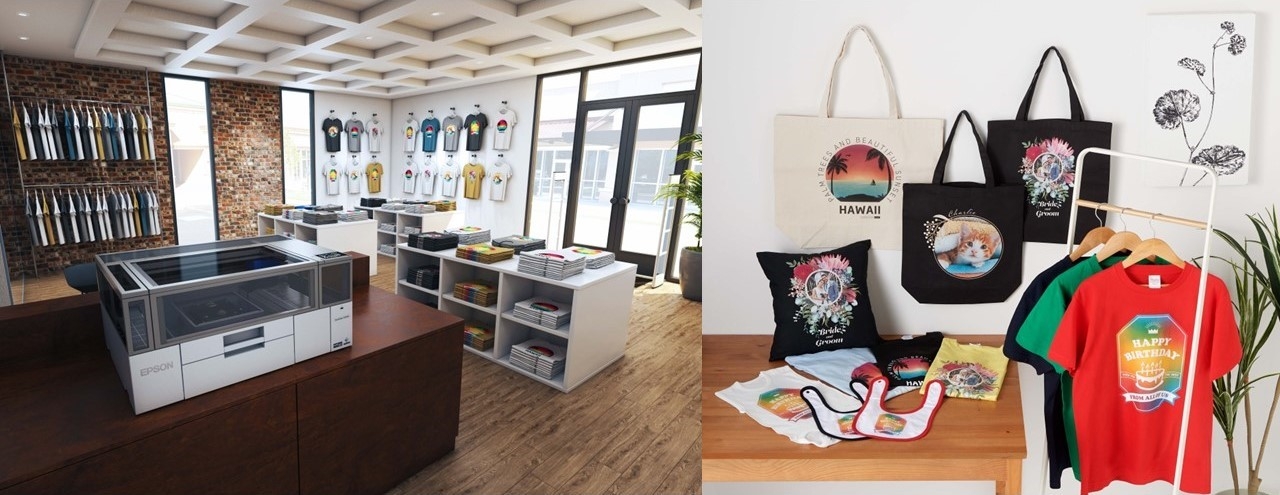
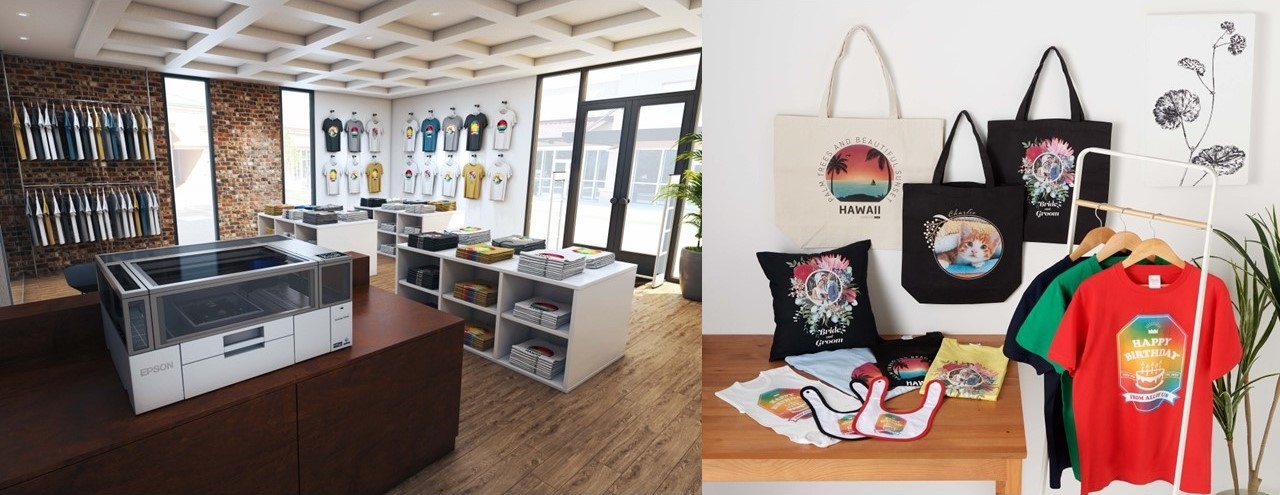
About SureColor F1070
The Epson SureColor F1070 is a compact hybrid direct-to-garment and direct-to-film printer for apparel decorators, entrepreneurs, makers and small print businesses. Epson announced it on January 9, 2024 and confirmed shipping on May 21, 2024. It is the entry point in Epson's current professional garment range, combining DTG and DTFilm capability in a footprint designed for studios and businesses where space and startup cost matter.
Key specifications
Printing
| Printing methods | Direct-to-garment (DTG) and direct-to-film (DTFilm) |
|---|---|
| Printhead | PrecisionCore MicroTFP |
Ink
| Ink | UltraChrome DG2 |
|---|---|
| Ink delivery | Cartridge-free ink pack system |
Workflow
| Software | Epson Garment Creator 2 |
|---|
Support
| Warranty | One-year limited warranty |
|---|
Pricing
| Launch MSRP | $7,495 |
|---|---|
| Business Edition MSRP | $7,995 |
Who should consider the SureColor F1070?
The F1070 is aimed at businesses that want to bring personalized apparel production in-house without moving straight to a larger production platform. Epson specifically targets garment decorators, entrepreneurs, artisan businesses and print service providers. Its hybrid design matters because one printer can handle direct garment work and DTFilm workflows for products or materials that are less suitable for direct printing.
That flexibility can suit a new apparel brand, personalization shop, school maker space or established print business testing a new revenue stream. The strongest case is not simply low volume. It is a workflow where a compact machine, flexible application range and Epson's integrated software and support are more valuable than maximum hourly throughput.
How do DTG and DTFilm change what a shop can sell?
Direct-to-garment printing places the design onto a compatible garment, making it useful for custom shirts and other apparel. DTFilm creates a transfer that can expand the range of materials and product shapes a decorator can serve. Epson positions the F1070 as purpose-built for both methods rather than treating film output as an unofficial workaround.
For a buyer, this means one machine can support different order types, but the downstream workflow is not identical. DTFilm requires the appropriate film, powder, curing and heat-transfer process. DTG jobs have their own garment preparation and curing requirements. Shops should price the complete process, labor and consumables rather than comparing only printer speed.
What does the F1070 improve for small production spaces?
Epson designed the F1070 around a compact, front-loading layout so it can fit more naturally into constrained workspaces. The printer uses a PrecisionCore MicroTFP printhead and UltraChrome DG2 ink, with a cartridge-free ink pack system intended to reduce routine ink replacement compared with small cartridges.
The practical advantage is accessibility rather than claiming production-class scale. A business can dedicate less floor area to the printer while still using a professional Epson garment workflow. That can be important for home studios, retail personalization areas and small commercial units where every work surface competes for space.
What should buyers know about maintenance and workflow?
Garment printing is not a maintenance-free process. White ink workflows in particular reward consistent operation and correct maintenance. Epson designed the F1070 with automated maintenance features and provides Garment Creator 2 software for job preparation, but operators still need a routine for consumables, platen care, pretreatment where required, curing and quality control.
A prospective buyer should map the entire production station before ordering. Printer footprint is only one part of the space requirement. DTG and DTFilm work can require a heat press or other curing equipment, storage for garments and film, pretreatment supplies, finishing space and safe material handling.
How does the F1070 compare with the F2270?
The F1070 is the more accessible and compact option. Epson launched it at a $7,495 MSRP in 2024. Epson's larger F2270 was introduced earlier at a substantially higher $18,995 MSRP and targets shops that need more production capacity and features such as automatic garment thickness adjustment.
A growing business should compare expected daily order volume rather than buying solely on purchase price. If the F1070 can comfortably handle forecast demand, its smaller investment can preserve capital for presses, pretreatment, blanks, marketing and finishing equipment. If orders already justify a higher-throughput garment station, moving up the range may reduce labor and bottlenecks.
What is the SureColor F1070 Business Edition?
In September 2025 Epson added the SureColor F1070 Business Edition as a turnkey package rather than replacing the underlying F1070 printer. Epson listed the Business Edition at $7,995 MSRP and bundled the printer with inks and maintenance supplies intended to help a new apparel business begin production with fewer separate purchasing decisions.
Buyers should therefore distinguish between the base F1070 printer and the Business Edition package when comparing prices. The package can be useful when starting from scratch, while an existing decorator that already owns supporting equipment and supplies may prefer to price the base printer and required consumables separately.
What are the main limitations?
The F1070 is an entry-level professional garment solution, so its compact size is also a capacity decision. Shops with sustained high-volume orders may be better served by a larger Epson garment platform. DTFilm also adds production stages outside the printer, and direct garment work can require pretreatment depending on the garment and ink workflow.
Epson specifies that the printer is designed for use exclusively with Epson ink packs. Buyers should include genuine ink, maintenance items, pretreatment, film, powder, curing equipment, electricity, rejected garments and operator time in their cost-per-print model. The printer purchase price alone does not describe production economics.
Who should choose something else?
Choose a larger garment printer such as the SureColor F2270 when existing order volume makes throughput and production features more important than compact size. A shop focused on dedicated wide-format DTFilm production should compare Epson's G-Series, including the G6070 and G9070, rather than buying a hybrid printer for a job dominated by film transfers.
Businesses producing polyester sportswear, soft signage or dye-sublimated decor should compare Epson's dye-sublimation F-Series models instead. Sign shops working with vinyl and banners belong closer to the S-Series, while direct-to-object printing on rigid goods is better matched to the V-Series UV flatbeds. The F1070 is strongest when flexible, small-footprint garment decoration is the actual business need.
Reviews
No reviews yet
Nobody has reviewed SureColor F1070 here yet.