About App Store
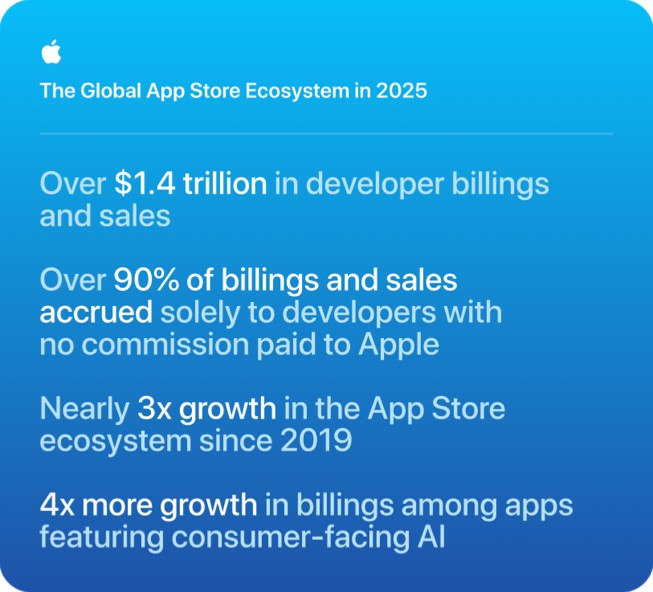
The App Store is the software distribution channel that ships with every Apple device, and in most of the world it is still the only one an iPhone will accept. It is really three businesses stacked together: a catalogue people browse, a review gate every binary passes through, and a payment system that collects money across 175 storefronts and remits the tax afterwards. Apple puts the catalogue at nearly two million apps, reports more than 850 million weekly users, and valued the total billings and sales flowing through the store at 1.4 trillion US dollars in 2025, of which the great majority was physical goods and advertising it takes no commission on. For a business, though, the store is less a place to be listed than a set of terms to sign, and since 2024 those terms have stopped being the same everywhere. Regulators in the European Union, Japan, Brazil and the United States have each pulled the rules in a different direction, so what you owe Apple on a sale now depends on where the buyer lives. This page covers the store as a distribution channel rather than the apps inside it.
What the App Store does that a developer would otherwise have to build
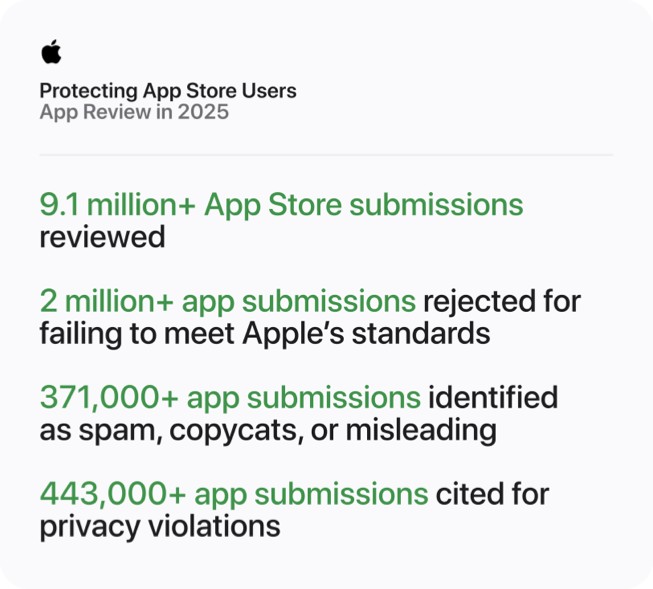
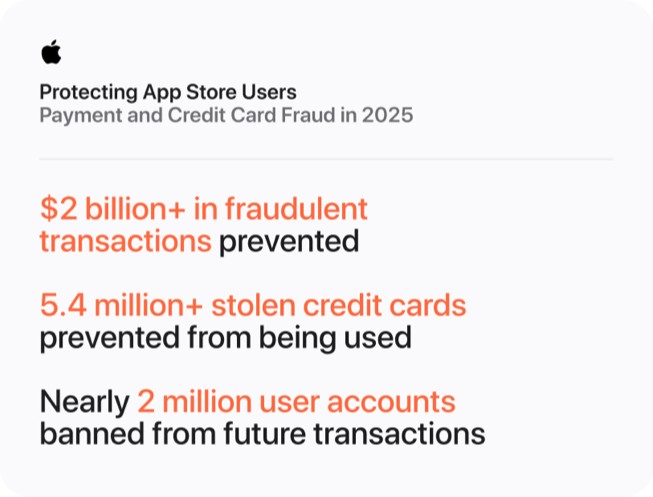
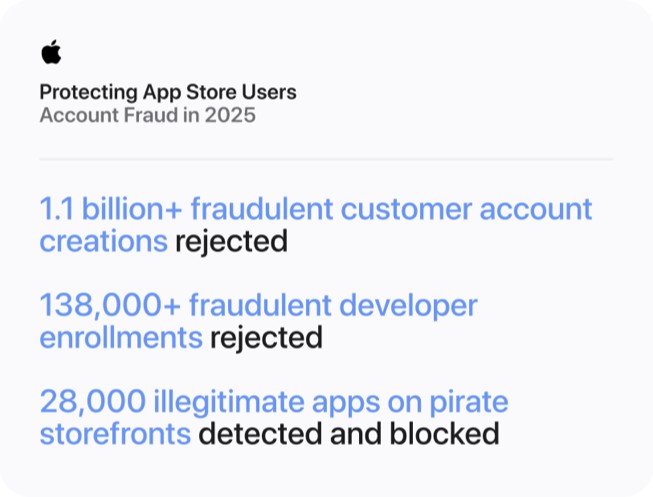
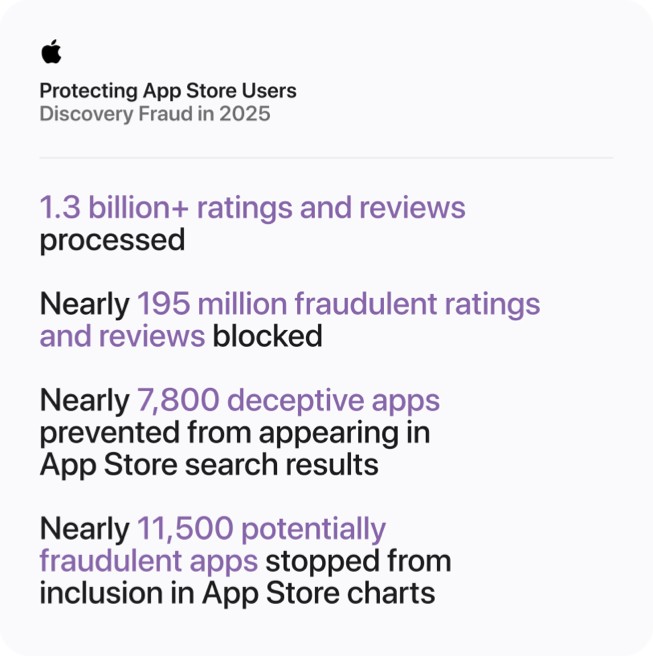
Hosting and worldwide delivery, automatic updates, notarisation and human review, age ratings, ratings and reviews, search and editorial placement, analytics, and billing. The billing is the part people underestimate. Apple acts as merchant of record in most territories, which means it collects the money, remits sales tax and VAT, absorbs refunds and chargebacks, and runs subscription renewals, grace periods and billing retries. Rebuilding that for 175 markets is a finance project, not a feature. The review gate is the other half of the bargain: Apple says nearly 500 reviewers look at more than 130,000 apps a week, that it rejected over 1.9 million submissions in 2024 for reasons including privacy violations and fraud, and that it blocked more than 2.2 billion US dollars of fraudulent transactions in 2025. Whether that gate reads as a service or an obstacle depends entirely on which side of it you are standing.
What does it cost to sell through the App Store?
Outside the regulated markets the structure has not moved. Thirty percent of the sale price is the headline rate. It falls to 15 percent under the Small Business Program, open to developers whose proceeds in the prior calendar year were under one million US dollars, counted across every associated account you control. It also falls to 15 percent from the second year of an auto-renewing subscription. A free app that sells nothing pays only the annual Apple Developer Program membership. Apple also takes no commission at all on physical goods and services sold through an app, which is how it can say that more than 90 percent of the billings it facilitates carry no commission. Those numbers are the reason the regional carve-outs below exist, and they are still what most developers in most countries pay.
How the terms differ between the EU, Japan, Brazil and the United States
In the European Union, Apple moved to a single business model on 1 January 2026, retiring the per-install Core Technology Fee in favour of a 5 percent Core Technology Commission. A sale promoted through a link out of the app carries an initial acquisition fee of 2 percent for the first six months, plus a store services fee of 13 percent for the full set of store features or 5 percent for a listing reduced to a download mechanism with no discovery, updates, reviews or analytics, plus the 5 percent commission. Alternative marketplaces and distribution straight from your own website are both permitted.
Japan followed with the Mobile Software Competition Act, implemented in iOS 26.2 in December 2025. Apps there can use alternative marketplaces, third-party payment processors inside the app, or links out to a browser, and Apple In-App Purchase has to be offered alongside any of them. The Japanese rates are 21 percent on digital goods, 10 percent for Small Business Program members, Mini Apps, Video Partner participants and second-year subscriptions, plus 5 percent for Apple payment processing when you use Apple billing. Out-of-app offers attract 15 percent, or 10 percent for programme members, on sales within seven days of the tap. Members had to accept the revised licence agreement by 17 March 2026.
Brazil is the newest. Under an agreement with the competition authority CADE, announced on 18 June 2026 and shipping with iOS 26.5, developers there can distribute through authorised alternative marketplaces, offer alternative payment processing inside the app, or link out to the web. Apps distributed outside the store go through notarisation, an automated and human check covering security and basic function, rather than full App Review. The rates track Japan closely: 10 or 21 percent commission on digital goods, 5 percent more for Apple payment processing, 15 percent store services on web-linked sales or 10 percent for programme members, and the same 5 percent Core Technology Commission for anything distributed off the store.
In the United States the position comes from litigation rather than legislation. Developers can link out to external purchases, and Apple is not currently taking a cut of those sales: the Ninth Circuit reversed Apple's stay in April 2026 and the Supreme Court declined to grant one in May, leaving the district court to work out what a reasonable fee would be. Price your US business on the assumption that the answer will not be zero forever.
App Store or Google Play, and are the alternative marketplaces real yet?
Google Play is the only channel of comparable scale, and the useful comparison is not the fee schedule but whether a second route exists at all. On Android, sideloading and rival stores have always been available, so Play is one option among several. On iOS the alternatives are new and small. The EU now has AltStore PAL, the Epic Games Store, Aptoide, Mobivention and Skich, and Onside has been available in Japan since 17 February 2026. Aptoide takes 10 to 20 percent and Skich takes 15. None of them publishes install figures that would justify treating them as a primary channel, and Setapp Mobile closed in February 2026, blaming terms it called still evolving and complex. Treat alternative iOS distribution in 2026 as a hedge and a negotiating position, not a plan.
Who should distribute somewhere else?
Anyone shipping software to their own staff rather than the public. Internal tools belong in Apple Business Manager and custom distribution, where the review gate and the commission are beside the point.
Anyone whose margin is thinner than 15 percent. If you resell physical goods, run a marketplace, or make money on a spread, the commission arithmetic does not work and no regional carve-out fixes it. The good news is that Apple does not take a cut of physical goods and services, which is why so many of those businesses live happily in the store as free apps and bill elsewhere.
Anyone whose customers buy on the web first. If people sign up on a desktop and the app is only the client, you may never need Apple billing at all, and that has been the quiet strategy of most large subscription businesses for years.
Anyone whose business model would not survive review. Emulators, alternative browsers before the recent rule changes, and anything skirting the payment rules have all had years of unpredictable outcomes. Read the guideline before writing the app, not after.
What to check before committing to the App Store as your only channel
Establish which entity is merchant of record in each market you sell into, and price the tax and refund handling you would otherwise build yourself. Confirm which agreement you are actually on, because in four jurisdictions the fee you pay now depends on which addendum you signed rather than on a single published rate. Model your pricing against the worst regional outcome instead of the best one. Watch the regulators rather than the release notes, since every change of the last two years arrived from a court or a competition authority first. And check whether your product genuinely needs in-app purchase at all, because the cheapest commission remains the one you never trigger.
Reviews
No reviews yet
Nobody has reviewed App Store here yet.