Updated 27 August 2026. The best TVs for sports in 2026 are not simply the brightest or most expensive models. For football, basketball, NFL, UFC and other live events, the most useful traits are clear motion, strong glare control, enough brightness for the room, a viewing angle that works for your seating layout, and good upscaling for HD broadcasts.
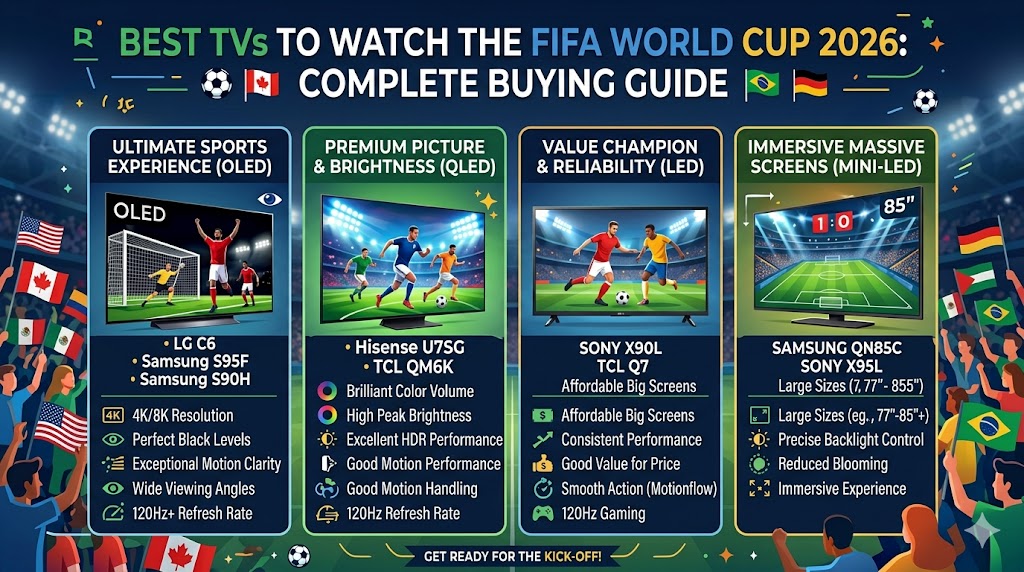
Short answer: the Samsung S95H is the strongest premium all-rounder in our current shortlist, the LG C6 is the more approachable OLED choice, and the Hisense U7SG, TCL QM7K and Hisense U65QF cover bright-room, mid-range and budget needs.
Methodology: Brandligo has not independently lab-tested these TVs. To identify the best TVs for sports in 2026, we reviewed current manufacturer specifications and current independent testing, especially RTINGS’ August 2026 sports-TV guide and TechRadar’s current sports-TV guide. We use those sources to compare motion, reflections, viewing angles, processing and value without presenting third-party test results as our own.
What matters most in a TV for sports?
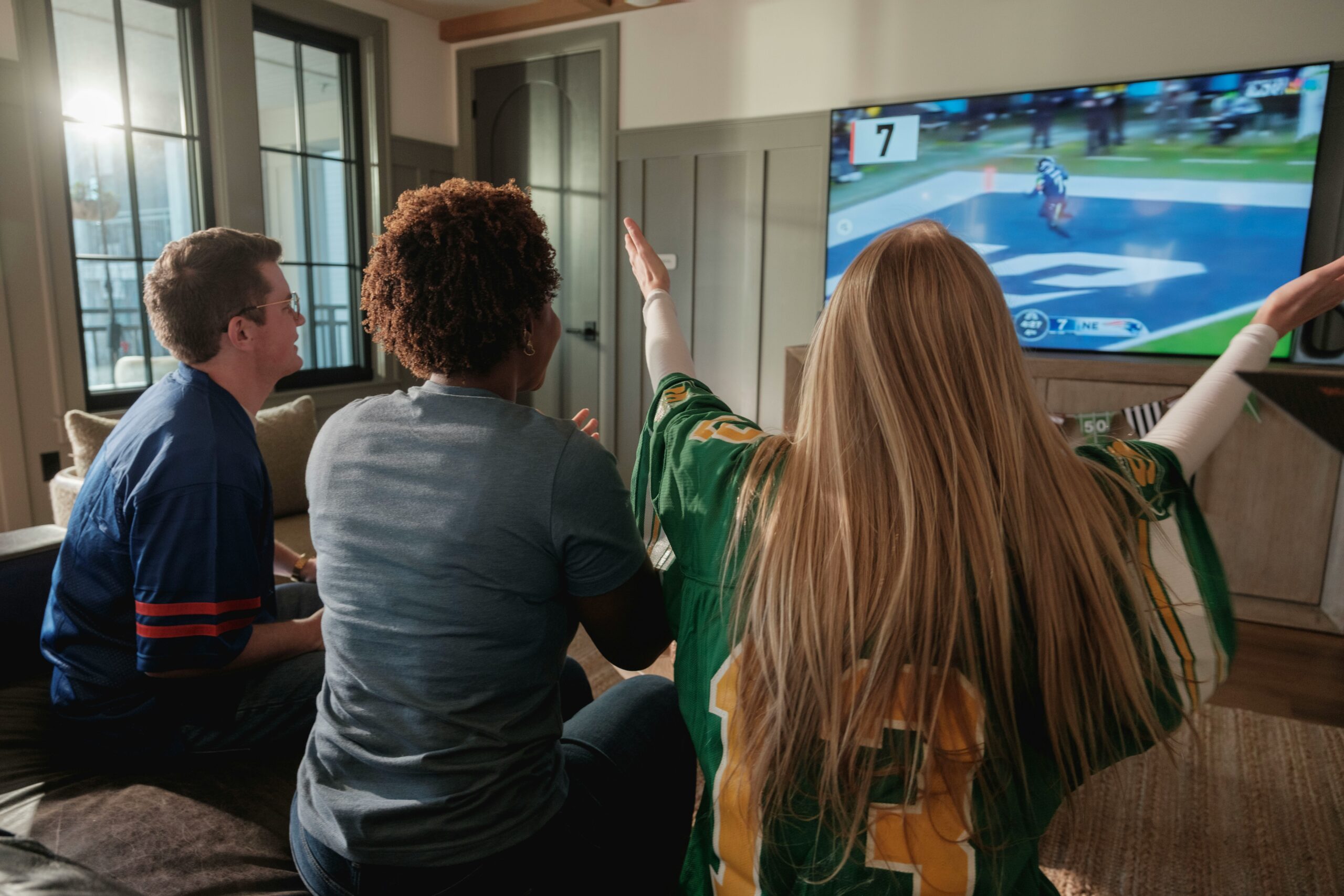
Motion clarity matters more than a headline refresh-rate number
A 120Hz-class panel is a useful target on premium sports TVs, but it is not a requirement for a 50/60fps broadcast feed. What matters just as much is response time and motion processing. Fast camera pans expose weak processing quickly, especially around players, the ball and score graphics.
Brightness and reflection handling matter in daytime rooms
Sports are often watched with lights on, curtains open and several people in the room. That makes glare control unusually important. A brighter Mini-LED TV can be easier to watch in a sunny room, while newer premium OLEDs such as Samsung’s S95H combine high OLED contrast with strong anti-reflection treatment.
Viewing angle matters for groups
Viewing angle varies by model. OLED panels generally preserve color and contrast better off-axis than many VA-based LCD TVs, although premium LCD models can narrow the gap with wide-angle layers and better panel design. If people will sit across a wide sofa or around the room, do not judge a TV only from the center seat.
Upscaling matters because live sports are not always native 4K
A premium panel cannot restore detail that never reaches it, but a good processor can make HD cable and streaming feeds look cleaner on a large 4K screen. RTINGS specifically treats upscaling as an important sports-TV factor, which is one reason current OLED flagships and better Mini-LED sets separate themselves from cheaper models.
If you are deciding between display technologies, our OLED vs QLED vs Mini-LED comparison explains the trade-offs in more detail.
Best TVs for sports in 2026: quick comparison
| Model | Best for | Panel | Main strength for sports | Main limitation |
|---|---|---|---|---|
| Samsung S95H | Best overall premium pick | OLED | Glare control, wide viewing angle, motion and upscaling | High price; no Dolby Vision |
| LG C6 | Best OLED value | OLED | Wide viewing angle, strong processing and 2026 feature set | Glossy reflections can matter in very bright rooms |
| Hisense U7SG | Best bright-room mid-range pick | Mini-LED | High brightness and anti-reflection treatment | Narrower viewing angle than OLED |
| TCL QM7K | Best lower-mid-range alternative | QD-Mini LED | Strong brightness and local dimming for the money | Off-angle performance is not its strongest trait |
| Hisense U65QF | Best budget pick | Mini-LED QLED | 144Hz-class gaming support, local dimming and good value | Less premium processing and viewing-angle performance |
1. Samsung S95H — best overall for sports
Samsung’s S95H is its 2026 flagship OLED. Samsung lists the 55-inch model at $2,499.99, the 65-inch at $3,399.99, the 77-inch at $4,499.99 and the 83-inch at $6,499.99 at the time of this update. Manufacturer pricing can change, so check Samsung’s current listing before buying.
For sports, the important features are the Glare Free screen, NQ4 AI Gen3 processor, Motion Xcelerator 165Hz support and AI Soccer Mode Pro. RTINGS currently places the S95H at the top of its sports recommendations because it combines reflection handling, a wide viewing angle, strong motion performance and good upscaling.
Choose it if: you regularly watch sports in a bright room with a group and want a current flagship rather than a value-focused model.
Skip it if: price matters more than squeezing out the best overall sports performance. The LG C6 and Hisense U7SG are easier value propositions.
2. LG C6 — best OLED value
LG’s 2026 C6 OLED starts at $1,399 in the United States. LG says the range spans 42 to 83 inches and uses its Alpha 11 AI Processor Gen3, with Dolby Vision, Dolby Atmos and 4K VRR support up to 165Hz.
The C6 is a strong sports choice for viewers who want OLED’s wide seating flexibility without paying S95H money. RTINGS currently recommends the C6 as its upper-mid-range sports option and specifically calls out its upscaling and wide viewing angle. The main compromise is reflection handling: direct light can be more distracting than on Samsung’s matte S95H.
Choose it if: you want OLED contrast, good processing and a wide seating layout at a lower starting price than Samsung’s flagship.
Skip it if: your TV faces strong windows or lamps all day. A bright Mini-LED or the S95H may be easier to see.
3. Hisense U7SG — best bright-room mid-range pick
Hisense positions the 2026 U7SG as a Mini-LED model built for fast-moving content and live sports. The US range spans 55 to 116 inches. Hisense advertises up to 3,000 nits peak brightness on supported sizes, anti-reflection treatment and sports-oriented processing, while RTINGS lists a 165Hz native refresh rate for the model it tested.
The reason to choose the U7SG is straightforward: it is built around brightness and glare control. That is useful for afternoon games and rooms with windows. The trade-off is viewing angle, so it fits a centered sofa better than a room where people sit far to either side.
Choose it if: brightness, value and daytime viewing matter more than the widest possible seating angle.
Skip it if: you host large watch parties with seats spread across the room. OLED is more forgiving off-axis.
4. TCL QM7K — best lower-mid-range alternative
TCL’s QM7K is a QD-Mini LED series available from 55 to 115 inches. TCL’s official specifications highlight its Halo Control System, up to 2,500 local dimming zones on supported sizes, HDR brightness rated up to 3,000 nits and a CrystGlow HVA panel designed to reduce reflections.
RTINGS currently recommends the QM7K as a lower-mid-range sports TV. It is not as strong as the U7SG for every bright-room situation, but it gives buyers another path to Mini-LED brightness without stepping into OLED pricing.
Choose it if: you want a large, bright Mini-LED TV and the current price is meaningfully below the U7SG.
Skip it if: wide viewing angles and the strongest upscaling are higher priorities than price.
5. Hisense U65QF — best budget pick
The Hisense U65QF is the budget-oriented Mini-LED option in this shortlist. Hisense’s official US page lists Mini-LED local dimming, QLED color, its Hi-View AI Engine and 144Hz Game Mode Pro. RTINGS currently recommends it as its budget sports pick.
This is the model to look at when you want to move beyond a basic LED TV without spending mid-range OLED money. It gives you useful brightness and local dimming, but you should still expect compromises in processing, off-angle viewing and overall refinement compared with the more expensive models above.
Choose it if: you want a current budget Mini-LED for sports and value matters most.
Skip it if: you watch from wide angles or expect premium upscaling from low-quality cable feeds.
OLED or Mini-LED for sports?
Neither technology wins every room. OLED is usually the safer choice for wide seating, deep blacks and evening viewing. Mini-LED usually gives you more brightness for the money and can be the better fit for sunny rooms.
- Bright room, centered seating: Hisense U7SG or TCL QM7K.
- Wide seating arrangement: Samsung S95H or LG C6.
- Budget first: Hisense U65QF.
- Premium bright-room OLED: Samsung S95H.
Five settings to check before a match
- Start with a reasonably accurate picture mode. Movie, Cinema, Filmmaker or a well-tuned Standard mode is usually a better baseline than an aggressively saturated Sports preset.
- Use motion smoothing conservatively. Increase it only until camera pans look clear without obvious halos or interpolation artifacts.
- Match brightness to the room. Daytime viewing may need a higher backlight or OLED pixel-brightness setting than nighttime viewing.
- Check your source quality. Confirm the streaming app, cable box or external device is outputting the best resolution and frame rate it supports.
- Keep sharpening moderate. Excessive sharpness can add artificial outlines around players, score graphics and field markings.
Complete the sports setup
If dialogue is hard to hear over crowd noise, our best soundbars for sports in 2026 guide compares options by center-channel clarity, eARC support and room fit. If you are choosing between a very large TV and a projector, see our projector vs TV comparison.
You can also explore Brandligo’s company profiles for Samsung, LG Electronics and TCL when comparing the companies behind these products.
Frequently asked questions
What is the best TV for sports in 2026?
Among the best TVs for sports in 2026, the Samsung S95H is the strongest premium all-rounder in this guide because it combines glare control, a wide viewing angle, strong motion handling and good upscaling. The LG C6 is the more affordable OLED option, while the Hisense U7SG is a better fit for buyers prioritizing bright-room value.
Is OLED or Mini-LED better for football?
OLED is usually better for wide seating and dark-room contrast. Mini-LED usually gives you more brightness for the money and is often easier to watch in a sunny room. The best choice depends more on your room than on the panel label alone.
Do I need a 165Hz TV for sports?
No. Higher refresh rates are useful for gaming and can accompany better motion processing, but live sports feeds are typically delivered at much lower frame rates. Motion clarity and processing matter more than buying a TV solely because it advertises 165Hz.
Should I buy a 2025 TV at a discount or a 2026 model?
Compare the actual features and current price. An outgoing flagship can be excellent value if it still has the glare control, processing, ports and panel quality you need. A newer model is worth paying more for only when its improvements matter to your room or use case.
What screen size is best for sports?
There is no universal size. Seating distance, room width, resolution and how many people watch together all matter. For group viewing, a larger screen can help people seated farther away, but do not sacrifice glare control or viewing angle just to gain inches.