About DRAM
Samsung DRAM is not one part but four families built on the same fabs and sold to four different kinds of customer. DDR goes into PCs and servers, LPDDR into phones, laptops, edge devices and cars, GDDR into graphics cards, and HBM into the accelerators that train and run AI models. Nobody walks into a shop and buys Samsung DRAM. It is designed in, years ahead, by a handset maker, a server builder or a chip designer, and the buying decision turns on qualification, supply commitment and roadmap rather than on any single figure.
Samsung is the largest DRAM maker in the world by revenue share and has been for most of the industry's history, but that leadership is not evenly spread across the four families. The company's position in commodity DDR and in mobile LPDDR is strong and improving. Its position in HBM, the smallest of the four by volume and the most profitable by some distance, is third. Understanding this line means understanding that split, because it is the single fact that shapes how Samsung is judged as a memory supplier right now.
The four DRAM families and what each is for
DDR is the general purpose part, the memory in a desktop, a laptop and the bulk of the world's servers. It is sold in enormous volume at thin margins, and its price swings on the memory cycle rather than on any one product decision.
LPDDR is the low power branch, built to hold state without draining a battery. Samsung's published range now runs from LPDDR4 through to LPDDR6, which it rates at up to 14.4 Gbps with densities from 16 Gb to 128 Gb. LPDDR5X sits below it at up to 10.7 Gbps and up to 192 Gb. Samsung also lists automotive grade versions of LPDDR4, LPDDR4X, LPDDR5 and LPDDR5X, which matter because a car qualifies parts on a much longer timescale than a phone does.
GDDR is the graphics branch, tuned for the wide, predictable streaming a GPU does rather than the random access a CPU does.
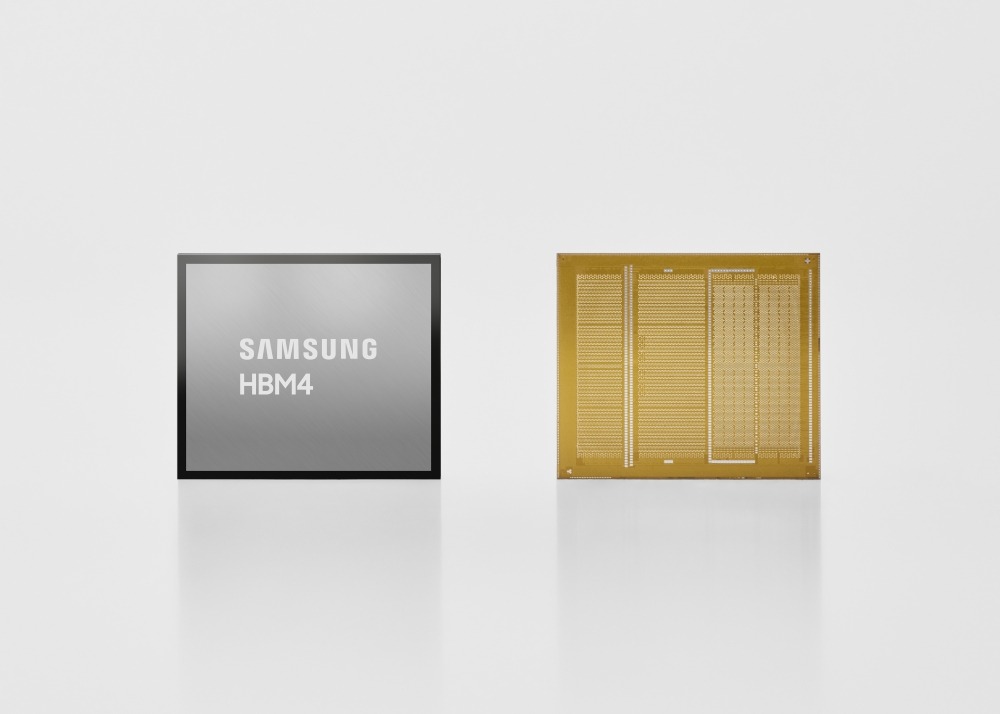
HBM is the one everybody is watching. Instead of sitting on a board next to the processor, it is stacked vertically and placed on the same package, which shortens the distance data has to travel. Samsung lists HBM3E at 24 and 36 GB with up to 1,180 GB/s per stack, HBM4 at 36 GB in a 12 high stack with up to 3,300 GB/s, and HBM4E at up to 64 GB in a 16 high stack with 4 TB/s. Those bandwidth numbers are why an AI accelerator costs what it costs.
Where Samsung sits against SK hynix and Micron
In overall DRAM, Samsung leads. Counterpoint Research put Samsung at 38 percent of the DRAM market in the first quarter of 2026, with SK hynix at 29 percent and Micron at 22 percent. By the second quarter of 2026 the same tracking had Samsung at 39 percent, SK hynix at 26 percent and Micron at 25 percent, a widening lead that analysts attributed to strong conventional DRAM demand and pricing alongside a growing HBM position.
In HBM the ranking inverts. Counterpoint put SK hynix at 58 percent of HBM in the first quarter of 2026, with Samsung and Micron both at 21 percent. Earlier data had been worse for Samsung: figures cited by Chosun Biz for the second quarter of 2025 showed SK hynix at 62 percent, Micron at 21 percent and Samsung at 17 percent, which put Samsung third in the segment it needs most.
The direction of travel is the useful part. SK hynix is losing share from a very high base, having fallen from 69 percent a year earlier, and Samsung is climbing. Whether that continues is the open question of the next two years.
Why HBM decides how this line is judged
Commodity DRAM is a cyclical business where the winner is whoever has the most capacity at the lowest cost, and Samsung has generally been that company. HBM is different. It is qualified per customer and per accelerator, the qualification takes a long time, and the incumbent supplier is hard to displace once a design is locked. That is why losing HBM share hurts more than the volume suggests.
HBM4 is the reset point. It is a generation change where every supplier has to requalify, which is the clearest opening Samsung has had to take share back. Samsung has the financial scale and the customer relationships to fund it, and has resumed construction on its P5 fab to support HBM4 volume. Whether the parts qualify on schedule at the accelerator makers is the thing to watch, and it is not something a specification sheet will tell you.
Who this line is for
This is a components line, so the buyers are engineering and procurement teams rather than end users. Four groups matter.
Handset and laptop makers buy LPDDR, and choose largely on power per bit and on whether Samsung can commit volume through a product cycle.
Server and hyperscale builders buy DDR in bulk, and care about price, supply security and having a second source.
Accelerator designers buy HBM, and care about qualification status, thermal behaviour in a stack and delivery dates far more than about headline bandwidth.
Automotive suppliers buy the automotive grade LPDDR parts, and care about temperature range and the length of time Samsung will keep making the part, because a car platform outlives a phone by a decade.
Who should buy something else
Look elsewhere if you need HBM in volume for a design shipping soon. SK hynix is the incumbent at most of the accelerator makers and holds the majority of the segment, and switching supplier late in a design is not a purchasing decision, it is a respin.
Look elsewhere if you are a consumer trying to buy memory. Samsung sells DRAM chips to manufacturers. The retail modules on a shop shelf are assembled and branded by module makers, some of whom use Samsung chips and some of whom do not, and the brand on the heatspreader tells you very little about the die underneath.
Look elsewhere if your requirement is a single unusual part rather than a family. Samsung's strength is scale across a broad catalogue, and a niche density, an unusual package or a very long lifetime commitment is often served better by a supplier that specialises in exactly that.
And treat any market share figure on this page as a snapshot. DRAM share moves several points a quarter on pricing alone, and the HBM ranking in particular is being actively contested.
Reviews
No reviews yet
Nobody has reviewed DRAM here yet.