About Azure HDInsight
Azure HDInsight is Microsoft's managed cluster service for running established open-source big data frameworks on Azure. It is aimed at teams that need Spark, Hadoop, Kafka, HBase, Hive or Interactive Query workloads without building every cluster component from scratch. HDInsight is most useful when an organization already has Hadoop ecosystem skills, needs compatibility with those frameworks, or must operate long-running analytics and streaming workloads that fit the cluster model. It is not the default choice for every new analytics project because Microsoft also offers newer managed data platforms with different operational models.
What is included
Service model
| Managed frameworks | Apache Spark, Hadoop, Kafka, HBase, Hive and Interactive Query workloads |
|---|
Lifecycle
| Current supported HDInsight version | HDInsight 5.1 |
|---|
Data architecture
| External storage | Supports Azure Blob Storage and Azure Data Lake Storage for durable data |
|---|
Security
| Identity and network integration | Microsoft Entra ID, Azure Virtual Network and encryption support |
|---|
Operations
| Monitoring | Integrates with Azure Monitor logs |
|---|
Pricing
| Billing model | Usage-based cluster node billing; underlying Azure resources and some workload-specific charges apply |
|---|
What workloads fit Azure HDInsight?
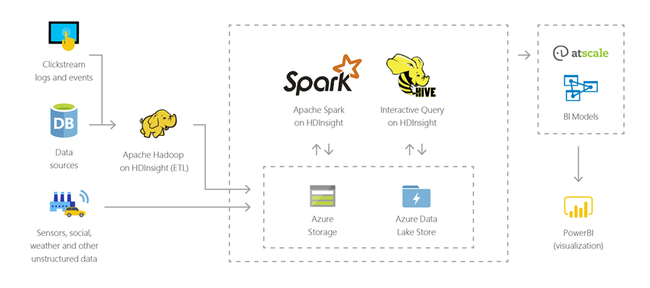
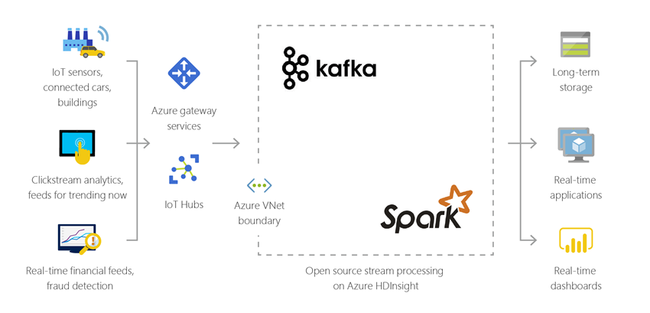
HDInsight supports managed clusters for Apache Spark, Hadoop, Kafka, HBase and Interactive Query workloads. Typical use cases include large-scale batch processing, ETL, data engineering, streaming ingestion, distributed analytics and data processing over information stored in Azure Storage or Azure Data Lake Storage. The service is designed around open-source ecosystem compatibility, so teams can continue using familiar tools and languages rather than rewriting every workload for a proprietary engine.
The strongest fit is usually an existing Hadoop ecosystem workload that needs Azure hosting, governance and integration. A team moving Spark or Kafka workloads from self-managed infrastructure may value HDInsight because Microsoft handles much of the cluster provisioning and Azure integration while the team keeps control over its framework-level jobs and configuration.
Which open-source technologies does HDInsight support?
Microsoft's current HDInsight overview lists Apache Spark, Apache Hive, Interactive Query with LLAP, Apache Kafka, Apache HBase and Apache Hadoop among the core supported frameworks. HDInsight clusters also include supporting ecosystem components such as Ambari, Avro, Hive, HCatalog, Hadoop MapReduce, YARN, Phoenix, Pig, Sqoop, Tez, Oozie and ZooKeeper depending on cluster type and version.
Developers can use languages including Java, Python, .NET and Go, while JVM-based languages can also be used where supported by the framework. This breadth is useful for organizations that already have jobs, libraries and operational knowledge tied to the Hadoop ecosystem.
How does HDInsight scale and separate compute from storage?
HDInsight clusters can be scaled up or down by changing cluster capacity, and Microsoft positions on-demand cluster creation as a way to control cost for workloads that do not need to run continuously. A common architecture keeps durable data in Azure Blob Storage or Azure Data Lake Storage while cluster compute is created for processing and removed when no longer needed.
This separation matters operationally. Deleting a cluster can stop cluster compute charges while data stored in external Azure storage remains available. Teams should still plan for framework metadata, checkpoints, Kafka disks and any other state that must survive cluster deletion. A cluster should not be treated as the only copy of business data.
What is the current HDInsight lifecycle?
Microsoft continues to support HDInsight 5.1. Microsoft's component retirement guidance lists HDInsight 5.1 as the current supported version and does not currently announce a support expiration or retirement date for that version. Older HDInsight 5.0 and 4.0 releases reached support expiration and retirement on March 31, 2025.
This makes version planning important for existing customers. Teams still tied to retired versions should move to the supported release rather than assuming an older cluster remains a suitable long-term platform. Buyers should also verify component versions inside the current HDInsight release because Spark, Kafka, HBase and related open-source projects have their own compatibility and lifecycle considerations.
How does HDInsight pricing work?
Pricing checked: August 28, 2026. Microsoft prices HDInsight around the cluster nodes and their underlying Azure virtual machines. Clusters are billed according to the number and type of nodes and how long those nodes run. Some workload types can also carry additional HDInsight charges, and Kafka requires managed disks that are billed separately.
Microsoft's pricing page shows the service as a usage-based cluster model rather than a flat monthly subscription. Actual cost varies by region, VM family, node count, storage, networking, cluster type and agreement. Buyers should model a representative cluster in the Azure pricing calculator and include external storage, managed disks and data transfer rather than comparing only a nominal node rate.
What security and monitoring controls are available?
Microsoft documents integration with Azure Virtual Network, encryption and Microsoft Entra ID as core HDInsight security capabilities. HDInsight also integrates with Azure Monitor logs so teams can centralize cluster monitoring and operational telemetry.
For enterprise deployments, network design, identity, storage access and administrative permissions should be planned before clusters are created. Teams should confirm whether workloads need private connectivity, restricted outbound access, enterprise identity integration, key management or specific compliance controls. The framework itself can also introduce security requirements, especially for Kafka, HBase and Hadoop ecosystem services that expose multiple endpoints and administrative surfaces.
What are the operational limitations buyers should understand?
HDInsight reduces cluster setup work, but it does not remove the need to operate the open-source frameworks running inside the cluster. Teams still need to understand partitioning, job tuning, framework configuration, capacity, failure behavior and version compatibility. This is materially different from a serverless analytics service where users submit work without managing a persistent cluster topology.
Cost can also become inefficient when clusters stay running while lightly used. Microsoft specifically advises customers to delete HDInsight clusters when they want compute billing to stop. Persistent data should therefore live in external Azure storage, and external metadata stores should be considered where Hive metadata must survive cluster deletion.
How does HDInsight compare with newer Azure analytics options?
HDInsight is best understood as a managed home for established Hadoop ecosystem frameworks rather than Azure's only analytics platform. Azure Databricks is often a stronger choice for organizations centered on a modern managed Spark and lakehouse experience. Microsoft Fabric can be more suitable when teams want a broader SaaS analytics environment spanning data engineering, warehousing and business intelligence. Azure Event Hubs is an ingestion service rather than a processing cluster, while Azure Stream Analytics offers a managed stream-processing model that avoids operating Kafka or Spark clusters for simpler real-time transformations.
The right choice depends on portability requirements, existing code, staff skills and how much cluster administration the organization wants to retain.
Who should choose something else?
Teams building a new analytics platform without existing Hadoop ecosystem dependencies should compare newer managed services before selecting HDInsight. If the main requirement is a managed Spark lakehouse, Azure Databricks may provide a more focused experience. If the goal is an integrated SaaS analytics platform with data engineering and BI, Microsoft Fabric may reduce infrastructure work. If the workload only needs event ingestion, Event Hubs is a more direct service, and if it needs straightforward real-time SQL-style processing, Azure Stream Analytics can be simpler.
HDInsight remains relevant when compatibility with Spark, Hadoop, Kafka, HBase or Hive is the deciding requirement and the team is comfortable operating those frameworks. Buyers should choose it for that specific need rather than simply because it is an Azure analytics service.
Reviews
No reviews yet
Nobody has reviewed Azure HDInsight here yet.