About Azure CycleCloud
Azure CycleCloud is Microsoft's HPC orchestration application for teams that want to build and operate scheduler-based high performance computing environments on Azure without replacing the scheduler workflows they already know. It sits above Azure compute, networking and storage resources and helps administrators define cluster topology, deploy scheduler and compute nodes, autoscale capacity for queued work, and reproduce environments from templates. Microsoft positions CycleCloud for traditional HPC administrators and users who need infrastructure orchestration, while Azure Batch is the sibling service for teams that prefer a scheduler-as-a-service model. As of August 31, 2026, Microsoft's current 8.x release notes list CycleCloud 8.9.3 as the current version, released August 28, 2026.
What is included
Workload
| Primary use | Orchestration and management of HPC and big-compute environments on Azure |
|---|
Schedulers
| Documented scheduler support | Slurm, PBS Pro, LSF, Grid Engine and HTCondor, with extensibility for other workload managers |
|---|---|
| OpenPBS integration | CycleCloud 8.9 includes the azpbs agent for heterogeneous OpenPBS clusters including hybrid environments |
Scaling
| Autoscaling | Adjusts cluster resources based on scheduler job load, capacity availability and time requirements |
|---|
Deployment
| Application model | Installable web application that can run on premises or on an Azure virtual machine |
|---|---|
| Recommended Azure install | Azure Marketplace virtual machine image |
Automation
| Interfaces | Web interface, built-in CLI and REST API |
|---|
Operations
| Event integration | Azure Event Grid integration for events such as Spot VM eviction and node allocation failure |
|---|
Security
| Azure Storage access | CycleCloud 8.9 supports managed identity based access for the orchestrator and CycleCloud Locker access |
|---|
Lifecycle
| Current version | CycleCloud 8.9.3, released August 28, 2026 |
|---|---|
| Microsoft lifecycle status | In support under the Modern Lifecycle Policy as checked August 31, 2026 |
Pricing
| CycleCloud application | Microsoft describes the application as free; Azure infrastructure and dependent services are billed separately |
|---|
What is Azure CycleCloud used for?
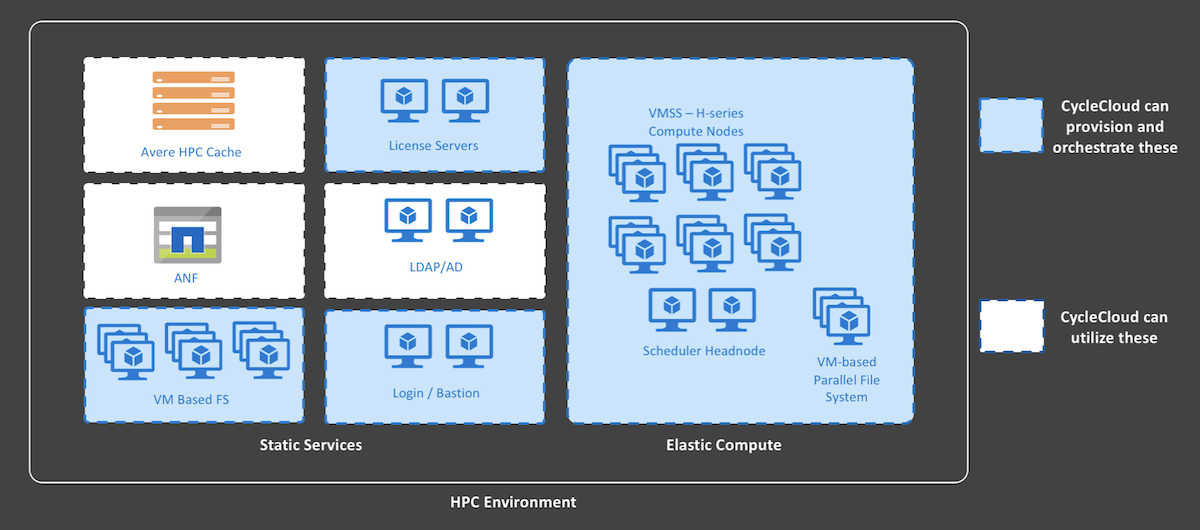
Azure CycleCloud is designed for high performance computing and big compute environments that need coordinated compute, storage, networking and scheduler infrastructure. Microsoft documents it as an orchestration and management tool that can deploy complete HPC systems rather than only individual virtual machines. A CycleCloud environment can include scheduler head nodes, compute nodes, file services, networking, authentication components, license services and other supporting resources.
This is useful for engineering simulation, scientific computing, research, rendering and other workloads where jobs are submitted to an HPC scheduler and the amount of compute needed changes over time. CycleCloud does not replace the scheduler. Its role is to give administrators a repeatable way to create, scale and manage the Azure infrastructure that the scheduler and jobs require.
Which schedulers does Azure CycleCloud support?
Microsoft's current CycleCloud documentation lists standard HPC schedulers including Slurm, PBS Pro, LSF, Grid Engine and HTCondor, and documents extensibility for other schedulers or workload managers through autoscaling interfaces and APIs. Microsoft also documents HPC Pack integration in the CycleCloud 8.x release highlights.
CycleCloud 8.9 expands scheduler support through the azpbs agent for OpenPBS. Microsoft describes azpbs as a configuration-based agent for heterogeneous OpenPBS clusters, including hybrid environments that span on-premises and cloud resources. That matters for established HPC teams because migration to Azure does not necessarily require replacing a scheduler model that users and administrators already understand.
How does CycleCloud autoscaling work?
CycleCloud adds autoscaling around scheduler demand. Microsoft states that clusters can automatically adjust size and components according to job load, capacity availability and time requirements. When users submit work to the scheduler, the environment can add or remove Azure compute instead of keeping a fixed cluster at full size continuously.
Autoscaling can reduce idle compute cost, but it does not guarantee capacity or the lowest possible bill. HPC teams still need to select suitable VM families, quotas, regions, storage, networking and scaling limits. Large tightly coupled jobs can be sensitive to placement and capacity, so production designs should account for regional availability and workload start-time requirements rather than assuming every scale-out request will be fulfilled immediately.
How are CycleCloud clusters deployed and customized?
CycleCloud uses declarative templates to define HPC environments. Microsoft provides templates for supported schedulers and common infrastructure patterns, and administrators can customize topology, node types, storage, networking, software configuration and other choices for a workload.
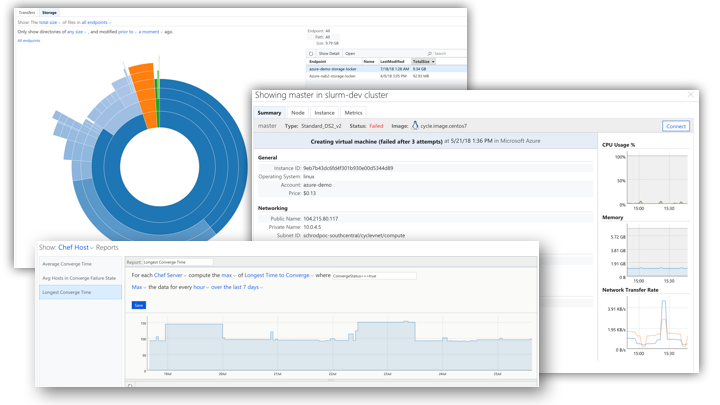
Microsoft also provides a REST API and built-in CLI, which makes CycleCloud suitable for teams that want to connect cluster operations to existing automation. CycleCloud also integrates with Azure Event Grid so teams can react to events such as Spot VM eviction or node allocation failure. This makes the product an orchestration layer that can participate in broader operational workflows rather than an isolated cluster console.
How is Azure CycleCloud installed and secured?
CycleCloud is an installable web application rather than a fully hosted Azure control plane. Microsoft says it can run on premises or on an Azure virtual machine. The recommended Azure quickstart uses the Azure Marketplace image, while manual installation remains available when administrators need more control.
The application server must be treated as part of the customer's managed environment. Production teams should plan authentication, network access, backup, patching, upgrades and administrative access for the CycleCloud server itself. Microsoft's current 8.9 documentation also describes managed identity support for Azure Storage access, allowing identity-based access to replace Shared Access Key access for the CycleCloud orchestrator and CycleCloud Locker access used by cluster nodes.
What changed in CycleCloud 8.9.3?
Microsoft lists Azure CycleCloud 8.9.3 as the current 8.x version, released August 28, 2026. Microsoft describes it as a security-focused maintenance release rather than a change to the core HPC operating model.
The release resolves an issue where CycleCloud could remove Virtual Machine Scale Set extensions that users or external automation such as Azure Policy had added when a node array was resized. It also fixes automatic population of the Full Name field for users authenticated through Microsoft Entra. Microsoft lists multiple resolved CVEs in the 8.9.3 notes, so administrators should treat version maintenance as an active operational responsibility rather than leaving the CycleCloud server indefinitely on an older build.
What does Azure CycleCloud cost?
Pricing was checked on August 31, 2026. Microsoft's Marketplace installation guidance describes Azure CycleCloud itself as a free application. Customers still pay for the Azure resources that CycleCloud creates and uses, including virtual machines, disks, networking, storage services, monitoring and any other dependent resources in the cluster design.
There is therefore no responsible single price for a CycleCloud cluster. Cost depends on VM family, node count, run time, storage architecture, region, data movement and other services. CycleCloud can show approximate ongoing cluster costs and tags virtual machines so cluster and node costs can be surfaced in Microsoft Cost Management, but buyers should model the full HPC architecture rather than focusing only on the orchestration application.
What does Microsoft's lifecycle policy mean for CycleCloud administrators?
Microsoft lists Azure CycleCloud as in support under the Modern Lifecycle Policy. Under that policy, customers must stay current with published servicing and system requirements, remain licensed to use the product, and use a version for which Microsoft currently offers support.
For CycleCloud this matters because the product is software that customers deploy and operate. Security updates and maintenance releases can require administrator action. Microsoft states that security update notifications are made when the updates become available and recommends adopting security updates immediately. Organizations should therefore include CycleCloud in their normal patching, testing, backup and rollback process instead of assuming Azure will update the application server automatically.
How does CycleCloud integrate with Azure services?
Microsoft documents integration with Azure Monitor and Microsoft Cost Management, and current release documentation also highlights Azure Event Grid and identity-based Azure Storage access. CycleCloud-managed HPC environments can use Azure services such as Azure NetApp Files or other storage options depending on workload requirements, and the service manages Azure virtual machines and scale sets as flexible compute resources.
These integrations make CycleCloud the orchestration layer rather than a replacement for compute, storage, identity or monitoring services. Each dependent Azure service still has its own regional availability, performance characteristics, quotas and billing, so those parts of the architecture should be evaluated separately.
What are the main limitations and operational considerations?
CycleCloud is not a job scheduler and does not remove the need for HPC administration. Teams still need scheduler expertise plus an architecture for networking, storage, identity, software licensing, user access and workload data. The amount of operational work is therefore higher than with a scheduler-as-a-service approach.
The CycleCloud application server also needs an upgrade and security-maintenance process. Current release notes reinforce this responsibility because Microsoft continues to ship maintenance and security releases such as 8.9.3. Organizations should define version-management, backup and rollback procedures and should test scheduler, cluster template and policy behavior before promoting an application-server update into production.
How does Azure CycleCloud compare with Azure Batch?
CycleCloud and Azure Batch address overlapping compute-heavy workloads but use different operating models. Microsoft describes Azure Batch as a scheduler-as-a-service option, while CycleCloud is aimed at traditional HPC administrators who want to deploy and manage environments built around a specific scheduler such as Slurm or PBS Pro.
CycleCloud is the stronger fit when an organization has existing scheduler expertise, custom cluster topology, tightly coupled MPI workloads, hybrid scheduler needs or direct infrastructure requirements. Azure Batch can be a better fit for developers building batch-processing workflows who do not need to preserve a traditional HPC scheduler and cluster-management model.
Who should choose something else?
A team should choose something else if it does not need a traditional scheduler-based HPC environment. Azure Batch is worth considering when the main requirement is managed batch job execution rather than operating a familiar HPC scheduler. Azure Kubernetes Service can be more appropriate when workloads are already containerized and the organization has standardized on Kubernetes orchestration.
Teams that only need a fixed set of Azure virtual machines may also find CycleCloud unnecessary. Its value increases when clusters need scheduler integration, templates, autoscaling and coordinated HPC infrastructure. Buyers should also avoid selecting it only because a workload is compute intensive. The real question is whether they need the cluster and scheduler operating model that CycleCloud is built to manage.
Reviews
No reviews yet
Nobody has reviewed Azure CycleCloud here yet.