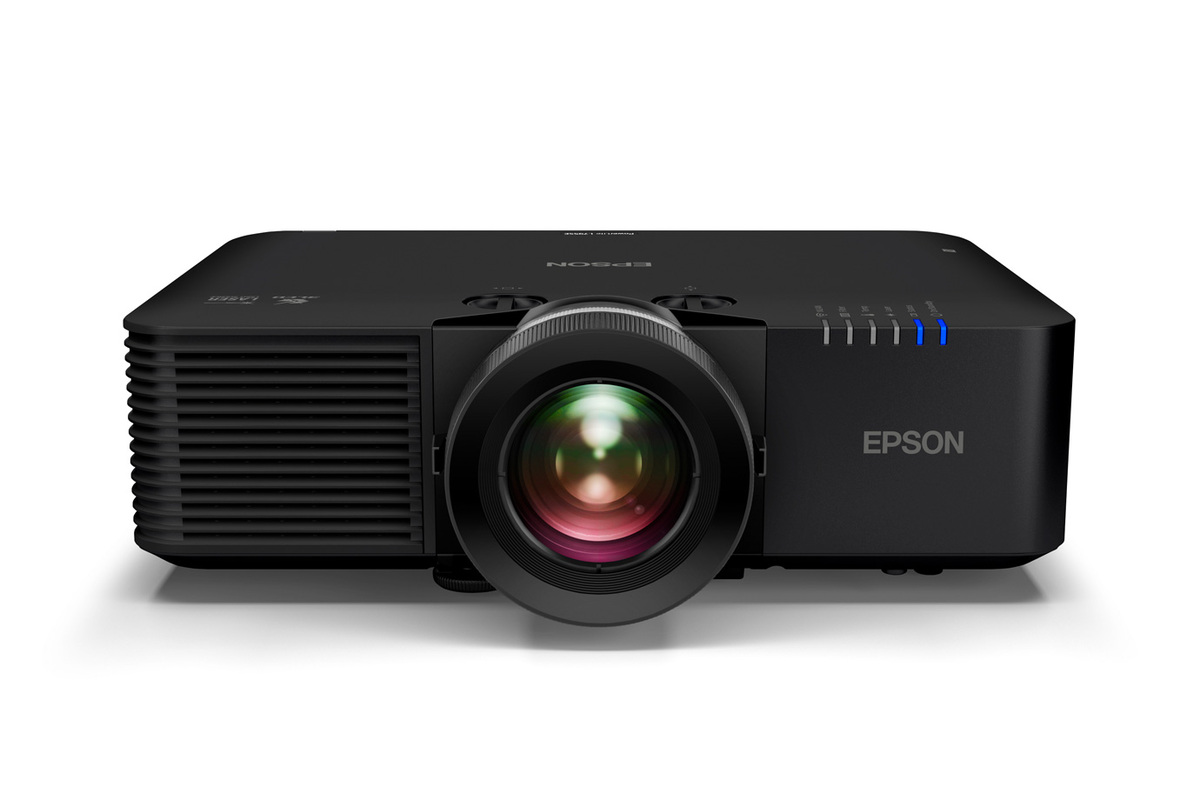
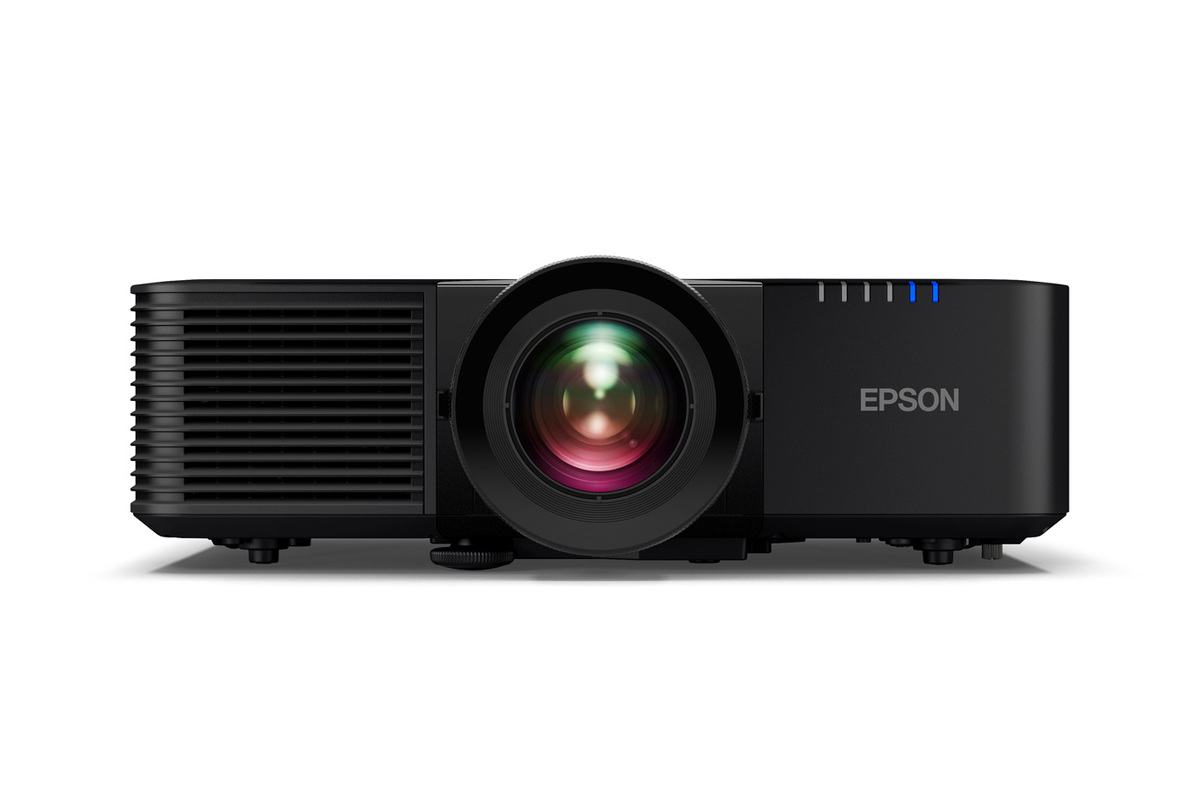
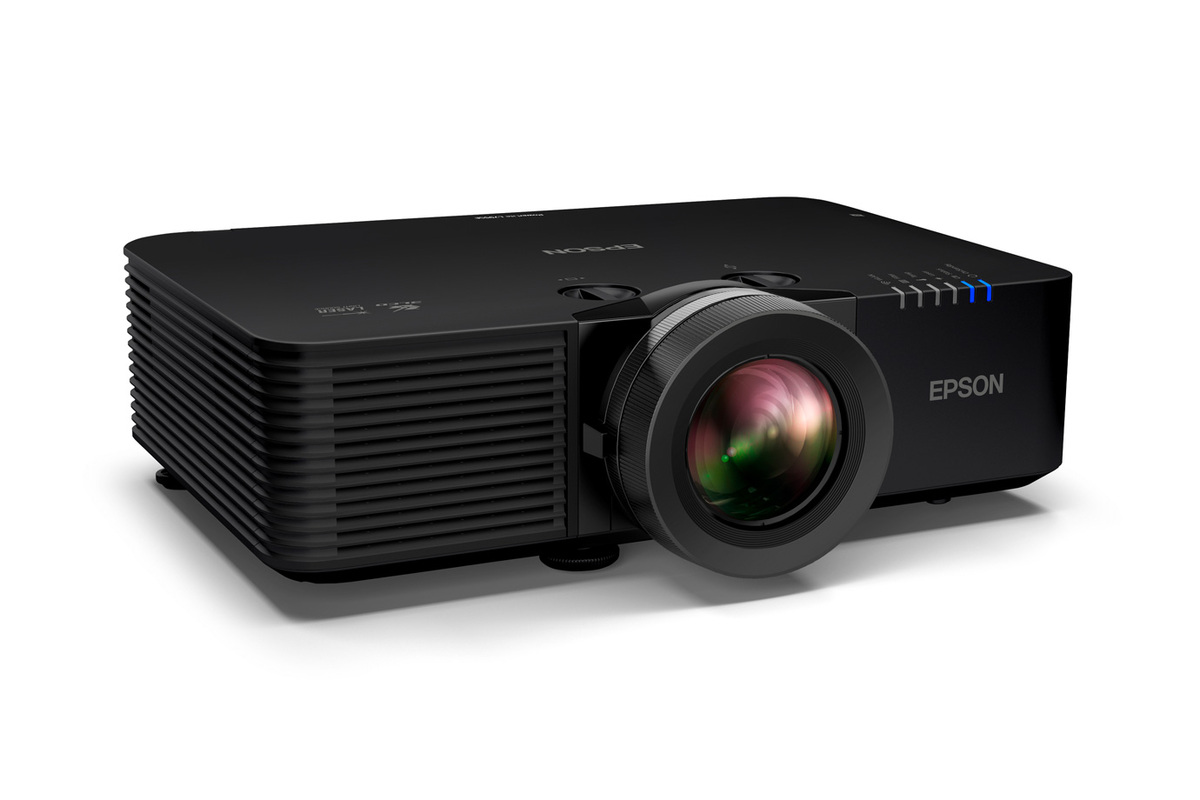
About PowerLite L695SU
The Epson PowerLite L695SU is a 6,200-lumen short-throw laser projector built for professional spaces that need a large image without placing the projector deep into the room. Epson introduced it in February 2025 as part of its refreshed PowerLite L-Series and confirmed availability through authorized resellers in June 2025. It combines 3-chip 3LCD imaging, native WUXGA 1920 x 1200 output, a 0.79 to 1.36 throw ratio and 1.7x optical zoom. Epson positions it for conference rooms, hybrid workspaces, golf simulation, museums and other installations where placement flexibility matters. The L695SU uses a black chassis, while its closely related L690SU sibling serves similar technical needs in a different finish.
Key specifications
Imaging
| Display technology | 3-chip 3LCD |
|---|---|
| Color brightness | 6,200 lumens |
| White brightness | 6,200 lumens |
| Native resolution | WUXGA 1920 x 1200 |
| Maximum accepted signal | Up to 4K |
Projection
| Throw type | Short throw |
|---|---|
| Throw ratio | 0.79 - 1.36 |
| Optical zoom | 1.7x |
| Maximum display | Up to 400 inches diagonal in 16:10 |
| Ultra-wide formats | 16:6 and 21:9 |
Light source
| Type | Laser |
|---|---|
| Maintenance interval | Up to 30,000 hours Extended Mode; 20,000 hours Normal Mode |
Connectivity
| Wireless | Wi-Fi 6/6E |
|---|---|
| Wireless sharing | Apple AirPlay 2, Miracast and Epson iProjection |
| Wired AV | HDBaseT; HDMI two inputs and one output |
Installation
| Configuration | Built-in NFC; optional PixAlign camera support |
|---|---|
| Mounting | 360-degree mounting and universal VESA mounting pattern |
Model
| Epson model number | V11HB31120 |
|---|
What makes the PowerLite L695SU useful?
The L695SU sits between Epson's very short-throw L695SE and standard-throw L-Series models. Its 0.79 to 1.36 throw ratio lets installers create a large image from less distance than a standard-throw projector, while the 1.7x optical zoom gives useful flexibility when matching an existing screen or ceiling position. Epson rates both color and white brightness at 6,200 lumens. That level is intended for professional rooms where some ambient light may remain, although screen size, surface, room lighting and content all affect perceived contrast. The projector can produce a 16:10 image up to 400 inches and also supports 16:6 and 21:9 formats.
WUXGA resolution and 4K input explained
Epson specifies native WUXGA 1920 x 1200 output for the L695SU. It accepts an input signal up to 4K, but buyers should not confuse signal compatibility with native 4K projection or Epson's 4K Enhancement feature. The L695SU displays at WUXGA. For presentations, dashboards, teaching material, simulation and many business video uses, WUXGA can provide a practical balance of detail and performance. Buyers who specifically want Epson's 4K Enhancement should compare the L695SE or other L-Series models carrying that feature rather than choosing this model on the basis of its accepted input signal.
Installation flexibility
The short-throw lens is the central reason to consider this model. Epson pairs the 0.79 to 1.36 throw ratio with 1.7x optical zoom, wide vertical and horizontal lens shift, 360-degree mounting, geometric correction and a universal VESA mounting pattern. Built-in NFC can help installers configure multiple projectors using Epson's Projector Config Tool app. Epson also supports an optional PixAlign camera for more complex multi-projector work such as screen matching, color calibration, blending assistance and stacking. These tools can simplify an installation, but they do not replace measuring throw distance, screen size and mounting geometry before purchase.
Wireless sharing and AV connectivity
The L695SU includes Wi-Fi 6/6E and works with Epson iProjection, Miracast and Apple AirPlay 2. Epson also supports remote fleet monitoring through Projector Management Connected. For fixed AV systems, HDBaseT and HDMI connectivity provide wired alternatives, including two HDMI inputs and an HDMI output for supported daisy-chain and monitoring workflows. Wireless sharing is convenient for meeting and teaching environments, but organizations should still evaluate network security, authentication and reliability requirements before making wireless casting the primary presentation path.
Maintenance and laser life
Epson rates the laser light source and air filter for up to 30,000 hours in Extended Mode and up to 20,000 hours in Normal Mode before the stated maintenance interval. Epson explains that the light-source figure is an approximate period until brightness falls to 50 percent of initial output under its test assumptions, so it should not be interpreted as unchanged brightness for the full period. The practical advantage over older lamp projectors is reduced routine lamp replacement, especially for organizations managing many rooms. Usage mode, airborne particulate levels and operating conditions can change real-world maintenance needs.
PowerLite L695SU vs L690SU and L695SE
The L695SU and L690SU share the same core 6,200-lumen WUXGA short-throw specification, including the 0.79 to 1.36 throw ratio and 1.7x zoom, so buyers should compare finish and deployment requirements rather than expect a large image-quality difference from the model number alone. The L695SE is a different proposition. It uses a shorter 0.5 to 0.7 throw ratio, produces 6,000 lumens and adds Epson's 4K Enhancement technology. The L695SE can be a better fit when the projector must sit substantially closer to the screen or enhanced image detail is more important than the L695SU's slightly higher rated brightness.
Price and buying context
Epson US currently lists the PowerLite L695SU at $4,661, although its direct product page may show it as out of stock while Epson states the 2025 L-Series is available through authorized resellers. Institutional, education and reseller pricing can differ from Epson's listed price. Buyers should budget beyond the projector itself for the screen, mount, cabling, installation labor and any external audio or control hardware. Epson also offers special education pricing through its Brighter Futures program, so schools should compare program and reseller quotes rather than treating the public list price as the final project cost.
Who should choose something else?
Choose the L695SE when the installation needs the shorter 0.5 to 0.7 throw ratio or Epson's 4K Enhancement. Choose a standard-throw L-Series model such as the L690U when the room has sufficient projection distance and short throw provides no practical benefit. Spaces that need more light output should compare Epson's 7,000- and 8,000-lumen L-Series options. Home cinema buyers should look to Epson's residential projector ranges, which prioritize cinematic features rather than commercial installation tools. In smaller meeting rooms, a commercial flat panel may also be simpler when the required image is modest and users value instant everyday operation over projection scale.
Reviews
No reviews yet
Nobody has reviewed PowerLite L695SU here yet.