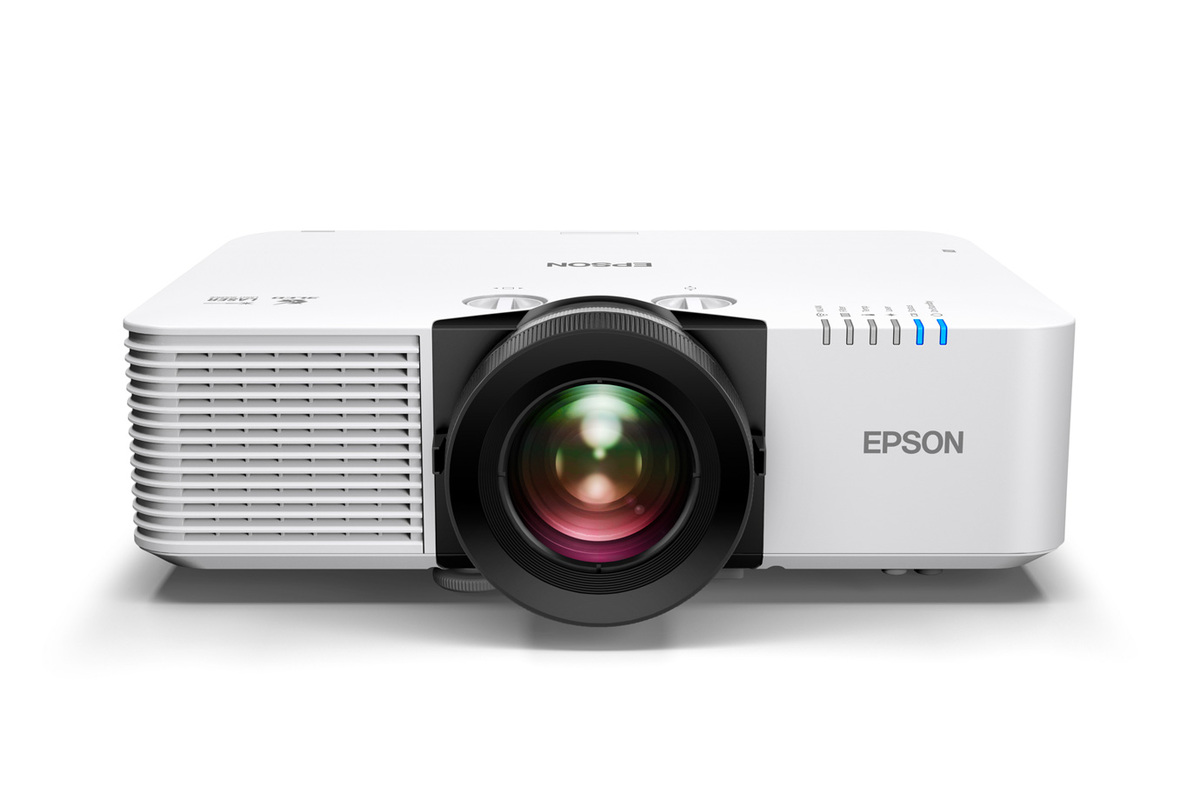
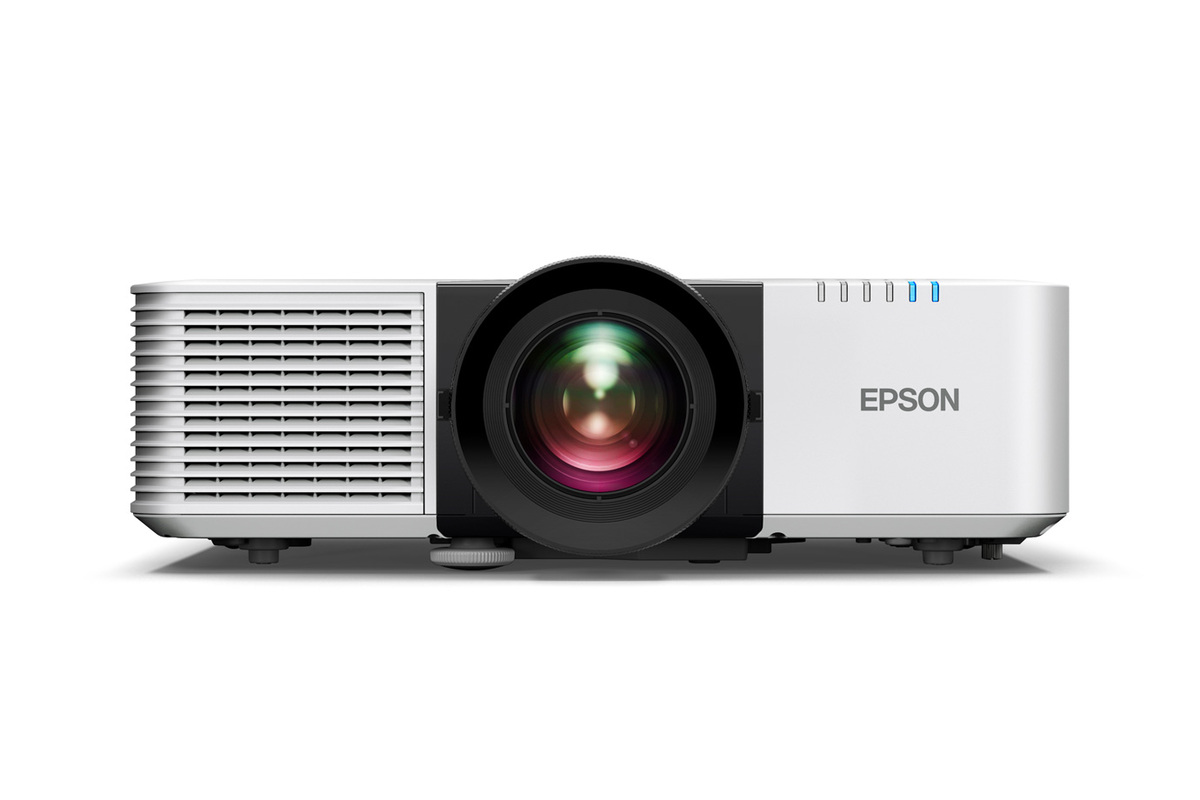
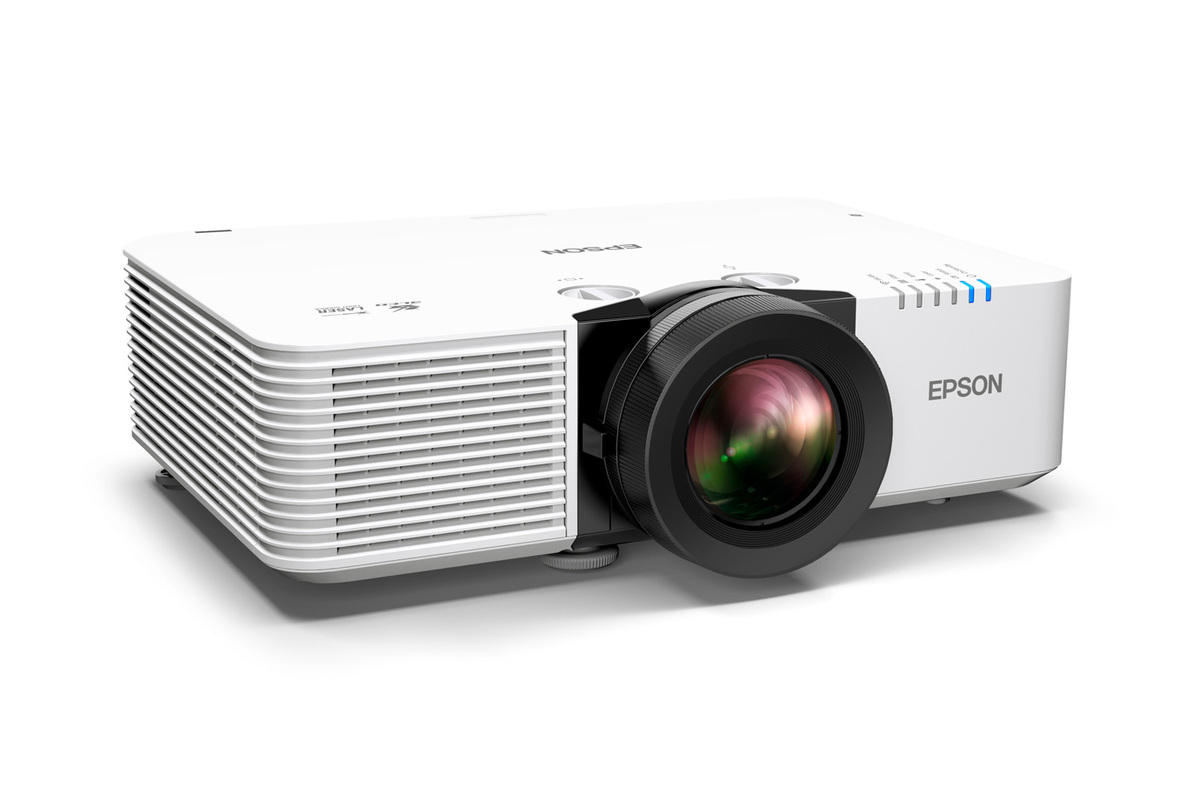
About PowerLite L690SU
The Epson PowerLite L690SU is a compact short-throw laser projector built for rooms that need a large, bright image without a long projection path. Epson introduced it in February 2025 as part of its refreshed PowerLite L-Series and later confirmed general availability through authorized resellers. It combines 6,200 lumens of equal color and white brightness with native WUXGA 1920 x 1200 resolution, a 0.79 to 1.36 throw ratio and 1.7x optical zoom. That mix makes it especially useful for conference rooms, hybrid workspaces, golf simulators, museums and education spaces where installers want more placement flexibility than a standard-throw projector provides.
Key specifications
Imaging
| Display technology | 3-chip 3LCD |
|---|---|
| Color brightness | 6,200 lumens |
| White brightness | 6,200 lumens |
| Native resolution | WUXGA 1920 x 1200 |
Projection
| Throw type | Short throw |
|---|---|
| Throw ratio | 0.79 - 1.36 |
| Optical zoom | 1.7x |
| Maximum display | Up to 400 inches diagonal in 16:10 |
| Ultra-wide formats | 16:6 and 21:9 supported |
Light source
| Type | Laser |
|---|---|
| Maintenance interval | Up to 30,000 hours in Extended Mode |
Connectivity
| Wireless | Wi-Fi 6/6E |
|---|---|
| Wireless sharing | Apple AirPlay 2, Miracast and Epson iProjection |
Installation
| Configuration | Built-in NFC |
|---|---|
| Mounting | 360-degree mounting and universal VESA mounting pattern |
Management
| Remote management | Epson Projector Management Connected |
|---|
Model
| Epson model number | V11HB31020 |
|---|
Price
| Epson US listed price | $4,661 |
|---|
What makes the PowerLite L690SU useful?
The L690SU sits in a practical middle ground between Epson's very short-throw L690SE and its standard-throw L690U. Its 0.79 to 1.36 throw ratio brings the projector closer to the screen than the L690U, while the 1.7x optical zoom gives installers more adjustment than a fixed or narrowly zoomed lens. Epson rates color and white brightness equally at 6,200 lumens, which is intended for large images in rooms where ambient light cannot always be eliminated. It can produce a 16:10 image up to 400 inches and also supports 16:6 and 21:9 ultra-wide formats. The short-throw geometry can also reduce the chance that a presenter crosses the beam during normal use.
Resolution and image quality
Epson uses its 3-chip 3LCD system with native WUXGA 1920 x 1200 output. The projector accepts up to a 4K input signal, but its displayed resolution remains WUXGA. That distinction matters when comparing it with the L690SE, L690E and other Epson models that use 4K Enhancement. For presentations, dashboards, teaching material, simulation and general business video, WUXGA provides a useful amount of detail without positioning this model as a native 4K projector.
Short-throw installation flexibility
The short-throw lens is the main reason to choose the L690SU over the L690U. Epson specifies a 0.79 to 1.36 throw ratio, 1.7x optical zoom, wide vertical and horizontal lens shift, 360-degree mounting, geometric correction tools and a universal VESA mounting pattern. Built-in NFC can help installers configure multiple units, while an optional PixAlign camera supports more involved multi-projector work such as screen matching, calibration, blending and stacking. These tools make installation easier, but buyers should still calculate throw distance and screen size before ordering mounts or committing to a room layout.
Wireless sharing and fleet management
Wi-Fi 6 and 6E are built in, and Epson supports iProjection, Miracast and Apple AirPlay 2 on the L690SU. Epson Projector Management Connected can be used for browser-based remote monitoring and control of compatible projector fleets. WPA3-Enterprise support also matters for managed education and corporate networks. For fixed AV rooms, wired HDMI or HDBaseT may still be preferable when predictable operation and centralized infrastructure matter more than ad-hoc wireless sharing.
Maintenance and laser life
Epson specifies up to 30,000 hours for the laser light source and air filter in Extended Mode. This is a maintenance interval under Epson's stated conditions, not a promise that brightness remains unchanged for 30,000 hours. The practical advantage over older lamp projectors is less routine lamp replacement, which can be valuable across campuses and businesses with many rooms. Operating mode, environment, dust and usage patterns still affect real-world maintenance needs.
PowerLite L690SU vs L690SE and L690U
Choose the L690SU when you want a short-throw lens, WUXGA resolution and 6,200 lumens. The L690SE reaches an even shorter 0.5 to 0.7 throw ratio and adds 4K Enhancement, but Epson rates it at 6,000 lumens and it does not include built-in AirPlay functionality. The L690U raises brightness to 6,500 lumens and costs less on Epson's US store, but its 1.35 to 2.20 standard-throw ratio needs more room between projector and screen. These differences are more important than simply choosing the model with the largest number.
Price and buying considerations
Epson US currently lists the PowerLite L690SU at $4,661. That price is a useful direct reference, while reseller, education and project pricing can differ. Buyers should budget for the full installation rather than the projector alone. A screen, mount, signal distribution, cabling, control hardware, audio and professional installation can materially change total project cost. Epson also offers special education pricing through its Brighter Futures program. Confirm room geometry and the required image size before comparing quotes, because those decisions can change the most suitable projector and mounting hardware.
Who should choose something else?
Choose the L690SE if you need an even shorter projection distance or specifically want Epson's 4K Enhancement. Choose the L690U when a standard-throw installation is easy and the lower Epson list price and slightly higher brightness are more valuable. Very small meeting rooms may be better served by a commercial flat panel, especially when the required image is modest and users want a simple always-ready display. Home theater buyers should look at Epson's Home Cinema or Pro Cinema ranges, where cinematic contrast, HDR and residential viewing features are the priority rather than high-brightness business installation.
Reviews
No reviews yet
Nobody has reviewed PowerLite L690SU here yet.