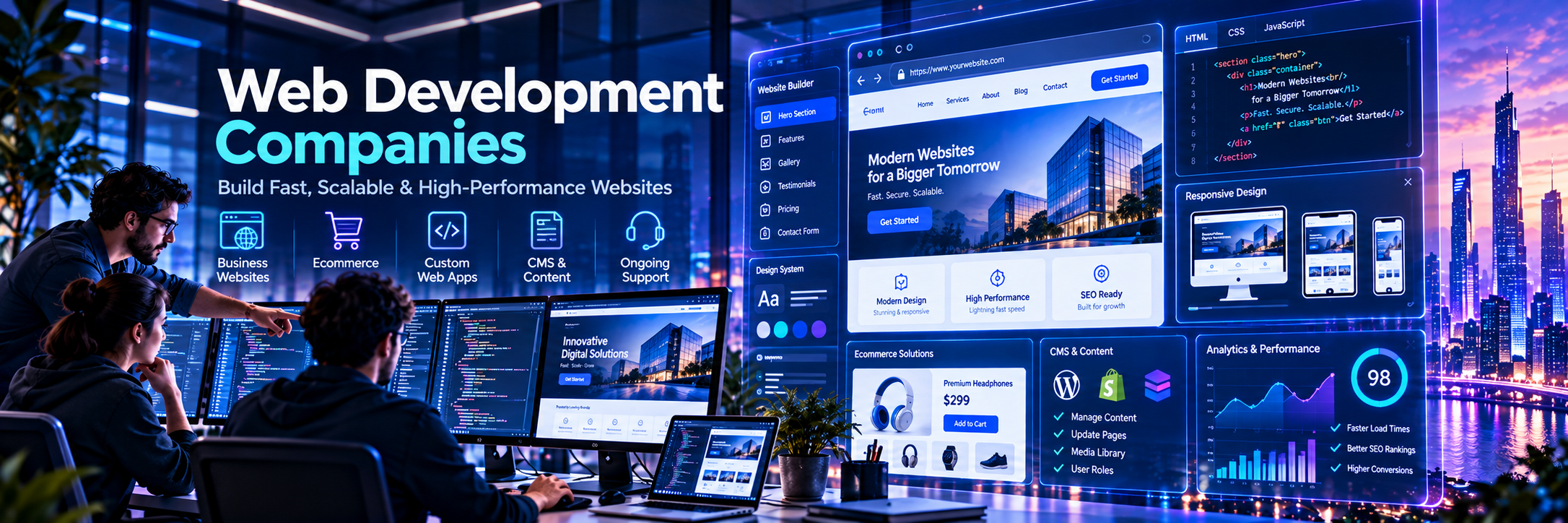
Web Development Companies
Compare web development companies for business websites, ecommerce, content platforms, custom web applications, redesigns, migrations, and ongoing website support. Use the listings to find providers, then compare them on relevant project experience, performance, accessibility, security, CMS choices, integrations, ownership, and post-launch maintenance.



Musketeers Tech is an Austin-based software and AI engineering company that builds AI agents, web applications, MVPs, custom software and cloud-focused solutions for startups and scaling teams.



PureLogics is a custom software company founded in 2006, with its primary development center in Lahore and several hundred engineers building web, mobile, AI and healthcare software.


red_mad_robot designs and engineers digital products, mobile applications, and applied AI systems. Its current work spans generative AI services, AI consulting, product design, and software delivery.



SimbirSoft develops custom web, mobile, enterprise, and data-driven software for organizations needing full delivery teams or specialist capacity. Services span discovery, UX/UI, engineering, QA, DevOps, support, and modernization.


Tensor Labs is an AI-first engineering company founded in Islamabad in 2023, building machine learning products, LLM applications, AI agents and the full-stack software around them.


San Antonio IT services company providing web and mobile development, cloud solutions, cybersecurity, digital marketing and technology recruitment for growing businesses.


How this page is ordered
Paid placements come first and are labelled Sponsored, then editorial picks and listings that earned a lift by publishing our badge, both labelled Featured. Everything below that is ordered by rating, then by name.
Every listing was approved by a person before it appeared, and editing one sends it back for approval. Ratings come from reviews we moderate; we do not write them.
How to Compare Web Development Companies Before You Hire
Choosing a web development company is not just a design decision. The site may be your sales channel, customer portal, content platform, ecommerce store, or the front end for a much larger software system. That means the right provider needs to understand the business behind the website, not only the code used to build it.
The strongest web development companies are usually good at turning a broad goal into a set of clear technical and product decisions. They ask what the site needs to achieve, who will maintain it, what systems it must connect to, how fast it needs to be, and what happens after launch. Those questions matter more than a long list of frameworks on a services page.
Start with the type of website you actually need
Website development covers very different kinds of work. A small marketing site, a content-heavy publishing platform, an ecommerce store, a membership site, and a custom web application may all be called websites, but they require different skills and delivery models.
Before comparing providers, write down the main job of the site. Is the goal to generate leads, publish content, sell products, support customers, run internal workflows, or provide a software product in the browser? The answer should shape the shortlist.
- Marketing and lead generation sites: usually need strong CMS experience, performance, analytics, SEO fundamentals, and a simple editing workflow for the internal team.
- Ecommerce websites: need product, checkout, payment, catalog, inventory, tax, shipping, and integration experience in addition to front-end development.
- Content platforms: need a CMS architecture that editors can use comfortably, along with search, taxonomy, publishing workflow, and performance planning.
- Custom web applications: usually require deeper software engineering, authentication, permissions, APIs, database design, testing, deployment, and ongoing product development.
- Legacy website rebuilds: often involve migration, redirects, analytics continuity, SEO preservation, content cleanup, and integration with existing systems.
If the project is mainly a custom business application rather than a public website, compare providers in Software Development Companies as well.
Look beyond visual portfolios
Web development portfolios often emphasize screenshots because screenshots are easy to compare. They are useful, but they do not tell you how the site performs, how easy it is to maintain, how the CMS works, how accessibility was handled, or whether the project stayed stable after launch.
Open the websites in the portfolio. Try them on desktop and mobile. Use the navigation. Submit a form. Check how pages load. If the site is ecommerce, inspect product filtering, cart behavior, and checkout flow. If it is content-heavy, look at search, categories, related content, and page consistency.
Then ask the company what part of each project it actually owned. Did it handle strategy, UX, design, front-end development, back-end development, CMS setup, integrations, migration, SEO support, hosting, or maintenance? A visually impressive project is only relevant if the provider was responsible for the work you need.
Ask how the company approaches performance
Performance affects both user experience and search visibility. A visually rich site that loads slowly can still be a poor result.
Ask how the company measures performance before and after launch. It should be able to discuss image handling, JavaScript size, caching, server response time, third-party scripts, font loading, content delivery, and how performance is monitored once real users arrive.
Google's current guidance on Core Web Vitals focuses on loading performance, interaction responsiveness, and visual stability. These metrics are not the only measure of a good website, but they are a useful common language for discussing real user experience with a development partner.
Be careful with guarantees such as "we always score 100." Real websites often have analytics, marketing tools, personalization, video, ecommerce scripts, and other business requirements that affect lab scores. A better provider will explain tradeoffs and show how it protects performance while meeting the actual product requirements.
Make mobile behavior part of the evaluation
Responsive design is now a basic expectation, but there is a difference between a page shrinking to fit a phone and a mobile experience that is comfortable to use.
Check navigation, forms, tap targets, sticky elements, cookie banners, modal windows, tables, filters, search, and checkout on smaller screens. Ask how the team tests across browsers, operating systems, and screen sizes.
For a public website, mobile should be considered during design and development rather than tested only at the end. Some interactions that work naturally with a mouse do not translate well to touch, and some layouts that look good on a large monitor become hard to scan on a phone.
Accessibility should be built in, not added later
Accessible web development is easier when semantic structure, keyboard behavior, form labels, color contrast, focus states, image alternatives, and component behavior are considered during design and implementation.
The Web Content Accessibility Guidelines from W3C provide the standard reference used by teams around the world. Your project may have specific legal or contractual requirements, but even without a formal compliance target, many of the same practices improve usability for a much wider audience.
Ask the provider how accessibility is tested. Automated checks can catch some issues, but they cannot replace keyboard testing, screen reader checks, and human review of the actual experience.
Do not choose a CMS by popularity alone
WordPress, Drupal, Shopify, headless systems, SaaS builders, and custom CMS platforms can all be the right choice in the right project. The question is whether the system fits the people who will operate the website after launch.
Ask who will create and edit content, whether pages need reusable layouts, how approvals work, whether multiple languages are required, how structured data is handled, and which integrations the CMS must support.
A flexible system is not automatically easier to maintain. Too much flexibility can create inconsistent pages. Too little flexibility can force developers to make every small content change. The best setup gives editors enough control while protecting the design and technical structure.
If WordPress is a core requirement, you can also compare providers in Wordpress when more listings are available there.
Clarify who owns SEO responsibilities during a rebuild
A website redesign or migration can damage search visibility if redirects, URLs, metadata, structured data, internal links, indexation controls, and content changes are handled without an SEO plan.
Ask the web development company what it considers part of the migration. Will it map old URLs to new ones? Preserve important metadata? Check canonical tags? Carry over structured data? Review staging environments for accidental indexation? Validate analytics and Search Console after launch?
The development team does not need to be your SEO agency, but it should understand the technical work required to avoid obvious losses during a rebuild.
If SEO is a major part of the project, treat it as a separate workstream with named responsibility rather than assuming it is included under "website development."
Security is part of web development
Public websites are exposed to the internet from the moment they launch. That makes security a normal part of delivery, not an optional add-on.
Ask how the team handles authentication, permissions, software updates, dependencies, secrets, backups, administrative access, forms, file uploads, and third-party plugins or extensions. If the site processes payments or sensitive customer data, the review should be deeper.
The OWASP Top 10 is a useful reference for common web application security risks. A good development company should be able to explain how its development and review process reduces risks that are relevant to your application.
If the project has unusually high security requirements, compare providers in Cybersecurity alongside the web development shortlist.
Ask how integrations are designed and maintained
Modern websites rarely operate alone. They may connect to a CRM, payment provider, ecommerce platform, marketing automation system, ERP, booking platform, analytics tools, identity provider, search service, or custom API.
Ask which system should be the source of truth for important data and how failures are handled when an external service is unavailable. If two systems need to stay synchronized, ask what happens when one update succeeds and the other fails.
Integration work can become the most complex part of a website project, especially during migrations. The provider should identify those risks early rather than treating them as small tasks at the end.
Understand what is custom and what is third-party
A website can be assembled from custom code, themes, plugins, packages, hosted services, and external APIs. Reuse is not a weakness. It can save time and reduce unnecessary custom work. The important part is knowing what your website depends on.
Ask which major components are custom, which are licensed, which require subscriptions, and who is responsible for updates. If a critical feature depends on a third-party plugin or SaaS service, understand what happens if pricing changes or support ends.
This is particularly important for ecommerce, page builders, search tools, membership systems, and marketing technology. A small dependency can become a long-term operational decision.
Content editing should be tested before launch
One of the most common website problems appears after the developers leave: the internal team discovers that normal content changes are awkward, fragile, or require technical help.
Before launch, ask the people who will actually manage the website to create and edit pages in the staging environment. Test common tasks such as adding an image, updating a call to action, publishing an article, changing navigation, creating a landing page, and editing SEO fields.
If those tasks are difficult during training, they will still be difficult six months later.
Ask how quality assurance is organized
Web QA should cover more than checking whether links work. Ask how the team tests forms, validation, browser compatibility, responsive layouts, accessibility, redirects, analytics, cookies, page metadata, search, user accounts, payments, and integrations where relevant.
For larger builds, it is useful to have a written launch checklist. The checklist should identify who verifies each critical area and what happens if something fails during deployment.
If testing is a major requirement or you already have a development team and need independent QA, compare Software Testing providers too.
Know what happens to the old website
Rebuilds often focus so heavily on the new design that the old website is treated as a file to replace. In reality, the existing site may contain years of search equity, backlinks, analytics history, customer bookmarks, content, and integrations.
Ask how content will be migrated, which URLs will change, how redirects will be created, and whether anything important is being removed. If the old site has thousands of pages, migration deserves its own plan and testing process.
Also decide what will happen to the old hosting, database, media files, and backups after launch. Do not delete the previous environment until the new site has been verified and the rollback plan is no longer needed.
Compare hosting and deployment responsibilities
Some web development agencies build the website and hand it over. Others manage hosting, deployment, monitoring, backups, and updates. Either model can work, but responsibilities should be clear.
Ask where the website will be hosted, who owns the account, how deployments are performed, how backups are tested, and what monitoring is in place. If the site becomes unavailable, know who is expected to respond.
For more complex cloud infrastructure or applications with significant scaling requirements, compare Cloud Consulting providers as well.
Do not compare proposals only by page count
A proposal that says "20 pages" can hide very different amounts of work. One site may use a small number of reusable templates. Another may include complex interactive components, custom search, integrations, migration, user accounts, and advanced content models.
Ask each company to describe the templates, components, integrations, migration work, testing, and post-launch support included in the estimate. That makes proposals much easier to compare.
Also clarify what happens when content or requirements change during the build. A rigid page count is less useful than a clear process for handling new information.
Useful questions for a web development shortlist
- Which live websites have you built that are similar to this project?
- What part of those projects did your team own?
- Which CMS or architecture would you recommend for us, and why?
- How do you measure and improve performance?
- How do you test accessibility and browser compatibility?
- What is included in migration and redirect work?
- How do you handle integrations and third-party dependencies?
- Who owns the hosting, repository, domain, and production accounts?
- What security practices are part of normal development?
- How will our content team be trained and supported?
- What testing happens before launch?
- What support and maintenance are available after launch?
Ask the same core questions to every shortlisted provider. Consistency makes it easier to compare how companies think, not just how well they present themselves.
When a web development company is not the right choice
Not every project needs a custom web development agency. A simple brochure site may be handled well with a quality website platform and a small implementation team. A mobile-first consumer product may need an App Development Company. A complex SaaS or enterprise system may be better led by a broader software engineering team.
If the real challenge is branding, positioning, or campaign strategy rather than technology, a design or marketing partner may need to lead the project instead.
A trustworthy web development company should be willing to say when the problem is smaller, larger, or different from the service it sells.
How to use the Brandligo web development companies directory
Use the listings above to create a focused shortlist rather than contacting every provider that offers website development. Open company profiles, check related specialisms, review locations and available feedback, and look for evidence that matches the type of website you are planning.
Brandligo helps with discovery and comparison. It does not replace technical, legal, accessibility, security, or commercial due diligence. Once you have a shortlist, give each company the same project brief and ask the same core questions. The quality of the questions they ask back will tell you a lot about how the project is likely to run.