About Dynamics 365 Finance
Dynamics 365 Finance is Microsoft's enterprise financial management application for organizations that need structured accounting, financial operations, planning, reporting, controls and automation. It sits inside the Microsoft Dynamics 365 family and is aimed at finance teams that manage multiple legal entities, detailed account structures, budgets, assets and reporting. Buyers should treat it as an ERP finance application that normally requires implementation planning, role design, data migration and integration work rather than as a lightweight accounting tool.
What it does
Pricing
| Dynamics 365 Finance | 210 US dollars per user/month, paid yearly, checked September 6, 2026 |
|---|---|
| Dynamics 365 Finance Premium | 300 US dollars per user/month, paid yearly, checked September 6, 2026 |
Planning
| Business performance planning | Planning operations require a Dynamics 365 Finance Premium license |
|---|---|
| Planning platform | Uses Microsoft Power Platform, Dataverse, Power BI and Excel |
Financial management
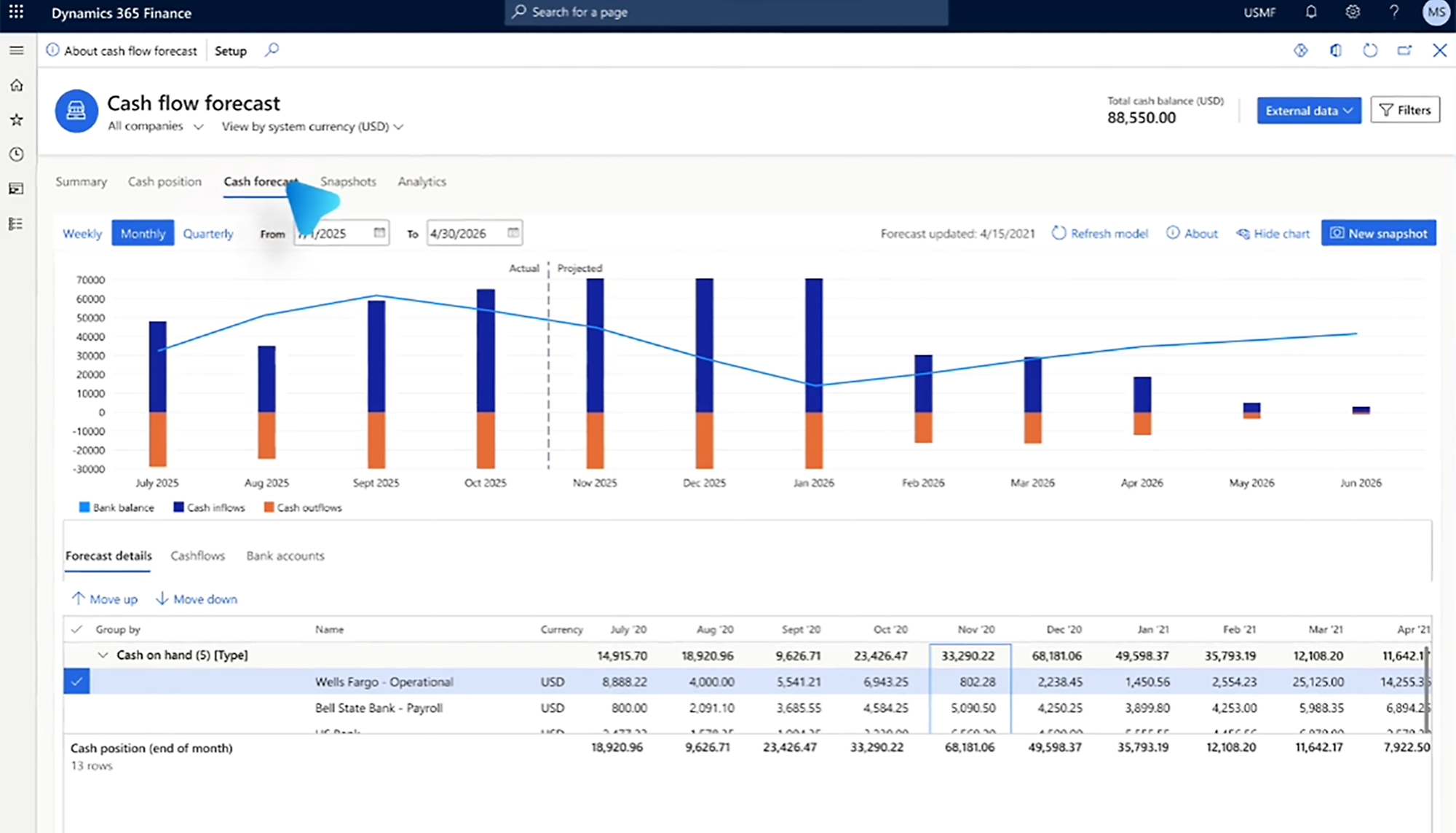
| Core areas | General ledger, accounts payable, accounts receivable, budgeting, cash and bank management, fixed assets and related finance workflows |
|---|
AI and agents
| Finance Premium Copilot Credits | 1,000 Copilot Credits per user/month included with each Finance Premium license |
|---|
What does Dynamics 365 Finance cover?
Microsoft's current documentation covers general ledger, accounts payable, accounts receivable, budgeting, cash and bank management, fixed assets, cost accounting, asset leasing, credit and collections, electronic invoicing and related financial processes. General ledger supports legal entity records, charts of accounts, financial dimensions, allocations, currency revaluation, year-end closing and consolidation.
This breadth suits organizations that want a shared ERP system for accounting and operational finance. It also means scope should be defined carefully. A company that only needs basic invoicing and bookkeeping may not need the implementation depth that Dynamics 365 Finance introduces.
How do Finance and Finance Premium differ?
Microsoft sells Dynamics 365 Finance and Dynamics 365 Finance Premium as separate plans. The standard Finance plan provides the core financial management application. Finance Premium adds advanced business performance management capabilities and higher entitlements identified in Microsoft's current plan comparison.
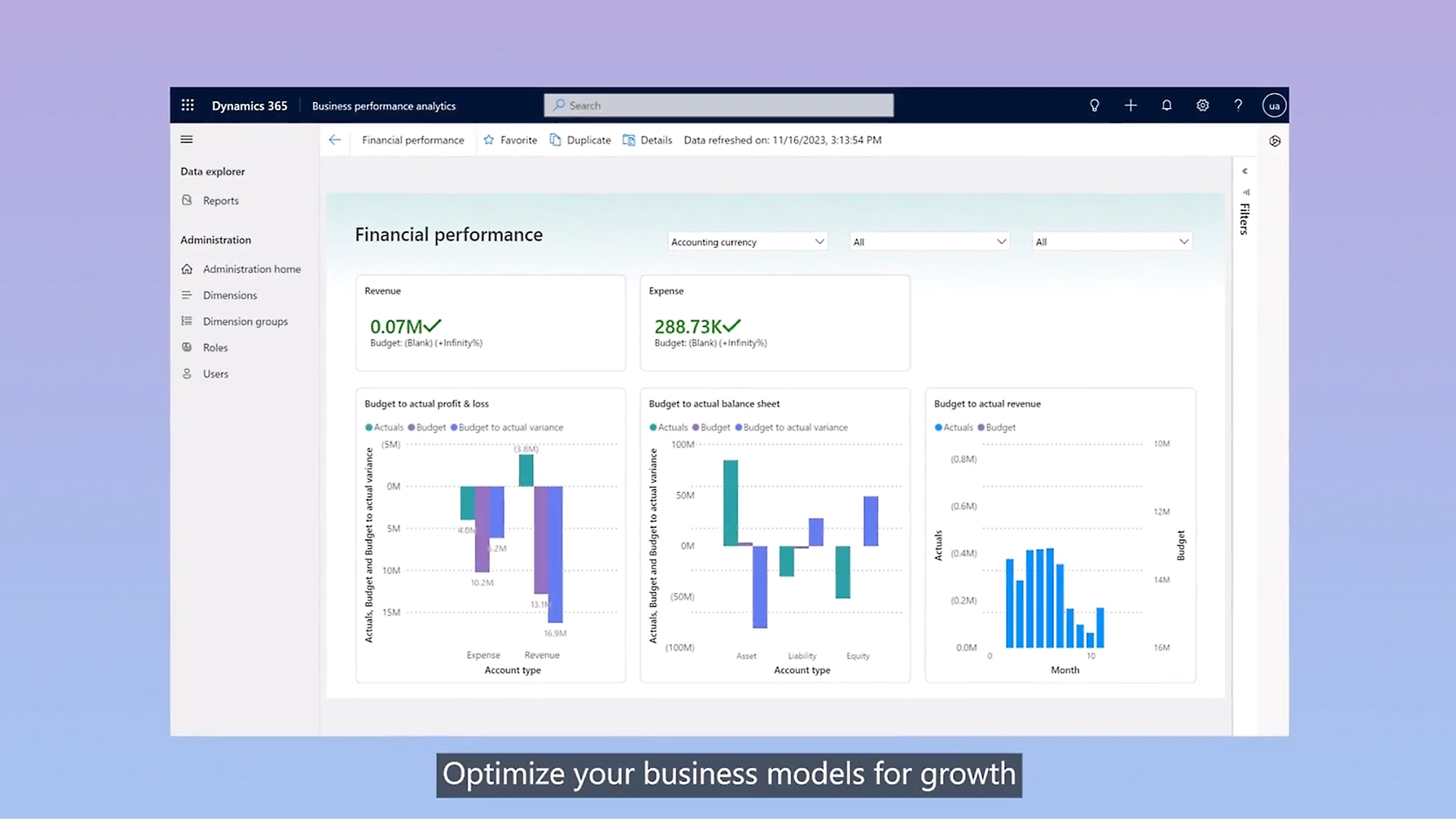
Business performance planning is a key Premium distinction. Microsoft documentation says planning operations require a Finance Premium license. The planning application uses Microsoft Power Platform, Dataverse, Power BI and Excel to support financial and operational planning, dimensions, cubes, scenario work, write-back and collaborative planning. Organizations should not assume those planning capabilities are included in the base Finance plan.
What is the current Microsoft pricing?
Microsoft's US pricing page listed Dynamics 365 Finance at 210 US dollars per user per month, paid yearly, and Dynamics 365 Finance Premium at 300 US dollars per user per month, paid yearly when checked on September 6, 2026. Microsoft notes that displayed prices can vary by country, region and purchasing context, so buyers should confirm the local offer before budgeting.
Microsoft also states that each Finance Premium license includes 1,000 Copilot Credits per user per month for eligible agent scenarios. Additional agent usage can use Copilot Credits, and Microsoft says an active Azure subscription is required for agent billing. These usage costs should be evaluated separately from the user license.
How should a finance team plan implementation?
Implementation should begin with the financial operating model, not with feature activation. Teams should define legal entities, chart of accounts, financial dimensions, fiscal calendars, currencies, approval controls, payment processes, bank structures, fixed asset rules and reporting requirements before configuration becomes difficult to change.
Data migration also deserves its own workstream. Opening balances, vendors, customers, fixed assets, unpaid transactions, historical detail and reference data should be classified by what must move, what can remain archived, and how reconciliations will prove the migration. Organizations replacing another ERP should budget for mapping, cleansing, testing and cutover rehearsals rather than treating migration as a simple import.
What integrations and platform dependencies matter?
Dynamics 365 Finance is part of Microsoft's broader business application stack, so deployments can connect it with other Dynamics 365 applications, Power Platform, Dataverse, Microsoft 365 services, reporting tools and Azure-based integrations. Business performance planning specifically relies on a Power Platform environment and uses Power BI visuals and Dataverse-backed planning components.
Buyers should distinguish useful integration from unnecessary complexity. A shared Microsoft ecosystem can simplify identity, automation and analytics decisions, but custom interfaces still need ownership, monitoring and testing. Integration architecture should document which system owns customers, vendors, products, projects, financial dimensions and other shared records.
Where can Dynamics 365 Finance become difficult?
The product can be demanding when an organization has heavily customized legacy processes, inconsistent master data, many legal entities or unclear ownership between finance and IT. Financial dimensions and account structures are powerful, but poor design can create reporting and posting complexity that becomes expensive to correct later.
Broad ERP capability also does not remove the need for process decisions. Local requirements, banking, consolidation, approvals and reporting can still vary by organization and region. Teams should validate regional functionality, partner skills and change-management effort before committing to a rollout schedule.
Who is Dynamics 365 Finance best suited for?
Dynamics 365 Finance is a strong fit for midsize and large organizations that need enterprise financial controls, multi-entity accounting, budgeting, cash management, fixed assets, reporting and an ERP platform that can connect with other Microsoft business applications. It is particularly relevant when the organization already uses Dynamics 365 or Power Platform and wants finance processes to sit in the same Microsoft ecosystem.
Finance Premium is more relevant when advanced planning and business performance management are part of the requirement. The standard plan may be sufficient when the priority is core financial management without the Premium planning capability.
Who should choose something else?
A small business with straightforward bookkeeping, invoicing and reconciliation may be better served by a simpler accounting product or by Dynamics 365 Business Central if its small and midsize business ERP scope fits better. Organizations already deeply standardized on another ERP should compare migration cost, process disruption and integration work against the value of moving.
Teams that mainly need financial planning rather than a new transaction-processing ERP should also compare dedicated planning platforms before replacing an existing finance system. The strongest reason to choose Dynamics 365 Finance is a need for enterprise financial management inside a broader Microsoft business application strategy.
Reviews
No reviews yet
Nobody has reviewed Dynamics 365 Finance here yet.