About GitLab Duo Agent Platform
GitLab Duo Agent Platform is GitLab's agentic AI layer for software delivery. It works across the GitLab Web UI, supported IDEs, CLI, issues, merge requests, pipelines, and security workflows so teams can use agents and multi-step flows with GitLab project context. The product became generally available in January 2026 and uses GitLab Credits for consumption rather than a separate fixed AI seat price. This page focuses on current capabilities, pricing mechanics, governance, deployment choices, limitations, and alternatives.
What can GitLab Duo Agent Platform do?
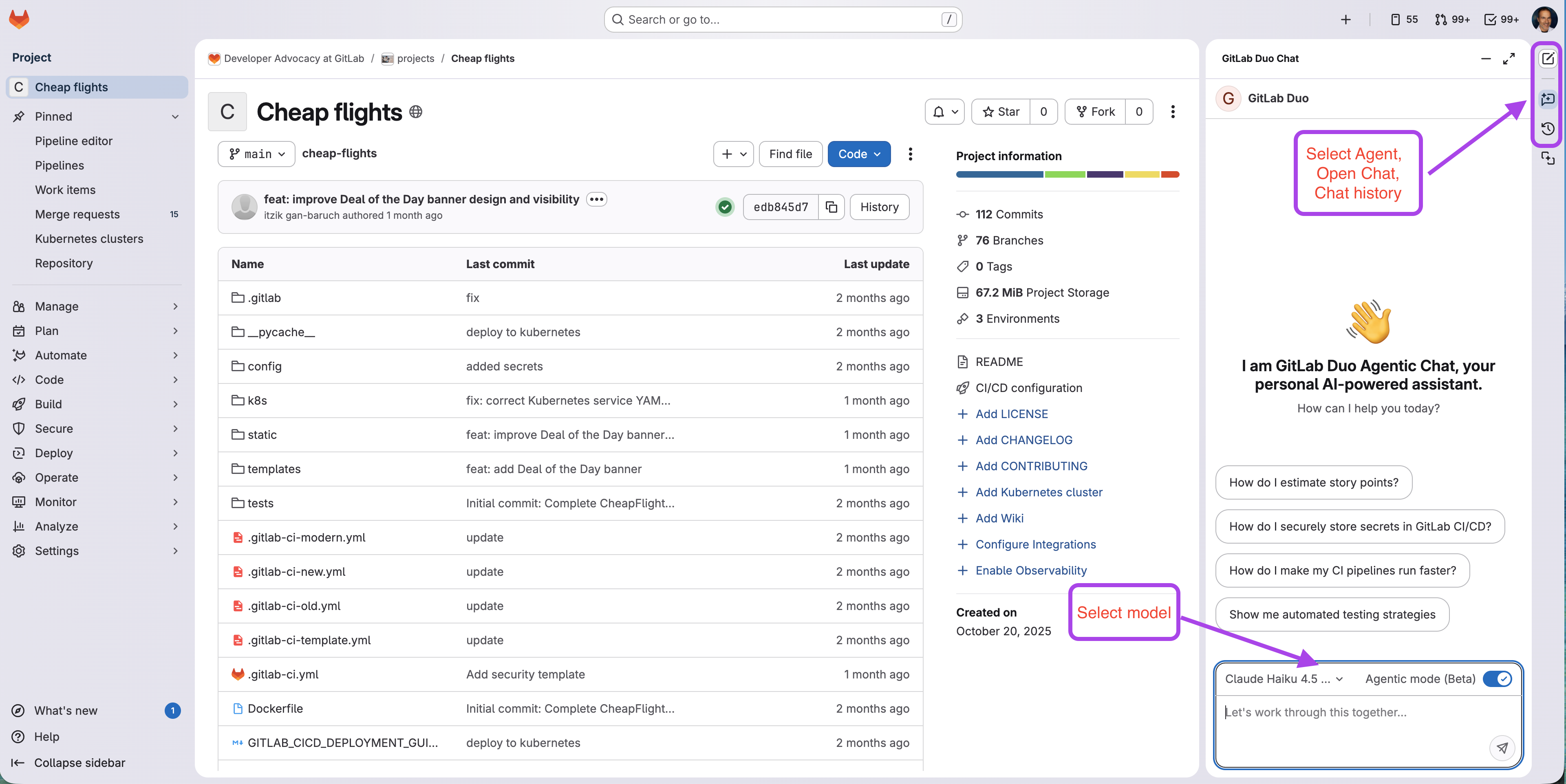
GitLab Duo Agent Platform combines interactive AI assistance with background automation. Agentic Chat can use code, issues, epics, merge requests, CI/CD pipelines, and security findings as context. It can help explain unfamiliar code, create or update work items, generate code and tests, troubleshoot pipelines, summarize changes, and analyze security findings.
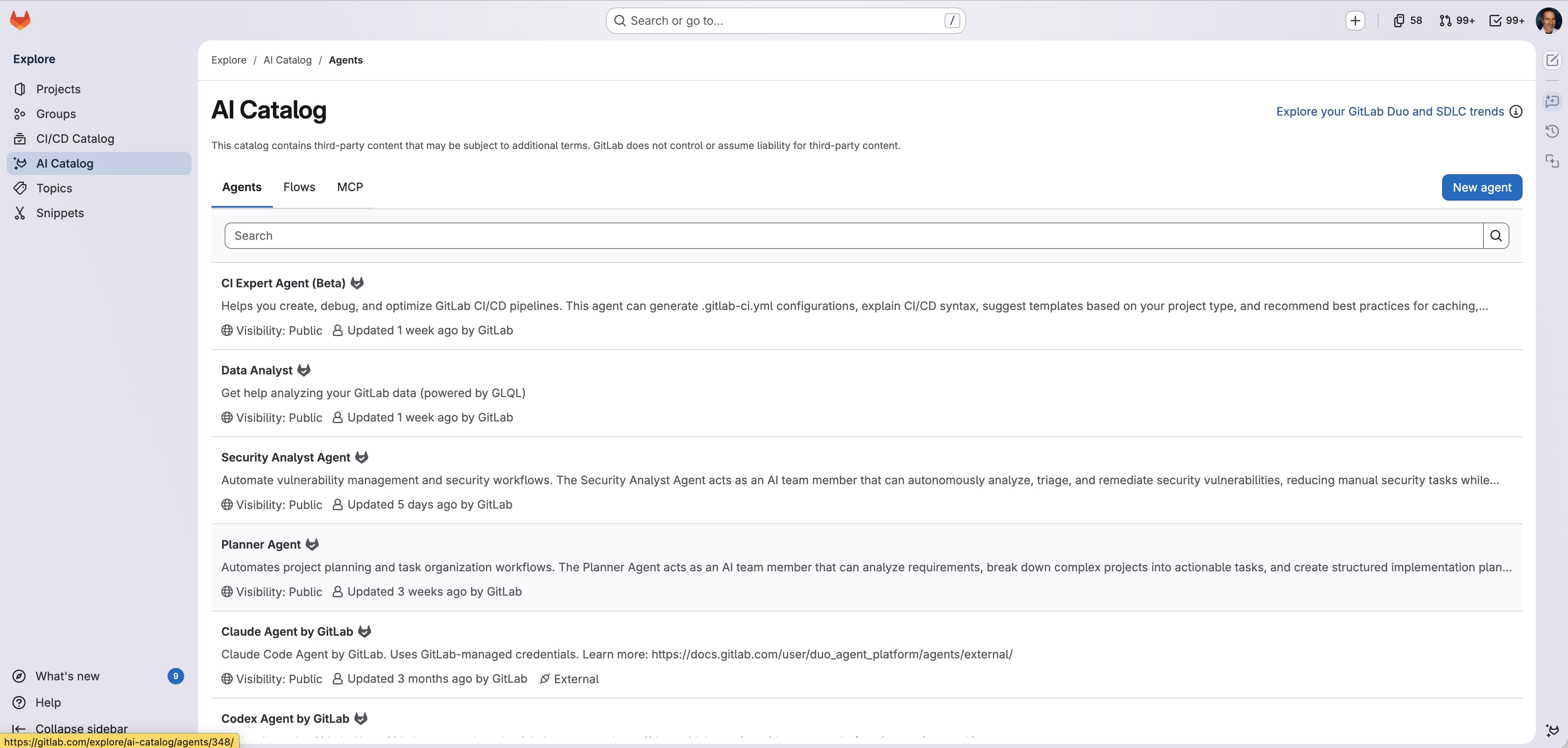
The platform also supports foundational agents maintained by GitLab, custom agents created by customers, and external agents. GitLab currently documents integrations for external tools including Claude Code and OpenAI Codex. The practical difference from a standalone coding assistant is that Duo Agent Platform can operate against the broader software lifecycle context already stored in GitLab.
What is the difference between agents and flows?
Agents are primarily interactive. A developer can use Agentic Chat in the GitLab interface or an IDE, select an available model or agent, and iterate in a conversation. Agents can read permitted project context and, when allowed, take actions such as creating work or changing code.
Flows are designed for longer or repeatable multi-step work. GitLab provides foundational flows for tasks such as turning an issue into a merge request, fixing a CI/CD pipeline, converting pipeline configuration, reviewing code, and handling selected security remediation work. Custom flows can automate organization-specific processes and can run asynchronously on GitLab platform compute. This distinction matters because autonomous background workflows require more governance than a normal chat response.
How does the AI Catalog work?
The AI Catalog is a central place for discovering, enabling, creating, and sharing agents and flows. Teams can use GitLab-provided components or publish organization-specific agents and workflows for reuse. The catalog also supports MCP server connections that can extend agents with approved external data and services.
For enterprises, a shared catalog can reduce the spread of one-off prompts and unmanaged local agents. It also creates a governance responsibility: administrators should decide who can publish agents, which external tools they can reach, what credentials they can use, and how changes are reviewed before an agent or flow becomes widely available.
How much does GitLab Duo Agent Platform cost in August 2026?
GitLab Duo Agent Platform is billed through GitLab Credits rather than one fixed monthly product price. The current on-demand list price is $1 per GitLab Credit. Organizations can also purchase a monthly commitment pool, with volume pricing depending on the commitment. Credit drawdown varies by the feature and AI model used, so two teams with the same number of developers can have very different AI costs.
GitLab currently provides a limited-time promotional allocation to paid GitLab.com customers: Premium receives $12 of included GitLab Credits per user per month and Ultimate receives $24 per user per month. GitLab explicitly states that these included credits are promotional and subject to change, so they should not be treated as a permanent entitlement. Free GitLab.com top-level groups can purchase a shared monthly credit commitment. Buyers should review the current credit drawdown table and set budgets based on expected agent, model, and workflow usage.
What controls are available for AI governance and spending?
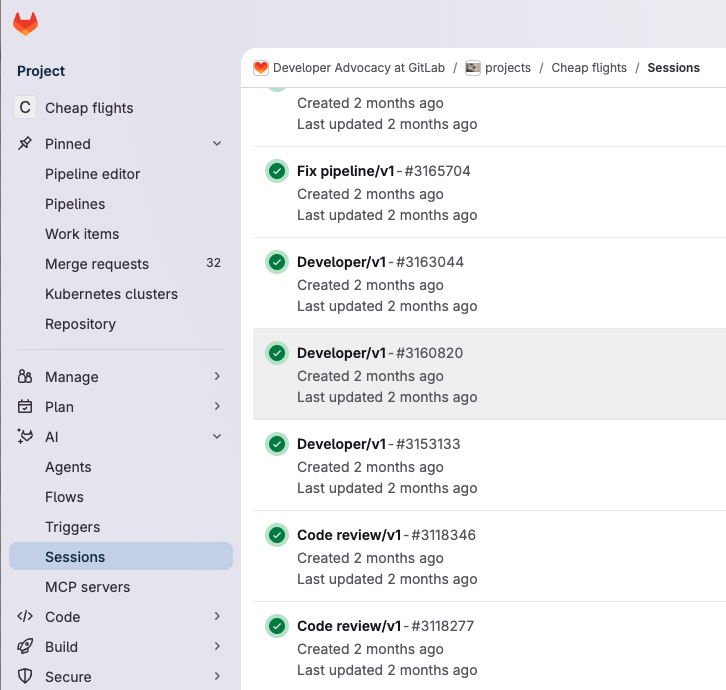
GitLab provides namespace-level access controls, model selection, activity records, sessions, and administration for agents and flows. Sessions record agentic activity so teams can review what ran and what actions occurred. Group-level settings can control who receives access, and GitLab supports enterprise identity patterns such as SAML and LDAP in relevant deployment configurations.
GitLab 19.3, released August 20, 2026, added generally available GitLab Credits usage caps. Organizations can set a monthly ceiling on agentic AI spend before usage becomes an overage. This is important for a consumption model because an autonomous flow can create cost without the same direct user interaction as a normal chat request.
What changed for GitLab Dedicated customers in August 2026?
GitLab made the AI Gateway for GitLab Dedicated generally available on August 20, 2026. GitLab Dedicated is a single-tenant SaaS deployment managed by GitLab, and the new gateway is designed to keep supported AI-processed data inside that environment and the customer's selected region.
This can be material for regulated or data-sensitive organizations that previously had to weigh AI functionality against regional or isolation requirements. It does not remove the need for an internal AI risk assessment. Buyers should still confirm model availability, data paths, retention, encryption, access controls, and the exact features supported in their chosen deployment.
How does Duo Agent Platform handle security work?
GitLab has extended agentic workflows into application security. The platform includes a Security Analyst Agent and security-focused flows that can explain findings, help prioritize vulnerabilities, and assist with remediation. In August 2026 GitLab announced bulk SAST false-positive detection and agentic SAST vulnerability resolution in beta, allowing teams to evaluate groups of findings and prepare fixes for confirmed risks.
Because some of these capabilities are beta, buyers should not treat them as equivalent to mature generally available security controls. Human review remains important before merging AI-generated security changes, and organizations should separate automated assistance from the policy decision about whether a vulnerability is accepted, fixed, or deferred.
What are the main limitations and trade-offs?
Duo Agent Platform is most valuable when an organization already keeps meaningful software-delivery context in GitLab. Teams whose source code, planning, CI/CD, and security systems are split across other vendors may get less benefit from GitLab-native context unless they also change their toolchain or connect external systems.
Usage-based pricing can also be harder to forecast than a flat AI seat. Heavy use of advanced models, external agents, or long-running workflows can consume more credits than lightweight assistance. Model availability and drawdown rates can change, and some capabilities depend on GitLab version, deployment type, or rollout status. Organizations using Self-Managed GitLab should also account for the operational work of keeping the instance current enough to receive newer Duo capabilities.
How does GitLab Duo Agent Platform compare with alternatives?
GitHub Copilot is a natural comparison for organizations centered on GitHub and developer coding workflows. OpenAI Codex and Anthropic Claude Code can be attractive when teams want agentic coding with less dependence on one DevSecOps platform. Cursor and similar AI-first development environments may appeal to teams that prioritize IDE experience over lifecycle-wide governance.
GitLab's main distinction is the attempt to orchestrate AI across planning, code, CI/CD, security, and compliance inside the same platform. That breadth can be an advantage for enterprises consolidating onto GitLab, but it can be unnecessary for teams that only want code generation or an AI assistant inside an editor.
Who should consider another product instead?
A team should consider another product if it mainly needs autocomplete, code chat, or local coding agents and does not use GitLab as a meaningful system of record. In that situation, paying for agentic workflows tied to GitLab context may add complexity without enough benefit.
Organizations should also consider alternatives if they require a model, region, integration, or data-handling pattern that GitLab does not currently support. The right choice depends on where the engineering context lives, how much autonomy agents should have, whether lifecycle-wide auditability matters, and whether consumption-based AI pricing is acceptable.
Reviews
No reviews yet
Nobody has reviewed GitLab Duo Agent Platform here yet.