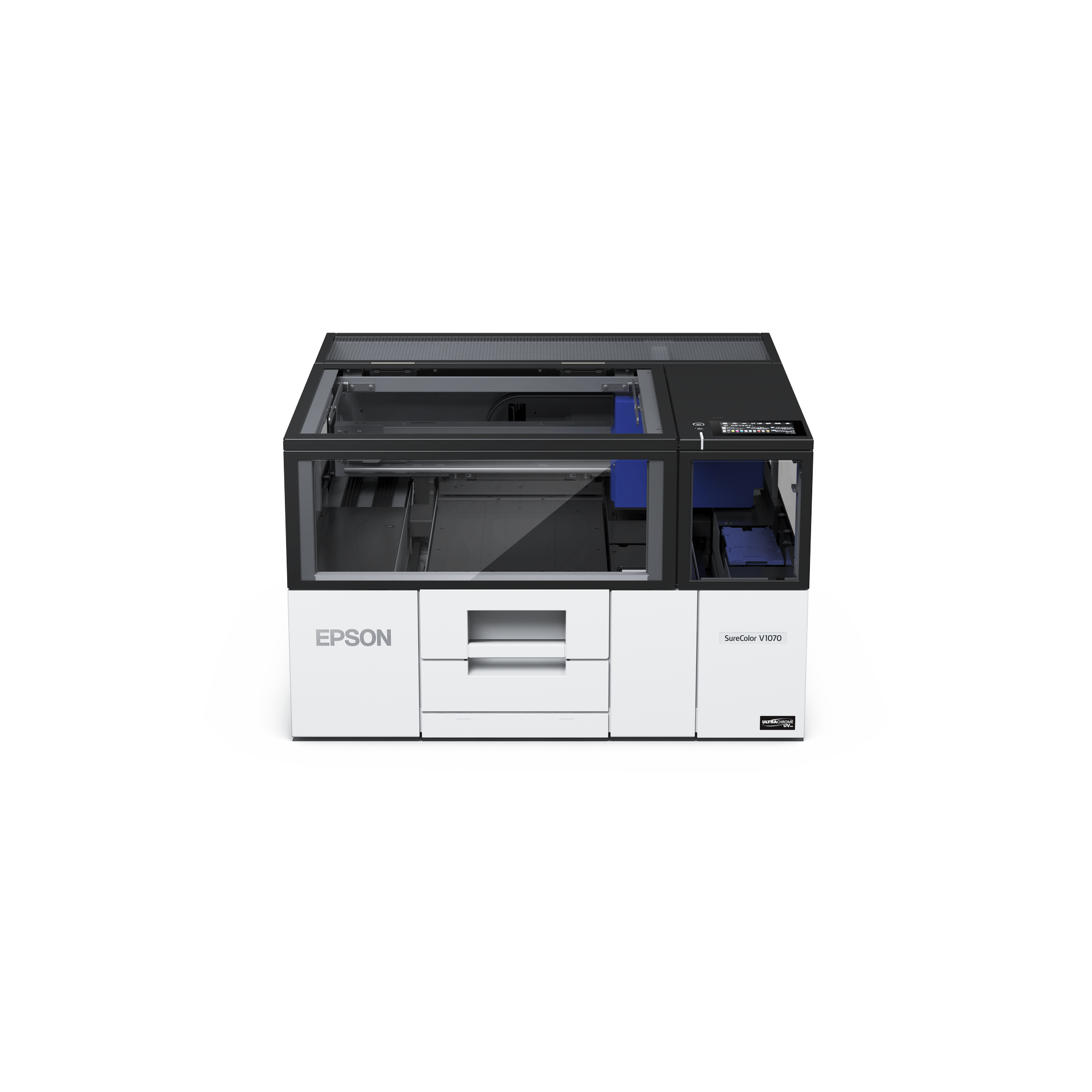
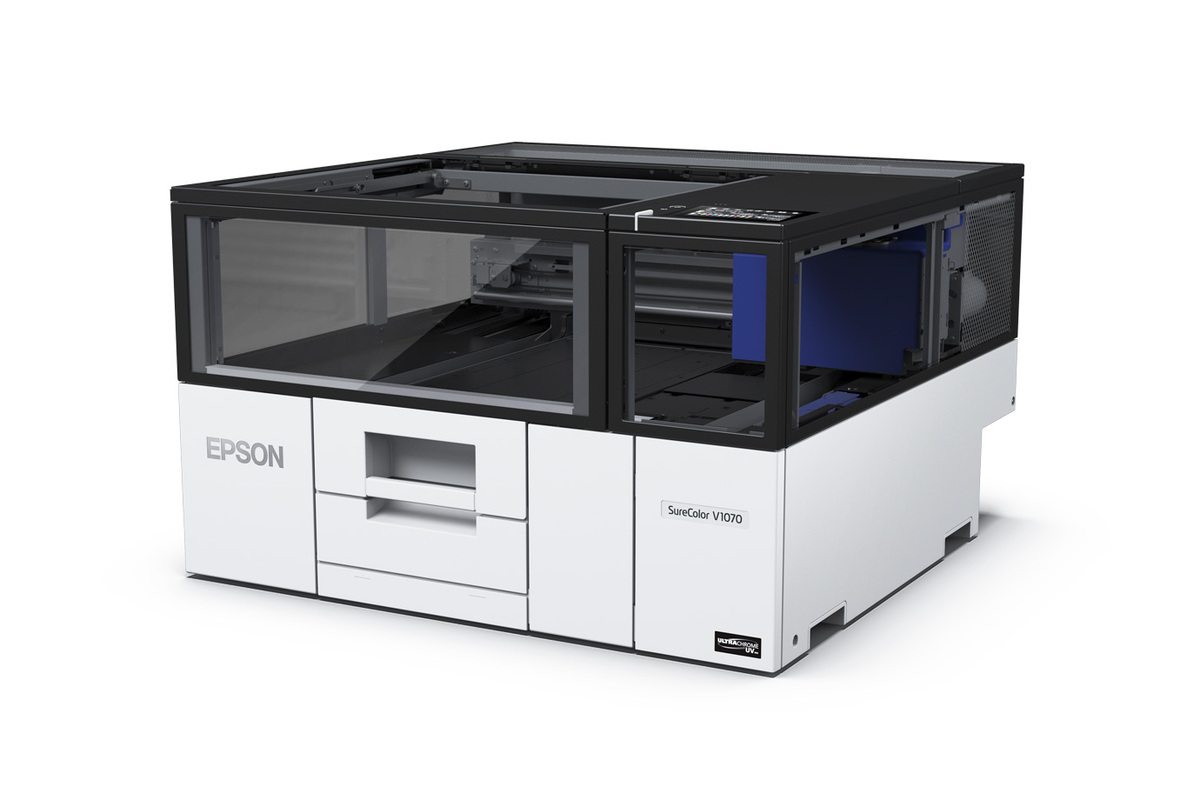
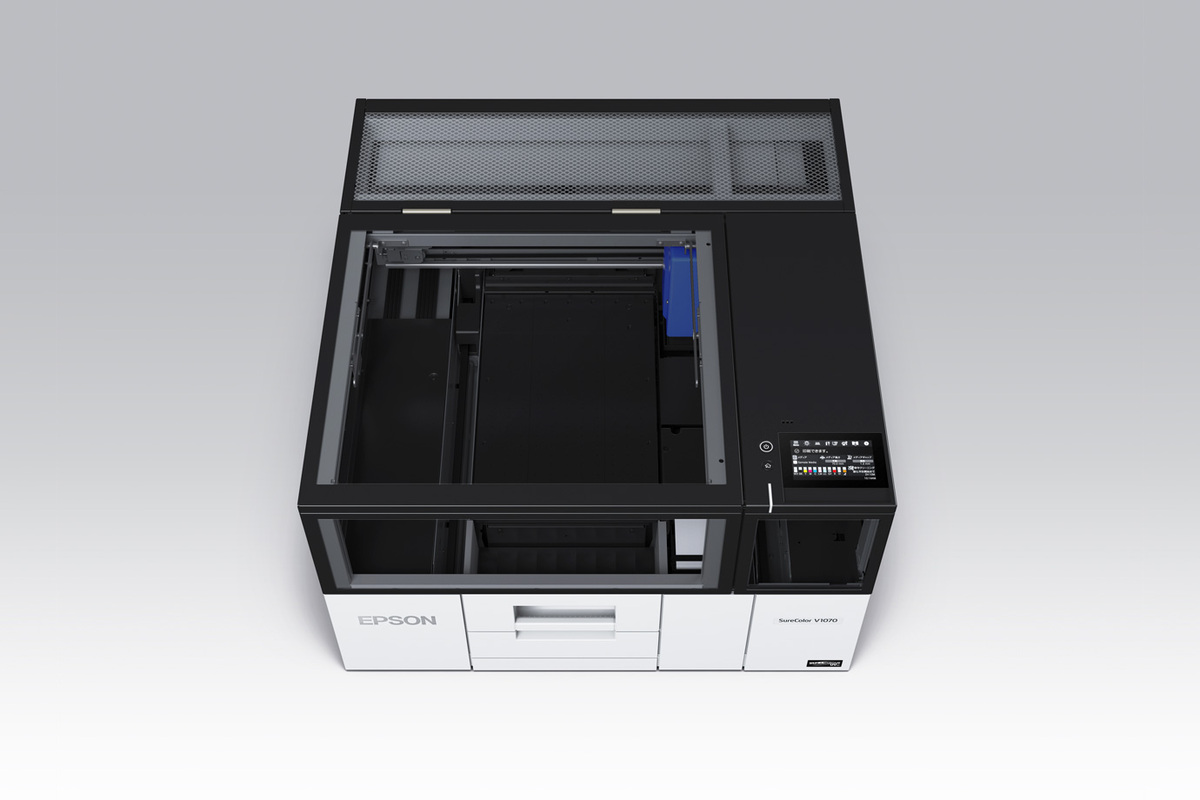
About SureColor V1070
The Epson SureColor V1070 is a compact A4 UV flatbed printer built for small businesses, makers and print shops that want to print directly onto objects and rigid materials without committing to a full-size commercial flatbed. Epson introduced it in September 2024 as its first desktop UV printer. It sits below the larger SureColor V4000 and V7000, making it the practical entry point into Epson's V-Series for personalized goods, short-run signage, samples and specialty products.
Key specifications
General
| Model | SCV1070PE |
|---|
Format
| Printer type | A4 desktop UV flatbed printer |
|---|
Ink
| Ink technology | 6-color UltraChrome UV Ink |
|---|---|
| Specialty inks | Opaque White Ink and Gloss/Matte Varnish Ink |
Applications
| Example materials | Wood, acrylic and compatible promotional goods |
|---|---|
| Example products | Keychains, golf balls, pens and signage |
Pricing
| Epson US price | $9,299 |
|---|
Who is the SureColor V1070 for?
The V1070 makes the most sense for businesses selling customized physical products rather than conventional paper prints. Typical work can include acrylic pieces, wood items, keychains, pens, golf balls, small signs and promotional merchandise. Its compact footprint is useful where production space is limited, including maker studios, retail personalization counters and small print shops.
It is also a sensible way for an established sign or garment business to add direct-to-object work without buying a much larger UV flatbed. The business case is strongest when there is repeat demand for personalized items and enough margin to justify a dedicated production device.
What can it print and how does the UV workflow help?
Epson designed the V1070 to print directly on a range of rigid and specialty materials, including wood and acrylic. UV ink is cured during printing, so the workflow differs from dye-sublimation, solvent signage and ordinary photo printing. That direct process can reduce the need for transfer media on suitable applications and opens up products that are awkward for roll-fed printers.
Material compatibility still matters. Buyers should test unfamiliar substrates and confirm preparation requirements rather than assuming every object or coating will accept UV ink equally well. Production planning also needs to account for object height, printable area and safe placement on the flatbed.
Why do White and Varnish inks matter?
The six-color UltraChrome UV ink system includes opaque White ink and Varnish in addition to the core color workflow. White is particularly useful when printing on transparent, dark or colored materials because it can provide a base beneath the image. Varnish can be used for gloss or matte effects, texture and visual embellishment.
Those capabilities are a major reason to choose a UV flatbed over a normal desktop inkjet. They also add workflow decisions. Shops need to think about layer order, artwork preparation, maintenance and the extra production time required for specialty effects rather than treating every job like a simple CMYK print.
How does the V1070 compare with the V4000?
The V1070 is the compact, lower-investment choice. Epson currently lists it at $9,299 in the United States, and its A4-class format targets smaller objects and short-run personalization. The V4000 is a much larger commercial flatbed with a 27.5 by 38.5 inch print area, thicker-media support and a broader 10-color configuration.
A shop should not choose the V4000 simply because it is higher in the range. If most paid work fits the V1070 bed, the smaller machine can be easier to place and finance. Conversely, a business regularly turning away larger rigid signage or higher-volume work may outgrow the V1070 quickly and should model that demand before buying.
What are the main operating considerations?
UV printing rewards disciplined maintenance and a controlled production process. White ink and specialty ink workflows require attention, and direct-to-object printing makes accurate placement important. Operators should build repeatable templates for common products, keep approved substrate settings documented and price jobs with setup time and rejected pieces in mind.
Epson emphasizes simple operation and maintenance, but simple does not mean maintenance-free. Businesses should also consider ventilation and workplace requirements, local service availability, ink inventory, cleaning procedures and the cost of fixtures or jigs needed to hold repeat products consistently.
What are the limitations?
The biggest limitation is size. The V1070 is intentionally a desktop A4-class flatbed, so it is not a substitute for a large-format rigid signage printer. Businesses expecting large boards, high-volume panel production or wide commercial jobs should look further up the V-Series.
It is also a specialized production printer, not an all-purpose office device. Epson states that it is designed for Epson ink packs rather than third-party ink packs. Buyers should therefore evaluate genuine ink costs, maintenance, substrate testing and service as part of total ownership cost instead of comparing only the purchase price.
Who should choose something else?
Choose the SureColor V4000 or another larger V-Series model if your revenue depends on bigger rigid media, thicker objects or commercial flatbed capacity. Choose SureColor S-Series if most work is roll-fed banners, vinyl, wraps and signage. Apparel decorators should compare Epson F-Series hybrid DTG and DTFilm systems or G-Series dedicated DTFilm printers, while photographers working mainly on paper should look at P-Series.
The V1070 is most compelling when small direct-to-object products are the core opportunity. If that is only an occasional request, outsourcing UV jobs may be financially smarter until demand becomes predictable.
Price and buying decision
Epson currently lists the SureColor V1070 at $9,299 in the United States under model SCV1070PE. That makes it a serious business purchase even though Epson positions it as a comparatively accessible desktop UV solution.
Before ordering, estimate monthly sellable jobs, average margin per item, material waste, operator time, ink and maintenance costs, and how often the bed size will constrain paid work. A shop with a clear personalization pipeline can value the V1070 for its compact format and specialty ink capability. A business without repeat UV demand should validate orders first rather than buying around hypothetical work.
Reviews
No reviews yet
Nobody has reviewed SureColor V1070 here yet.