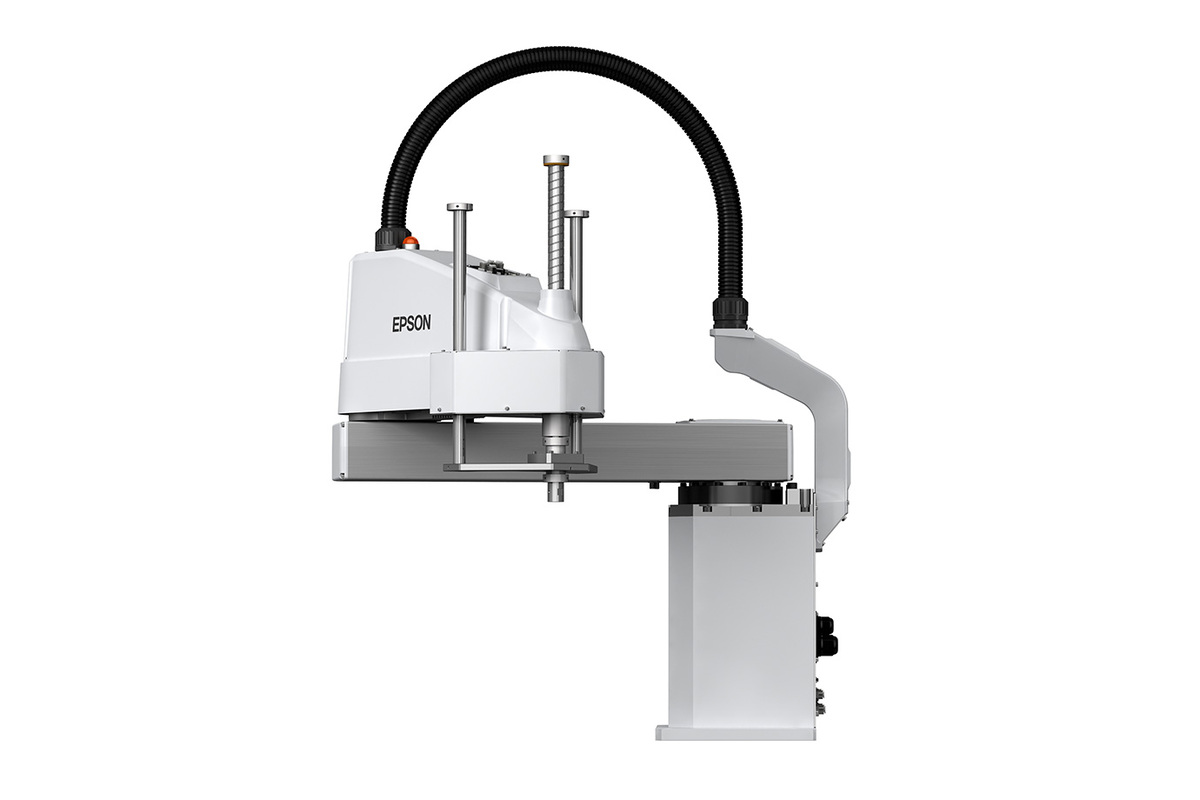
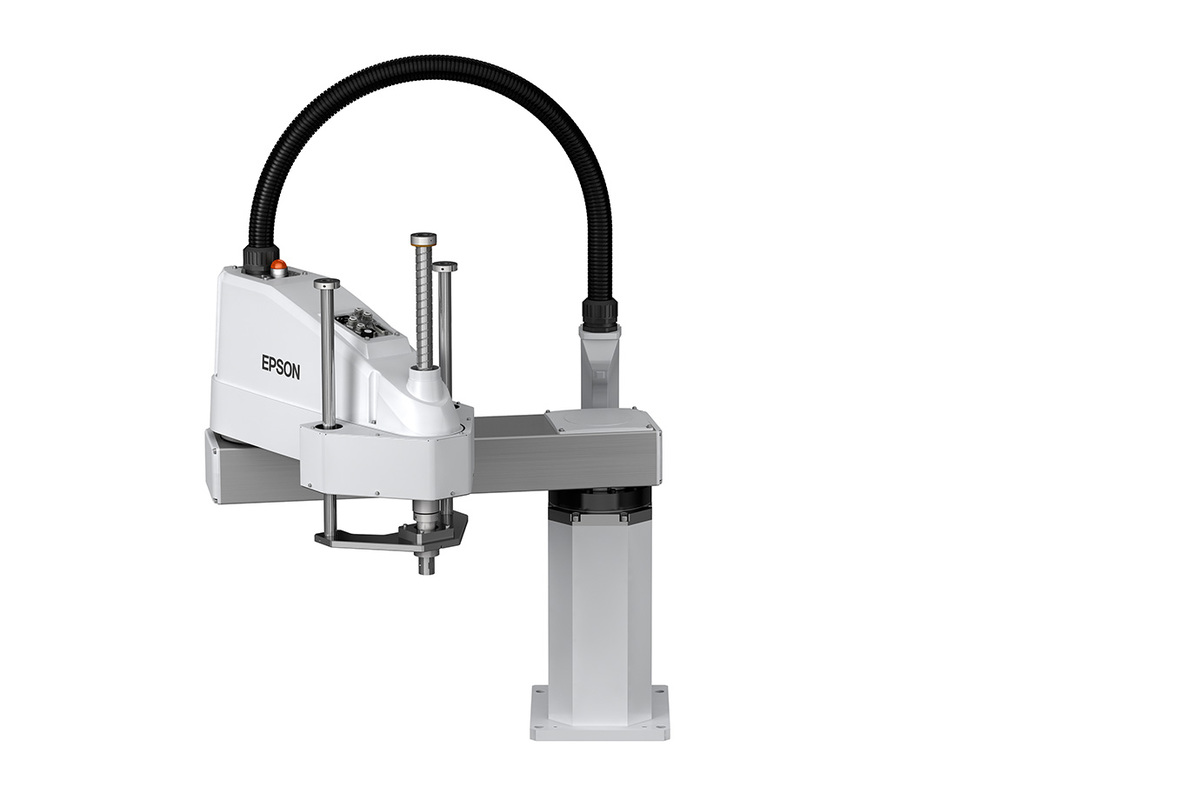
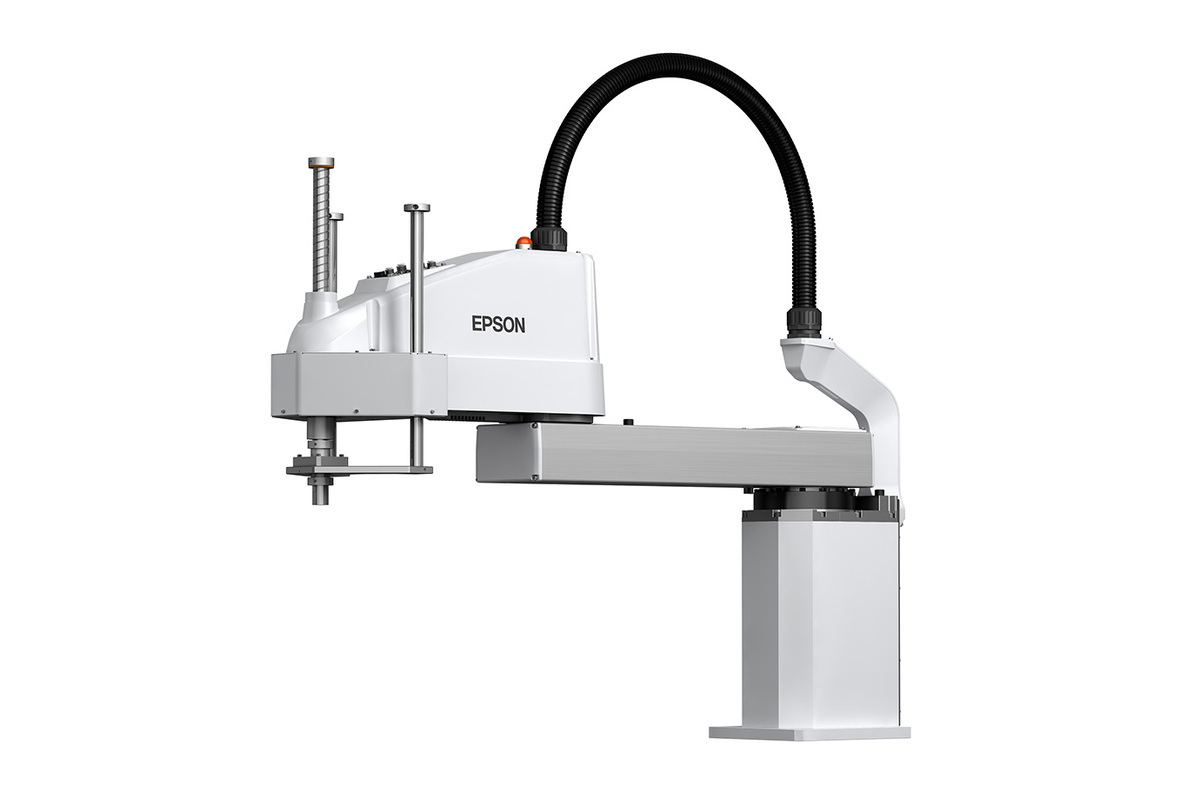
About LS50C
The Epson LS50C is a high-payload SCARA robot introduced in April 2026 for manufacturers that need to move heavier parts without giving up the compact footprint and fast planar motion that make SCARA robots useful. With a 1,000 mm reach and support for payloads up to 50 kg, it is Epson's largest-payload SCARA and extends the LS Series into applications that previously needed a different robot class or a more complex cell.
Key specifications
Robot
| Robot type | SCARA |
|---|---|
| Maximum payload | 50 kg |
| Reach | 1,000 mm |
Safety
| Safety technology | Compatible with Epson SafeSense technology |
|---|
Positioning
| Range position | Epson's largest-payload SCARA at launch |
|---|
Who is the Epson LS50C for?
The LS50C is aimed at manufacturers, machine builders and automation integrators handling larger or heavier components. Epson highlights demanding high-precision automation, and the combination of reach and payload makes the robot relevant to material handling, assembly, machine tending and transfer operations where smaller SCARA models run out of capacity.
The strongest use case is not simply a heavy workpiece. Integrators should calculate the complete moving payload, including gripper, sensors, adapters and the part itself, then consider reach and cycle requirements together.
What do 50 kg payload and 1,000 mm reach mean in practice?
A payload ceiling of 50 kg gives the LS50C substantially more handling capacity than compact SCARA robots, while its 1,000 mm reach lets a cell cover a broad working area. This can help consolidate operations or handle larger fixtures and components without moving to a robot architecture solely because of load capacity.
Maximum figures should not be treated as a recommended operating point for every cycle. Real applications need to account for inertia, center of gravity, tooling geometry, required acceleration, duty cycle and the motion path. Epson or an authorized integrator should validate the final configuration.
What is the value of SafeSense?
Epson pairs the LS50C with SafeSense technology. Epson says it may reduce the need for traditional safety guarding in certain applications after a proper risk assessment. Where the application permits it, that can make better use of floor space and improve access to surrounding equipment.
The important qualification is the risk assessment. SafeSense does not turn every LS50C installation into a collaborative cell automatically. Payload, speed, end tooling, the handled material and nearby machinery can introduce hazards that still require guarding or other protective measures.
How does LS50C compare with smaller Epson SCARA robots?
The LS50C should be selected when its payload and reach solve a real requirement. Smaller Epson SCARA robots can be more economical and easier to integrate when parts are light and the work envelope is compact. Buying excess payload rarely improves the business case by itself.
At the other end, Epson's GX-C Series targets top-of-the-line SCARA precision and performance. Buyers with demanding precision requirements should compare the relevant GX-C configuration rather than assuming the largest LS model is automatically the highest-performance choice.
What should buyers plan beyond the robot arm?
A production robot is one part of an automation cell. The final budget can include controller and safety equipment, end-of-arm tooling, vision, fixtures, guarding where required, conveyors or machines, integration engineering, programming, commissioning, training and ongoing support.
Cycle-time simulations and payload calculations should be completed before purchase. Manufacturers should also define recovery procedures for faults and product changeovers so that a fast robot does not sit idle because the surrounding process is difficult to reset.
What are the main limitations?
SCARA geometry is excellent for many horizontal assembly and transfer tasks, but it does not provide the same freedom of orientation as a 6-axis articulated robot. Applications that require complex approach angles, extensive wrist orientation or motion around obstacles may be a poor fit even when the LS50C meets the payload requirement.
The 50 kg rating can also tempt buyers to oversize. If the process handles much lighter loads, a smaller model may reduce cell cost and footprint while still meeting production targets.
Who should choose something else?
Choose an Epson 6-axis robot when the process requires complex orientation or a more flexible three-dimensional path. For applications centered on close human interaction and redeployment, compare the AX6 collaborative robot that Epson introduced in September 2026.
For lighter high-speed pick-and-place or assembly work, compare smaller LS, T-Series or appropriate GX-C SCARA models. The LS50C earns its place when the application genuinely needs its combination of 50 kg payload capacity, 1,000 mm reach and SCARA motion.
Pricing and purchasing considerations
Epson's April 2026 launch announcement does not publish a retail price for the LS50C, so Brandligo does not present an invented figure. Industrial robot pricing is also only one part of the installed cost because tooling, safety hardware and integration can materially change the project budget.
Buyers should request an application-specific quote through Epson or an authorized automation partner and compare proposals on complete cell scope, expected cycle time, commissioning, training, support and spare-parts planning rather than robot-arm price alone.
Reviews
No reviews yet
Nobody has reviewed LS50C here yet.