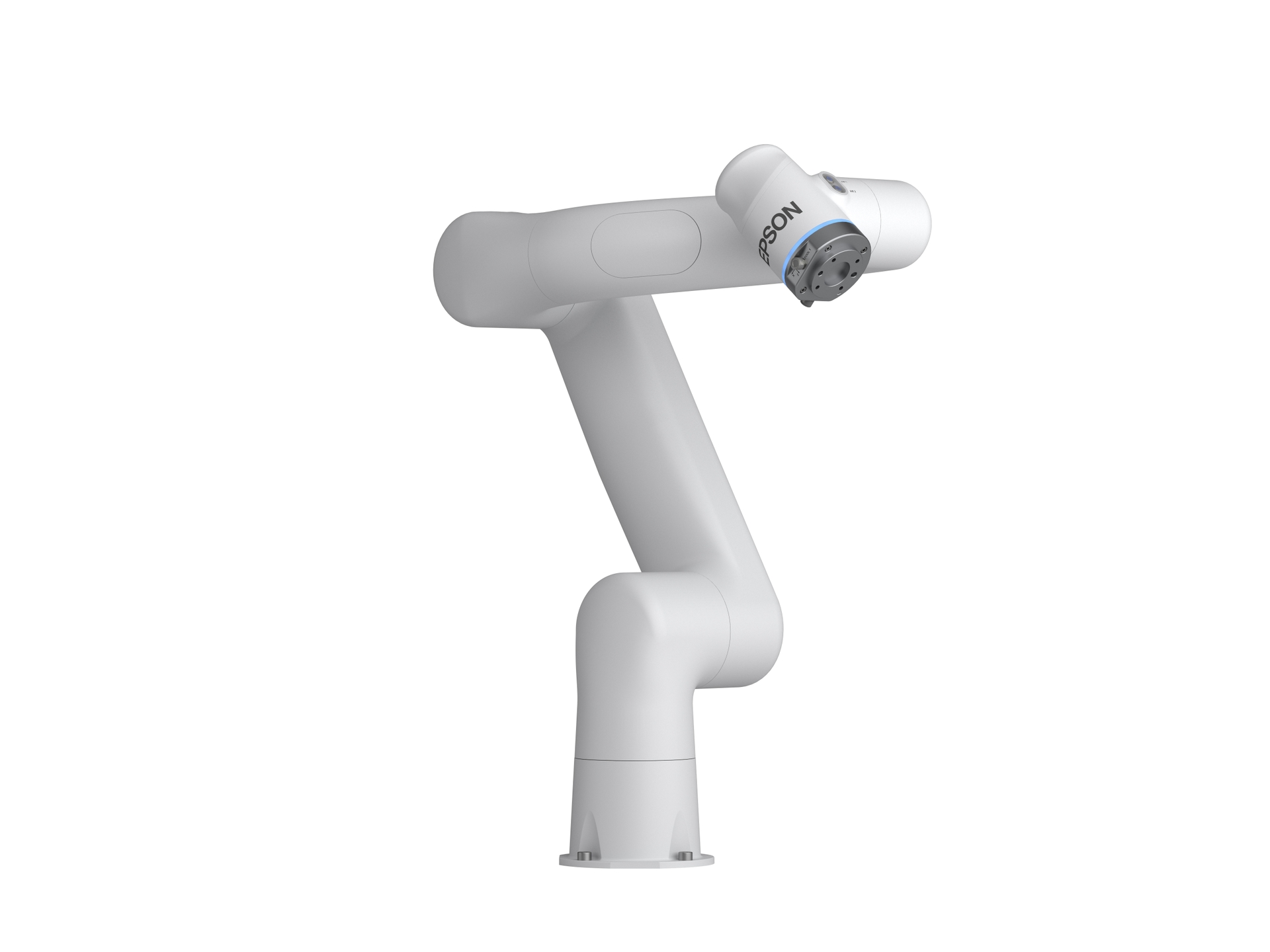
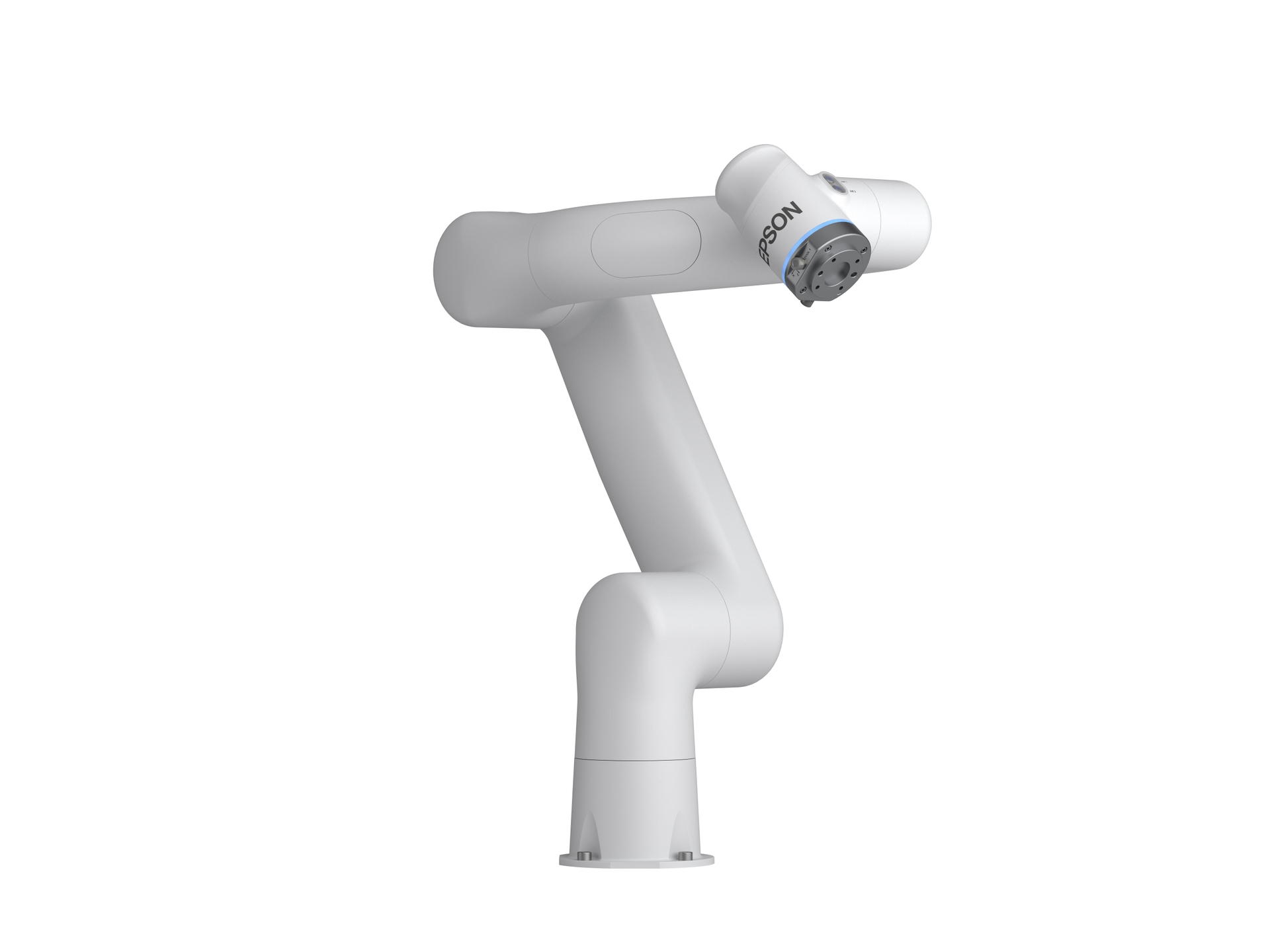
About AX6
Epson AX6 is the first collaborative robot in Epson's AX Series, aimed at manufacturers that want a 6-axis robot to work closer to people, fit into compact cells and be easier to redeploy than a traditional fenced installation. It combines power- and force-limiting operation with no-code programming, while still giving experienced teams a Python development path.
Key specifications
Robot
| Robot type | Collaborative 6-axis robot |
|---|---|
| Maximum payload | 6.0 kg |
| Arm length / reach | 900 mm from J2 to wrist center |
| Repeatability | ±0.03 mm |
| Maximum TCP linear speed | 2,000 mm/sec |
Installation
| Mounting | Tabletop, ceiling or wall |
|---|---|
| Robot weight | 18 kg |
Environment
| Protection | IP54 |
|---|---|
| Cleanroom | ISO Class 5 |
Power
| AC input | 100 V - 240 V ±10%, 50 Hz - 60 Hz |
|---|---|
| DC input | 48 V ±15% |
Control
| Controller | RC-A101 |
|---|
Tooling
| Pneumatic lines | 4 x 4 mm |
|---|
Software
| Programming | No-code AX Portal and customizable Python development environment |
|---|---|
| Simulation | 3D simulator |
Where does AX6 fit in Epson's robot range?
AX6 fills a gap between Epson's traditional industrial robots and its SafeSense industrial collaborative approach. Instead of making maximum cycle speed the main priority, AX6 is built around worker interaction and flexible deployment. Its six-axis motion makes it relevant to handling, tending, dispensing and other tasks that need articulated movement rather than the mainly planar motion of a SCARA robot.
What makes AX6 easier to deploy?
Epson uses a compact carbon-fiber structure and gives the robot tabletop, wall and ceiling mounting options. The arm provides 900 mm from joint 2 to the wrist center, carries up to 6 kg and weighs 18 kg. End-of-arm Ethernet, four pneumatic lines, multifunction buttons and a status LED ring reduce some of the extra work around tooling and teaching. The robot supports 100 V to 240 V AC as well as 48 V DC power.
How do programming and simulation work?
For teams new to robotics, AX6 includes an intuitive no-code environment through Epson's AX Portal software. Positions can be taught by manually moving the arm and using its teach buttons. For more advanced workcells, Epson provides a customizable Python environment where developers can load libraries and modules. Industrial kinematics support straight-line, curved and joint motions, and the included 3D simulator lets a team test programs before running them on the physical cell.
What should buyers know about collaborative safety?
The AX6 uses power- and force-limiting features, but that does not make every AX6 installation barrier-free by default. Epson specifically conditions shield-free operation on a proper risk assessment. Tooling, the workpiece, sharp edges, pinch points, speed and the surrounding process can change the safety requirements. A qualified integrator should assess the complete application rather than treating the cobot label as the safety case.
Where can AX6 work well?
Its IP54 rating, compact construction and ISO Class 5 cleanroom rating make AX6 interesting for controlled environments and space-conscious production cells as well as general collaborative automation. Epson lists repeatability at plus or minus 0.03 mm and maximum tool-center-point linear speed at 2,000 mm per second. Those figures should still be evaluated against the actual payload, path and process instead of used alone to predict cycle time.
What are the main limitations?
AX6 tops out at a 6 kg payload and 900 mm arm reach as Epson specifies it, so it is not intended to replace larger articulated robots. Collaborative operation can also trade some raw throughput for closer human interaction. Buyers with heavy tooling, long reach requirements or a process that can stay fully guarded may get a better production result from a conventional industrial robot.
Who should choose something else?
Choose an Epson SCARA robot when the job is dominated by very fast horizontal assembly, pick-and-place or handling and does not need six-axis articulation. Consider Epson's industrial 6-axis robots when payload, reach or high-throughput motion matters more than frequent worker interaction. SafeSense can also be worth comparing when the goal is an industrial collaborative workcell that slows or stops as workers approach rather than a power- and force-limited cobot.
How should a buyer compare AX6 quotes?
Epson sells AX6 through its robotics distributor channel rather than publishing a simple consumer-style price. Compare quotes on the complete cell: robot, controller, end-of-arm tooling, safety equipment, integration, programming, training and support. Also confirm whether the IP54 and cleanroom requirements apply to the exact installation and whether the chosen tooling stays within the 6 kg payload limit.
Reviews
No reviews yet
Nobody has reviewed AX6 here yet.